

Key takeaways
- The best LED reef lights for coral growth, compared by wattage, spectrum, lens angle and controls, with tips on PAR and acclimating corals.
The NICREW HyperReef 100 Gen 2 is the best overall choice for coral growth in a mid-size tank, because it pairs 100W of output with an enhanced violet and blue spectrum, a wide-angle lens and five programmable channels, which is what mixed LPS and SPS reefs need. Coral growth depends on light intensity (PAR), spectrum and a consistent daily schedule, so this guide ranks each light by how well it can deliver those three things for a given tank size. Smaller or softer-coral setups have good options as well, from the 60W Ahareef to the app-controlled PopBloom.
Quick List
- NICREW HyperReef 100 Gen 2 – best overall for mixed LPS and SPS reefs
- PopBloom 100W RL90 – best for keepers who want WiFi app control and coral presets
- VIPARSPECTRA 165W – best for larger or deeper tanks that need more raw output
- Ahareef 60W Reef Light – best for nano and mid-size tanks with sunrise and sunset modes
- NICREW NavaReef 65W – best for soft corals and LPS under a focused blue spectrum
- Pawfly 48W Extendable Light – best for long, shallow tanks with soft corals and fish
Which One Is Right for You?
| If you… | Choose |
|---|---|
| Want a phone app, WiFi scheduling and coral scenario presets | PopBloom 100W RL90 |
| Keep a mix of LPS and SPS in a tank around 30 to 60 gallons | NICREW HyperReef 100 Gen 2 |
| Have a deep or large tank that needs the highest wattage here | VIPARSPECTRA 165W |
| Need a modest light with gentle sunrise, sunset and moon modes | Ahareef 60W Reef Light |
| Keep soft corals and LPS and like a blue-focused look | NICREW NavaReef 65W |
| Own a 48 to 54 inch long tank with undemanding corals | Pawfly 48W Extendable Light |
Start with the corals you keep, not the wattage you can afford to run. Soft corals and mushrooms are happy under lower intensity, LPS need moderate light, and SPS need strong, well-spread light and good water quality. Tank depth matters too, because light loses intensity as it travels down, so a deeper tank needs more output at the same lens angle.
All 6 Picks in Detail
1. NICREW NavaReef 65W – Best for Soft Corals and LPS
As an Amazon Associate we earn from qualifying purchases at no extra cost to you.

The NavaReef is a 65W LED aimed at soft and LPS corals, with a blue-focused spectrum, a 90 degree narrow-angle lens and a built-in timer. The narrower angle concentrates light below the fixture, which can help in a deeper nano tank, but it also means less spread across a wide tank. The blue-weighted spectrum makes fluorescent corals pop, and soft corals typically thrive at the moderate intensity such a light can provide. Confirm on the listing what the rest of the title says about efficiency and control.
- Power: 65W
- Target corals: soft and LPS
- Spectrum: blue-focused
- Optics: 90 degree narrow-angle lens
- Timer: built in; confirm app or controller options
The narrow beam works best when the fixture is mounted close to the surface of a compact tank, or when you want a pronounced shimmer on a central aquascape. In a wide or long tank you may need two units to avoid dark corners. Soft corals such as leathers and mushrooms respond well to this kind of moderate, blue-biased light, but give new additions a few weeks to adapt.
Pros
- Focused beam for deeper nano tanks
- Built-in timer is convenient
Cons
- Narrow spread may leave edges dim in wide tanks
- Not marketed for SPS
Next to the Ahareef 60W, it prioritizes a blue look and narrow focus over a broader coral claim.
2. Ahareef 60W Reef Light – Best for Sunrise and Sunset Modes

The Ahareef is a 60W dimmable reef light aimed at SPS and LPS coral in saltwater tanks, with sunrise, sunset and moonlight modes. Sixty watts is a practical level for nano and mid-size tanks, and the simulated light transitions help reduce shock to fish and corals when the lights switch on or off. The listing text gives no tank-size range here, so check the recommended coverage before pairing it with SPS, which typically need strong light. Treat it as a good fit for LPS and softer SPS in smaller tanks.
- Power: 60W
- Target corals: SPS and LPS, per listing
- Modes: sunrise, sunset and moonlight
- Dimming: yes
- Coverage and PAR: confirm on listing
A light like this is a sensible match for a 20 to 30 gallon reef with a few LPS heads, a zoanthid colony and perhaps a small SPS frag placed high in the rockwork. Place demanding corals near the top and the light-sensitive ones lower, which uses the intensity gradient to your advantage. The moonlight mode can also reduce stress on fish that sleep in the tank.
Pros
- Gentle light transitions
- Appropriate size for smaller reefs
Cons
- May be underpowered for demanding SPS in deeper tanks
- Limited spectrum details in the listing
It sits just below the NavaReef 65W in intent, though it is described as suiting SPS and LPS rather than soft and LPS only.
Always raise intensity in small steps over several weeks when adding new coral.
3. NICREW HyperReef 100 Gen 2 – Best Overall for Mixed Reefs

This 100W fixture is marketed for LPS and SPS corals with an enhanced violet and blue spectrum, a wide-angle lens and five fully programmable channels. Manufacturer information describes a roughly 120 degree output angle intended to spread light more evenly than the earlier Gen 1 model, plus a variable-speed fan, a redesigned heatsink and two USB-C control ports for an external controller sold separately. Sunrise, sunset, cloud and storm effects are listed as well. We did not find a verified PAR figure for the Gen 2, so check the manual’s PAR chart for your tank depth instead of relying on a headline number.
It suits a keeper who wants flexibility, since five channels let you shape the spectrum and ramp slowly when adding new corals.
- Power: 100W
- Channels: 5, fully programmable
- Spectrum: enhanced violet and blue, per listing
- Optics: wide-angle lens, about 120 degrees per manufacturer information
- Controller: external controller sold separately; confirm what is included
Plan the install around the controller: decide before purchase whether you will run it on its basic settings or add the separate controller for daisy-chaining and finer channel work. A first-time reef keeper can start with a gentle sunrise and sunset ramp and a mid-level peak, then adjust the violet and blue channels slowly while watching coral color and polyp extension over several weeks.
Pros
- Wide, even spread and programmable spectrum
- Variable-speed fan stays quiet at low output
Cons
- Full control may need an extra controller
- No verified PAR figure at depth was found
Compared with the PopBloom, it relies on a separate controller for the best features, while the PopBloom builds in WiFi control.
4. Pawfly 48W Extendable Light – Runner-Up for Long, Shallow Tanks
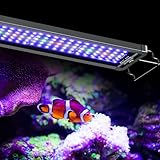
The Pawfly is a 48W dimmable LED for 48 to 54 inch tanks with extendable brackets and a full-spectrum design. Forty-eight watts spread across a four-foot-plus tank is a low power density, so we place it as a runner-up for coral growth: it should suit fish-heavy tanks and undemanding soft corals or mushrooms, but it is unlikely to satisfy SPS or many LPS in a deep tank. Check the listing for the spectrum channels and mounting height before buying.
- Power: 48W
- Tank length: 48 to 54 inches, extendable
- Spectrum: full, per listing
- Dimming: yes
- PAR and mounting data: confirm on listing
If your tank is a fish-focused system with a few hardy corals, a light of this kind keeps things bright and simple. For coral growth as the main goal, treat it as an entry-level option and consider adding a second unit to raise intensity. Confirm the mounting method and whether the legs fit your rim width, since extendable frames only work with the right glass or rim thickness.
Pros
- Extendable frame suits longer tanks
- Lower heat and electrical load
Cons
- Low power density for demanding corals
- Better for fish and soft corals than SPS
Compared with the 100W lights, it is the one to choose for a gentle, low-demand tank rather than for fast coral growth.
5. PopBloom 100W RL90 – Best for App Control and Presets

The PopBloom is a 100W LED reef light described with a natural shimmer effect, multi-sync capability and high PUR (the portion of light corals can actually use), and the RL90 model adds WiFi, a phone app and coral scenario presets. The listing also claims highly uniform PAR across its coverage area; treat that as a manufacturer claim and confirm the measurement conditions on the product page. It is a good choice if you prefer to adjust lighting from your phone and to match a preset to the coral type you keep rather than build a schedule from scratch.
Multi-sync lets several fixtures follow one schedule, which helps on a long tank.
- Power: 100W
- Control: WiFi and phone app with coral scenario presets
- Effects: natural shimmer, per listing
- Sync: multi-sync for multiple lights
- Coverage and PAR data: confirm on listing
Presets are most useful as a starting point rather than a final answer. Pick the scenario closest to your coral mix, run it for a couple of weeks, and then fine-tune intensity based on how the corals look. Because the control relies on an app, check that your router, phone and the light share a stable connection, and keep a basic timer schedule saved as a fallback during outages.
Pros
- App control with presets reduces setup work
- Multi-sync suits longer tanks
Cons
- Depends on WiFi and app support over time
- PAR claims need to be confirmed
Next to the HyperReef Gen 2, it offers easier control, while the HyperReef offers more channels to tune.
6. VIPARSPECTRA 165W – Best for Larger or Deeper Tanks

The VIPARSPECTRA is listed as a 165W dimmable full-spectrum LED light for corals and saltwater fish tanks, with remote and timer control. It has the highest wattage in this set, which makes it a candidate for a bigger or deeper tank where lower-power fixtures would leave the sand bed dim. Wattage alone does not predict PAR, because lenses, LED counts and efficiency differ, so confirm the tank size and mounting height in the listing. Full-spectrum fixtures can look brighter and whiter than blue-heavy reef lights, which some keepers prefer for viewing.
- Power: 165W
- Spectrum: full spectrum, dimmable
- Control: remote and timer
- Intended use: corals and saltwater fish tanks
- Coverage area and PAR: confirm on listing
On a larger tank, mount the fixture high enough to spread light and keep its fans free of splashes, since heavy salt creep inside a vent can shorten fan life. If the tank is shallow, you may find the full 165W far more than soft corals need, so dim it generously and use the timer to ramp intensity gradually. A remote makes it easy to dim for feeding or photographs.
Pros
- Most output on the list for deeper tanks
- Remote and timer make daily scheduling simple
Cons
- Higher wattage means more heat to manage
- Fewer advanced channel and effect details are stated
Compared with the HyperReef Gen 2, it brings more power but less obvious spectrum programming.
Specs Compared
| Light | Power | Target corals | Spectrum | Optics | Control |
|---|---|---|---|---|---|
| NICREW HyperReef 100 Gen 2 | 100W | LPS and SPS | Enhanced violet and blue | Wide-angle lens | 5 programmable channels |
| PopBloom 100W RL90 | 100W | Confirm on listing | Natural shimmer, high PUR | Confirm on listing | WiFi app, presets, multi-sync |
| VIPARSPECTRA 165W | 165W | Corals and fish | Full spectrum | Confirm on listing | Remote and timer |
| Ahareef 60W | 60W | SPS and LPS | Confirm on listing | Confirm on listing | Dimmable with sunrise, sunset, moonlight |
| NICREW NavaReef 65W | 65W | Soft and LPS | Blue-focused | 90 degree narrow-angle | Built-in timer |
| Pawfly 48W | 48W | Fish and soft corals (runner-up) | Full spectrum | Confirm on listing | Dimmable |
How We Chose These
This is a research-based comparison built on the six listings in this set. We compared wattage, stated target corals, spectrum descriptions, lens or angle details and control features, and we read manufacturer information for the NICREW lights to understand the optics. Where a listing name left out a value such as PAR, coverage area or tank size, we mark it as something to confirm. We ranked lights by how well their stated features match coral growth needs, and we placed the lowest-power fixture last because its wattage per foot of tank is limited. The order reflects fit for coral type and tank size rather than measured results.
What to Look For
PAR, not watts
Photosynthetically active radiation (PAR) measures the light corals can use at a given depth. Common guidance puts soft corals at roughly 30 to 100 PAR, LPS at about 75 to 200 and SPS at about 200 to 400 or more, though species vary. Watts only measure power draw, and a 60W light with a good lens can out-perform a 100W light with a poor one at the same depth. Look for a manufacturer PAR chart at a stated height and depth, and be wary of a single peak number without conditions.
Spectrum and color
Corals use blue and violet light heavily, and many fluorescent pigments glow under violet and royal blue. A blue-heavy fixture makes colors vivid, while adding white and red channels improves how natural the tank looks to your eyes. Programmable channels allow you to build a spectrum that supports growth during the day and a viewing mode in the evening.
Lens angle, hang height and spread
A narrow lens such as 90 degrees reaches deeper but covers less area, and a wide lens of about 120 degrees spreads light across the tank but loses intensity at depth. A rule of thumb is that one 100W fixture covers roughly 18 to 24 inches square when hung 6 to 10 inches above the water, so a 48 inch tank usually needs two fixtures or a longer bar. Hanging higher widens the spread but lowers PAR.
Acclimation, photoperiod and a worked example
Run 8 to 10 hours of main light, with short ramps at each end. When you install a new fixture, start at 30 to 40 percent of the planned peak and raise it by about 5 to 10 percent per week. For example, if your target peak is 60 percent, you would begin near 25 percent and reach 60 percent after about five to seven weeks. Rushing the increase can bleach corals, while moving too slowly is safe.
Heat, fans and electrical safety
Powerful LEDs make heat, and fans or heatsinks carry it away. Keep fan vents clear of dust and salt creep, leave a few inches of air space around the fixture and check water temperature after raising intensity. Use a drip loop on the power cord, plug into a ground-fault circuit interrupter outlet and mount the fixture so it cannot fall into the water.
Questions
How long should reef lights stay on?
Most reef keepers run 8 to 10 hours at the main intensity, with short ramps at the start and end. A consistent schedule matters more than hitting an exact number of hours.
Do I need a separate controller?
Not for basic timers or app control, but some lights with many channels need an external controller to use the full feature set. Check what is included in the listing before you buy.
Can I use one light over a 48 inch tank?
Only a long fixture designed for that length will cover the whole tank, and even then the edges are dimmer. Two shorter fixtures or an extendable bar give a more even spread.
Will a stronger light make corals grow faster?
Only up to the point where the coral is receiving enough light and has stable nutrients, alkalinity and flow. Past that, extra intensity risks bleaching and algae.
How do I know if the light is too strong?
Watch for corals that pale, retract or turn white at the tips. If that happens, lower intensity right away and ramp back up more slowly.
How often should I replace LEDs?
Quality LEDs commonly last for years of daily use, but output and color fade gradually. Replace or upgrade when coral growth slows despite stable water or when the fixture visibly dims.
Update History
- October 20, 2026 – Initial publication; product set drawn from current catalog listings.
- Check the product page for current specifications and availability before buying.
Sources
- Manufacturer product and specification pages for NICREW reef lights
- Retailer listing titles and specification fields for each fixture
- General reef-keeping guidance on PAR ranges, photoperiod and acclimation

Write Your Review
No reviews yet. Be the first to share your experience!