

The best betta tank in 2026 is a heated, filtered tank of at least 5 gallons, and the Fluval Spec V is the most popular all-round choice because it packs a quiet built-in filter, a lid and an LED into a compact footprint. If you want more swimming room, a 9 to 15 gallon tank such as the Fluval Flex 9 gives a betta stable water and space for plants. This guide ranks six tank kits by gallons, lid design and water flow, since flow is the detail that most often goes wrong for long-finned bettas.
Our top picks
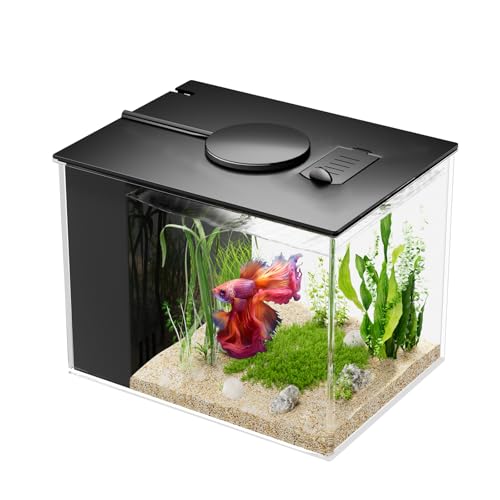 Vehipa Betta Fish Tank 1 Gal
- Perfect Mini Habitat: Measuring just 7.8"L x 5.8"W…
- Vibrant 3-Color LED Lighting: Illuminate your underwater world…
- Discreet & Silent Filtration: A concealed filter pump…
 NICREW 2.5 Gallon Nano Nature Aquarium Kit
- Compact and stylish, designed for small spaces like…
- Effortless setup and maintenance with our step-by-step guide…
- High-clarity glass with 91.2% transmittance makes your aquascape…
| Product | Key specs | |
|---|---|---|
 Tetra LED Half Moon 1.1 Gallon Fish | Check price | |
| Vehipa Betta Fish Tank 1 Gal | Perfect Mini Habitat: Measuring just 7.8"L x 5.8"W… Vibrant 3-Color LED Lighting: Illuminate your underwater world… Discreet & Silent Filtration: A concealed filter pump… | Check price |
| NICREW 2.5 Gallon Nano Nature Aquarium Kit | Compact and stylish, designed for small spaces like… Effortless setup and maintenance with our step-by-step guide… High-clarity glass with 91.2% transmittance makes your aquascape… | Check price |
 VIVOHOME 2 Gallon Smart Fish Tank with | Check price |
As an Amazon Associate we earn from qualifying purchases at no extra cost to you.
Quick Comparison of Betta Tanks
| Tank | Best for | Volume | Filter | Lid | Price tier |
|---|---|---|---|---|---|
| Fluval Spec V | Best overall | About 5 gallons | Built-in 3-stage, adjustable flow | Hinged glass-style lid with cutouts | Mid-range |
| Fluval Flex 9 | Best bigger home | About 9 gallons | Built-in 3-stage | Flip-up lid with light | Mid-range |
| Fluval Evo V | Best looking desk tank | About 5 gallons | Built-in | Hood with LED | Mid-range |
| Fluval Spec III | Best small tank | About 2.6 gallons | Built-in | Hinged lid | Budget to mid |
| Marineland Portrait 5 | Best budget curved front | 5 gallons | Hidden filter | Hinged hood | Budget to mid |
| Fluval Flex 15 | Best for a planted showpiece | About 15 gallons | Built-in 3-stage | Flip-up lid with light | Upper-mid |
Volumes are the nominal values given by the manufacturers. Actual water volume is lower once substrate and decor are added.
Gallons: How Big Should a Betta Tank Be?
Bettas are often sold in cups and tiny bowls, but that reflects marketing, not need. Fish keepers widely recommend a minimum of 5 gallons, and many suggest 10 gallons for more stable chemistry and more room to explore. The extra water also lets you add a heater and filter without overheating or creating strong currents.
| Volume | Heater wattage (typical) | Stability | Suitability |
|---|---|---|---|
| 2.5 to 3 gallons | 10 to 25 W | Low | Only for experienced keepers who change water often |
| 5 gallons | 25 W | Moderate | Accepted minimum for most keepers |
| 10 gallons | 50 W | Good | Recommended starting point |
| 15 gallons or more | 50 to 75 W | Very good | Room for plants, snails and a few tank mates |
The Best Betta Fish Tanks
Best overall: Fluval Spec V
The Spec V is a 5 gallon rectangle with a rear filter chamber, a nozzle that lets you aim and slow the outflow, and an LED light. It is easy to find replacement media, the footprint fits a shelf and the lid includes openings for a heater cord and feeding. You still need to buy and install a heater, because it does not include one.
Trade-off: the outflow can be strong for fancy-finned males, so point it toward the glass and use the flow controls or a sponge pre-filter.
Best bigger home: Fluval Flex 9
The Flex 9 gives about nine gallons of water in a curved-front format. The filter is hidden behind a back panel, and the light is built into the lid. Nine gallons is enough for a heater with a wider safe temperature margin and for planting a few stems, anubias and moss.
Trade-off: it takes more counter space, and the lid still needs to be kept closed to stop jumping.
Best looking desk tank: Fluval Evo V
The Evo V looks more like furniture than equipment, with a clean curved profile and an LED that you can dim. It suits a bedroom or office and is about 5 gallons.
Trade-off: it costs more than a basic 5 gallon, and cartridge replacement adds upkeep.
Best small tank: Fluval Spec III
The Spec III is the smallest option here, around 2.6 gallons. It works for a keeper with limited space who is ready for frequent water changes. Some experienced hobbyists use it for a hospital or quarantine tank rather than a permanent home.
Trade-off: small volume means temperature and ammonia change quickly. Treat it as the minimum, not the ideal.
Best budget curved front: Marineland Portrait 5
The Portrait series has a curved front panel and a hidden filter in a rear chamber. A 5 gallon size brings more room than a bowl at a modest cost. The format is well known, so accessories are easy to find.
Trade-off: factory lighting is basic, and you will probably add a heater and a thermometer.
Best planted showpiece: Fluval Flex 15
For keepers who want a planted betta home with a school of snails or shrimp, the Flex 15 provides the volume to make that work. It has a three-stage filter, a lid and a programmable light in newer models.
Trade-off: it needs a strong, level surface, and a larger tank takes longer to fill and clean.
Flow, Lids and Heat: Three Details That Matter
Flow. Bettas have long fins and a labyrinth organ that lets them breathe air. Strong currents tire them. If a betta hides or struggles in the filter flow, reduce it by adding a sponge over the outlet, redirecting it at the glass or adding floating plants to break the surface.
Lids. Bettas jump. A tight-fitting lid with small gaps for cords is better than leaving the surface open. Leave a little space under the lid so the fish can still gulp air.
Heat. A steady 78 to 80 F is a common target. Use an adjustable heater and a separate thermometer, and check both daily at first.
Setting Up in Order
- Rinse the tank, substrate and decor with plain water only.
- Add substrate, then hardscape and soft decor. Prefer smooth items, since rough edges tear fins.
- Fill with dechlorinated water and start the filter and heater.
- Run the tank for several weeks to cycle, testing ammonia and nitrite.
- Add the betta once readings are stable, and feed small portions of quality food.
Plants, Decor and Tank Mates That Suit a Betta
A bare tank is stressful for a betta, which likes cover and resting places near the surface. Soft plants and smooth decor cut down on fin damage and give the fish places to explore.
| Item | Good choice | Why | Avoid |
|---|---|---|---|
| Live plants | Anubias, java fern, marimo balls, hornwort | Hardy and low light, soft leaves | Sharp plastic plants that tear fins |
| Resting spot | Betta leaf hammock, broad floating leaves | Gives the fish a place to rest near the surface | Rough ornaments with narrow gaps |
| Hiding place | Smooth caves, driftwood | Reduces stress | Chipped ceramic |
| Floating plants | Frogbit, red root floater | Shades the tank and softens flow | Dense mats that block surface air |
| Tank mates (10 gallons or more) | Nerite snails, a few ghost shrimp, kuhli loaches in bigger tanks | Peaceful, occupy different levels | Guppies, fin-nippers, other bettas |
A simple pantyhose test helps check decor: pull a stocking across any ornament. If it snags, the item is too rough for betta fins.
Weekly Care Routine
A betta tank is low effort but not zero effort. A short routine each week keeps water healthy and avoids most disease problems.
- Test water. Check ammonia and nitrite, which should read zero, and nitrate, which should stay low.
- Change 25 to 30 percent. Match temperature and treat tap water with a dechlorinator.
- Vacuum the surface of the substrate. Remove uneaten food and waste.
- Rinse filter media in tank water. Do this once a month, never in tap water.
- Check the heater and thermometer. A stuck heater can overheat a small tank quickly.
Signs of trouble include clamped fins, white spots, faded color, bloating or hiding for long periods. Raising water quality and checking temperature are the first steps. For persistent signs, consult an aquatic veterinarian or experienced fish store.
Frequently Asked Questions
Do bettas need a filter?
Yes, a gentle filter helps keep water clean and stable. Choose an adjustable one or reduce flow with a sponge. A filter is not a substitute for water changes.
Do bettas need a heater?
In most homes, yes. Bettas are tropical fish and prefer 78 to 80 F. A heater keeps temperature steady, which prevents stress and illness.
Can a betta live in a 3 gallon tank?
It can survive, but 5 gallons or more is considered a healthier standard. Smaller tanks swing in temperature and ammonia quickly.
Can I keep tank mates with a betta?
Some bettas tolerate snails or shrimp, while others attack them. Use a tank of 10 gallons or more and have a backup plan.
How often should I change the water?
For a 5 gallon tank, 25 to 30 percent weekly is typical. Larger, well-planted tanks may need less frequent changes.
Why does my betta stay at the top?
Bettas breathe air, so visits to the surface are normal. If the fish hovers there constantly, check temperature, ammonia and flow.
Which Betta Tank Should You Buy?
Pick the Fluval Spec V for a dependable 5 gallon, the Flex 9 or Flex 15 for more room and plants, the Evo V for a stylish desk setup, the Marineland Portrait for a lower budget and the Spec III only if space forces a small tank. Details come from manufacturer specifications and general fishkeeping guidance. Check the kit’s contents and your local needs before buying.
Write Your Review
No reviews yet. Be the first to share your experience!