

Key takeaways
- Let it acclimate. After placing a glass heater in cold water, wait about 15 to 30 minutes before powering it on to avoid thermal shock to the tube.
- Unplug before water changes. A heater exposed to air while hot can crack. Unplug it and let it cool before lowering the water level.
- Place it in good flow. Near the filter outlet or a powerhead, the heater’s heat is distributed evenly, which also improves the thermostat’s reading.
- Replace on schedule. Even good heaters wear. Many keepers swap them every two to four years, sooner if the temperature starts to drift.
- Use a drip loop. Route the cord so water cannot run down the cable to the outlet.
The best aquarium heater for most tanks in 2026 is the Eheim Jäger TruTemp: a glass-and-thermostat classic with a wide wattage range and an adjustable dial you can calibrate against a separate thermometer. If you want a slimmer, better-looking unit for a rimless or nano tank, the Cobalt Neo-Therm is the usual runner-up. Which one is right for you depends on tank volume, room temperature and how much you worry about a stuck thermostat, so this guide matches wattage to tank size before it ranks any model.
Our top picks



As an Amazon Associate we earn from qualifying purchases at no extra cost to you.
Quick Comparison of the Top Aquarium Heaters
| Heater | Best for | Wattage options | Control type | Price tier |
|---|---|---|---|---|
| Eheim Jäger TruTemp | Best overall | Roughly 25 to 300 W | Analog dial, calibratable | Mid-range |
| Cobalt Neo-Therm | Best slim, precise heater | Roughly 25 to 300 W | Dial or digital with LED | Upper-mid |
| Fluval E Series | Best digital display | Roughly 50 to 300 W | Electronic, LED readout | Mid-range |
| Fluval M Series | Best submersible for small tanks | Roughly 10 to 50 W | Preset or adjustable | Budget to mid |
| Hygger titanium with external controller | Best for large tanks | Up to about 1,000 W | Separate digital controller | Mid-range |
| Aqueon Pro | Best budget | Roughly 50 to 250 W | Adjustable dial | Budget |
Wattage ranges above reflect the manufacturers’ typical lineups; exact sizes vary by retailer and model year, so confirm the box rating before you buy.
Step One: Size the Heater to Your Tank
The common rule is 3 to 5 watts per US gallon, but that rule hides the variable that matters most: how many degrees above room temperature you need to hold the water. Use the table below as a starting point.
| Room temperature | Target water | Temperature lift | Watts per gallon | Example: 20 gallon tank |
|---|---|---|---|---|
| 74 F | 78 F | 4 F | About 2.5 W | 50 W |
| 70 F | 78 F | 8 F | About 3 W | 60 to 75 W |
| 65 F | 78 F | 13 F | About 4 to 5 W | 100 W |
| 60 F (garage or basement) | 78 F | 18 F | 5 W or more | 100 W, or two 50 W units |
A worked example: a 55 gallon tank in a 68 F living room, aimed at 78 F, is a 10 degree lift. At roughly 3 to 4 watts per gallon you land at 165 to 220 watts, which is why most keepers choose a single 200 W unit or, better, two 100 W heaters at opposite ends of the tank.
The Best Aquarium Heaters
Best overall: Eheim Jäger TruTemp
The Eheim Jäger is the heater other products get compared with. It uses a glass body, a shock-resistant design and a thermostat dial that can be recalibrated with the manufacturer’s TruTemp mechanism if it drifts from a reference thermometer. It switches off if it ends up out of the water, and the wattage range covers everything from 20 gallon community tanks to 100 gallon setups. Per Eheim’s published specifications the adjustable range runs from about 65 F to 93 F.
Main trade-off: the glass is long on the larger models, so it can be awkward in shallow or narrow tanks, and glass is still glass: handle it gently during water changes.
Best slim and precise: Cobalt Neo-Therm
The Neo-Therm is a flat, compact heater designed to disappear into planted and rimless aquascapes. Cobalt markets accuracy in the half-degree range and offers dial and digital versions, depending on the model. Its flat profile also makes it easier to hide behind decor or a filter intake. Reviewers regularly recommend it for nano tanks and display setups where a big glass tube looks out of place.
Main trade-off: it costs more than the Eheim or Aqueon, and its track record is shorter than Eheim’s decades-long reputation.
Best digital display: Fluval E Series
The Fluval E uses an electronic thermostat with an LED temperature readout, so you can see the actual water temperature without a separate thermometer. It is shatter-resistant, designed to be mounted in the water vertically or horizontally, and is made for roughly 10 to 80 gallon tanks according to the maker. The display is handy if you adjust temperature seasonally, for example when moving from a tropical community to a cooler-water setup.
Main trade-off: the electronics are another part that can fail, so pair it with a backup controller or thermometer.
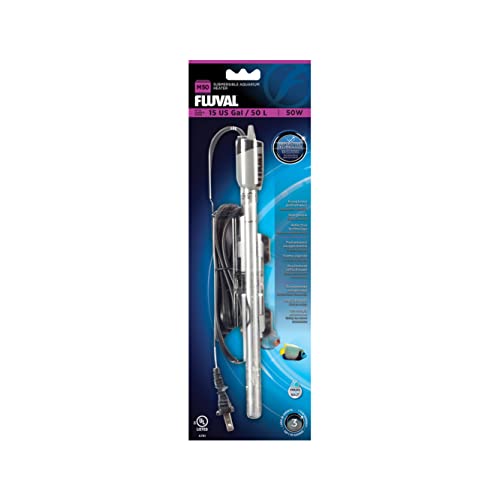
Best small-tank option: Fluval M Series
The Fluval M-line heaters are compact, submersible and aimed at small volumes, with a polished finish that blends into the tank. They fit nano tanks, 5 to 10 gallon betta homes and shrimp bowls where a 100 W glass tube would be both overkill and oversize. Preset-temperature versions suit people who do not want to touch a dial.
Main trade-off: low wattage means they are only appropriate in warm rooms; they cannot make up a large temperature gap.
Best for large tanks: Hygger titanium with controller
Large aquariums are a good match for titanium heater tubes paired with an external digital controller. Titanium does not crack, and the controller reads temperature from a separate probe, so you set the target on the controller and the heater simply obeys. Hygger sells this combination in several wattages, and the higher-output units target tanks up to well over 100 gallons.
Main trade-off: there are more parts to position and manage, including a probe cable and a controller you need to mount safely above the splash zone.
Best budget: Aqueon Pro
The Aqueon Pro is a straightforward adjustable heater with a self-contained thermostat, available in a spread of wattages. It is a sensible first heater for community tanks and does the job without extras. Keep a separate stick-on or digital thermometer on the glass and check it daily for the first week.
Main trade-off: fewer calibration features and a less refined thermostat than the Eheim or Cobalt.
Single Heater or Two? A Safety Decision Matrix
| Your situation | Better choice | Reason |
|---|---|---|
| Tank under 10 gallons | One low-wattage heater | Space is limited, and overheating risk from a stuck unit is mostly about overwatt |
| Tank of 20 to 40 gallons | One properly sized heater plus a thermometer | Easy to monitor, and a failure is gradual |
| Tank over 50 gallons | Two heaters at half the total wattage each | If one fails you lose only half the output, and heat spreads more evenly |
| Expensive livestock (reef, discus) | Any heater plus an independent controller | The controller cuts power if the thermostat sticks on |
An independent temperature controller, such as the widely used Inkbird models, is cheap insurance. It switches the heater’s power outlet using its own probe, so a stuck internal thermostat cannot cook the tank.
Heater Types Compared
| Type | Strength | Weakness | Best match |
|---|---|---|---|
| Glass submersible with thermostat | Inexpensive, easy to find, accurate when calibrated | Breakable, visible in the tank | Standard community tanks |
| Shatterproof plastic or titanium | Resists cracks, safe around larger fish | Can cost more, some plastics age | Cichlids, goldfish, large fish that bump decor |
| In-line or external heater | Nothing inside the tank, even heat | Needs a canister filter hose, higher price | Display tanks, reef setups |
| Preset heater | No dial to fiddle with | Fixed temperature, usually 76 to 78 F | Single betta tanks |
| Heater plus external controller | Backup against stuck thermostats | More cords and parts | Large or valuable tanks |
Substrate heating cables and heat mats exist, but they are niche tools for planted tanks rather than all-purpose solutions, so they are not covered in this list.
How to Calibrate and Check Your Heater
- Fill and place. Install the heater fully submerged near flow, but do not plug it in yet.
- Wait. Give the glass about 20 minutes to match water temperature.
- Set the dial. Turn the dial to a modest target, then plug in.
- Verify with a thermometer. After 24 hours, compare the heater’s setting with a separate thermometer on the opposite side of the tank.
- Adjust in small steps. Change the dial by a fraction of a degree, then wait another day before another change. Heaters respond slowly.
Installation and Ownership Realities
- Let it acclimate. After placing a glass heater in cold water, wait about 15 to 30 minutes before powering it on to avoid thermal shock to the tube.
- Unplug before water changes. A heater exposed to air while hot can crack. Unplug it and let it cool before lowering the water level.
- Place it in good flow. Near the filter outlet or a powerhead, the heater’s heat is distributed evenly, which also improves the thermostat’s reading.
- Replace on schedule. Even good heaters wear. Many keepers swap them every two to four years, sooner if the temperature starts to drift.
- Use a drip loop. Route the cord so water cannot run down the cable to the outlet.
Frequently Asked Questions
What size heater do I need for a 10 gallon tank?
A 50 W heater is the standard answer for a 10 gallon tank in a room that stays around 68 to 72 F. If your room is regularly cooler, step up to 75 W. Because small tanks heat and cool quickly, avoid grossly oversized units.
What temperature should a tropical aquarium be?
Most tropical community fish do well between 76 and 80 F, with 78 F a common compromise. Check the species you keep, since some prefer cooler or warmer water, and keep the temperature steady rather than chasing an exact number.
Can an aquarium heater be too powerful?
Yes. An oversized heater heats the water faster and fails more dramatically if the thermostat sticks. For tanks over 50 gallons, two smaller heaters are safer than one very large one.
Do I need a heater for a goldfish tank?
Usually not. Common goldfish are comfortable at room temperature, and sustained warm water holds less oxygen. Fancy varieties sometimes appreciate a slightly warmer, steady temperature in cold rooms.
How do I know if my heater is failing?
Watch the thermometer. If the reading swings by several degrees, the heater never turns on, or the water keeps rising past the setting, unplug it and replace it. Condensation inside a glass tube is another sign to retire it.
Where should I put the heater in the tank?
Place it near the filter output or in an area with steady circulation, fully submerged and angled according to the manufacturer’s instructions. Keep it a little off the substrate and away from fish that could rest against it.
Bottom Line
Choose the Eheim Jäger TruTemp if you want proven reliability, the Cobalt Neo-Therm if looks and precision matter, the Fluval E if you want a readout, the Fluval M for nano tanks, a titanium-and-controller set for big volumes, and the Aqueon Pro if the budget is tight. Whichever you pick, match the wattage to your room temperature and add a separate thermometer. Information here is drawn from manufacturer specifications and published aquarium-keeping guidance; always follow the instructions that come with your heater.
Write Your Review
No reviews yet. Be the first to share your experience!