

The best budget aquarium filter is usually an Aqueon QuietFlow hang-on-back for tanks of 10 to 20 gallons, or a sponge filter such as the Hikari Bacto-Surge or a hygger bio sponge if you keep shrimp, bettas or fry. Sponge filters cost the least, run quietest and give the best biological filtration for the money, but they need a separate air pump. Hang-on-back models give you mechanical and chemical filtration out of the box and are the easier choice for a first tank.
Our top picks


As an Amazon Associate we earn from qualifying purchases at no extra cost to you.
Quick comparison of budget aquarium filters
| Pick | Best for | Tank size | Filter type | Price tier |
|---|---|---|---|---|
| Aqueon QuietFlow 10 | Beginner 10 to 20 gallon tanks | Up to 10 to 20 gallons (per maker) | Hang-on-back, cartridge | Budget, low end |
| Tetra Whisper IQ | Quiet small community tank | 10 to 30 gallons by model | Hang-on-back, cartridge | Budget, upper end |
| AquaClear 20 (smallest size) | Longevity and custom media | 5 to 20 gallons | Hang-on-back, media baskets | Budget, check current price |
| Hikari Bacto-Surge | Shrimp, fry, hospital tanks | Up to about 10 to 20 gallons | Sponge, air-driven | Lowest cost, plus air pump |
| hygger Bio Sponge | Bettas and delicate invertebrates | 6 to 20 gallons | Sponge, air-driven | Budget |
How to choose a budget filter
At this price, the useful questions are about tank volume, livestock and upkeep, not features. A simple rule from filter makers and experienced keepers is to choose a filter rated for roughly four to six times your tank volume in gallons per hour. A 10 gallon tank therefore wants about 40 to 60 GPH of real flow, and a 20 gallon tank wants 80 to 120 GPH. Ratings printed on the box are measured with no media in the way, so go toward the higher end.
Best for beginners: Aqueon QuietFlow 10
Aqueon’s QuietFlow line is a self-priming hang-on-back filter that restarts after a power cut without manual priming. It is listed for tanks up to roughly 10 to 20 gallons depending on the model, and the 10 sits within this budget. It uses disposable cartridges, which keeps maintenance simple but ongoing replacement costs add up. You also give up adjustable flow and easy media swaps.
Best use: a 10 gallon community tank or a small planted tank with hardy fish. Skip it for bettas or shrimp unless you add a pre-filter sponge on the intake.
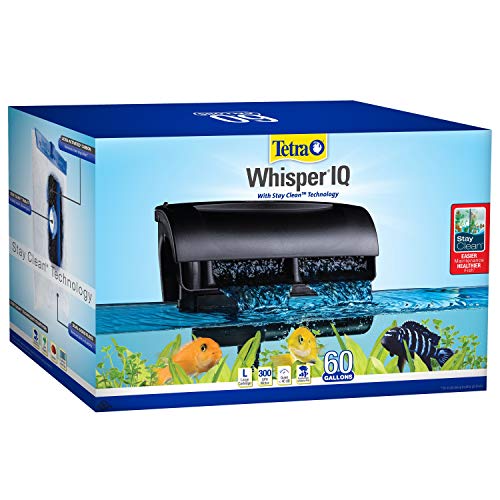
Best quiet option: Tetra Whisper IQ
The Tetra Whisper IQ is a cartridge-based hang-on-back filter that is generally priced around the upper end of this range. It is designed to run at a lower noise level than the cheapest alternatives. Like the QuietFlow, it relies on proprietary cartridges. It is a reasonable pick for a bedroom tank where noise is the main complaint.
Best for long-term value: smallest AquaClear
AquaClear hang-on-back filters are a long-standing recommendation because the media basket lets you load foam, carbon and ceramic or BioMax-style media of your choice and reuse the foam for years. The smaller AquaClear models are at or slightly above the upper limit of this budget depending on the retailer, so check current pricing. The reason to stretch for one is the lifetime cost: you replace carbon occasionally and rinse the foam rather than buying cartridges.
Best for shrimp and fry: Hikari Bacto-Surge sponge filter
A sponge filter is an air-driven foam block. Air bubbles lift water through the sponge, which traps debris and grows beneficial bacteria. Its intake is gentle enough that baby shrimp and fry are not pulled in. The Bacto-Surge is described by reviewers as a good breeding and hospital tank filter at a very low price. The catch is that you need an air pump, air line and a check valve, which adds a small extra cost.
Best sponge filter for a betta: hygger Bio Sponge
The hygger Bio Sponge is sold in sizes for roughly 6 to 20 gallon tanks and keeps flow gentle, which suits long-finned fish such as bettas. It is similar in function to the Bacto-Surge. If you want flow that is easy to adjust, most air pumps have a valve or can be fitted with an inexpensive one.
Cost per year: cartridge versus sponge
| Filter type | Upfront | Yearly consumables | Notes |
|---|---|---|---|
| Cartridge HOB (QuietFlow, Whisper IQ) | Budget | Cartridges replaced roughly monthly, a recurring cost | Convenient, but costs recur |
| Media-basket HOB (AquaClear) | Budget, upper end | Carbon and foam, low | Lowest cost over several years |
| Sponge filter plus air pump | Budget, low end together | Near zero, rinse sponge in tank water | Needs a quiet air pump |
Decision matrix: match the filter to your tank
| Your tank | Choose | Why | Watch for |
|---|---|---|---|
| 5 to 10 gallon betta tank | Small sponge filter, low airflow | Gentle flow protects long fins | Needs an air pump and check valve |
| Shrimp tank of any size | Sponge filter or HOB with a foam intake cover | Baby shrimp cannot be sucked in | Rinse foam often |
| 10 to 20 gallon community tank | Aqueon QuietFlow or Tetra Whisper IQ | Simple, self-priming, easy to find | Cartridge cost over time |
| 20 gallon planted tank | AquaClear 20 with sponge and ceramic media | Reusable media and adjustable flow | Price may sit at the top of the budget |
| Quarantine or hospital tank | Sponge filter seeded from a healthy tank | Instant biological filtration | Keep it running in the display tank beforehand |
Worked example: sizing for a 15 gallon tank
A 15 gallon tank times four gives 60 GPH, and times six gives 90 GPH. A filter rated at 100 GPH on the box will deliver less once media is loaded and the intake gets dirty, so it falls into the right band. A rating of 200 GPH would be too strong for a betta or shrimp tank, but is fine for hardy community fish if you can baffle the outflow. If a filter is rated for 10 to 20 gallons, put it on the 15 gallon tank only if the flow is adjustable or you plan to add a sponge on the intake.
Maintenance steps that protect your bacteria
- Rinse sponges and media in a bucket of old tank water, never tap water. Chlorine kills the bacteria that process ammonia.
- Do not replace all media at once. Swap half so the colony survives.
- Clean the impeller every few months. A gritty impeller is the main reason cheap filters start rattling.
- Check that the intake is not blocked and the water level covers the intake lip on HOB filters.
What to avoid
Very cheap hang-on-back filters, especially the cheapest off-brand units, are commonly reported to fail within months because of weak impeller motors. Established brands such as Aqueon and AquaClear tend to hold up longer. Also avoid oversizing: a large filter on a small tank can blow bettas and shrimp around.
Frequently Asked Questions
Is a sponge filter better than a hang-on-back filter?
Neither is better in every case. Sponge filters are gentler, cheaper and very good at biological filtration, which suits shrimp and bettas. Hang-on-back filters offer stronger flow and easy chemical and mechanical filtration, which suits community fish.
What size filter do I need for a 10 gallon tank?
Aim for roughly 40 to 60 gallons per hour of flow, or four to six times the tank volume. If you keep bettas or shrimp, choose adjustable or gentle flow.
How often should I change filter cartridges?
Many makers recommend roughly monthly, but you can rinse the cartridge gently in tank water and replace it only when it falls apart. Replacing too often removes useful bacteria.
Do sponge filters need an air pump?
Yes. The air pump drives water through the sponge. Use airline tubing and a check valve so water cannot siphon back if the pump stops.
Can a cheap filter really keep a tank clean?
Yes, if it is sized correctly and you keep up with water changes. A budget filter does not replace weekly partial water changes, which remove nitrate that no filter can.
Prices and ratings are general market ranges and manufacturer specifications. Check current listings before you buy.
Write Your Review
No reviews yet. Be the first to share your experience!