

Key takeaways
- Compare the best auto top off systems for reef tanks by sensor type, failure protection and tank size, plus how to size a safe reservoir.
For most reef keepers the FZONE QST2.0 ATO controller is the best overall choice, because it pairs a smart controller with optical sensing and a time-limit alarm that is designed to stop the pump before a sensor error becomes a flood. An auto top off (ATO) system tops up the fresh water that evaporates from your tank so salinity stays steady instead of climbing between manual refills. Smaller tanks and sumps have options too, from sealed single-probe units to the dual-sensor FZONE and Useek models. Whichever you pick, a reservoir of limited size is the real safety net.
Quick List
- FZONE QST2.0 ATO Controller – best overall for keepers who want a controller with built-in fault protection
- FZONE Dual Optical Sensor ATO – best for all-in-one tanks that want two sensors for redundancy
- Useek QST ATO System – best for reefers who want real-time anti-overflow logic
- Sealed One-Piece Probe Mini ATO (nano sump) – best for nano tanks and tight sumps
- Compact Sealed-Sensor ATO – best for small to medium sumps where a long pump life matters
- Clscea Water Filler Compensator – best as a basic, simple top off for low-stakes freshwater tanks
Which One Is Right for You?
| If you… | Choose |
|---|---|
| Want smart fill timing and an alarm if refilling runs too long | FZONE QST2.0 ATO Controller |
| Have an all-in-one tank and want two optical sensors | FZONE Dual Optical Sensor ATO |
| Prefer anti-overflow logic that reacts in real time | Useek QST ATO System |
| Keep a nano tank or a cramped sump | Sealed One-Piece Probe Mini ATO |
| Run a small or medium sump and want a compact sealed sensor | Compact Sealed-Sensor ATO |
| Need a simple filler for a lower-risk freshwater tank | Clscea Water Filler Compensator |
Choose by the consequence of a failure, not the feature list. A saltwater reef with expensive coral deserves optical or dual-sensor logic and a small reservoir, while a freshwater planted tank can accept a simpler device. Whatever you buy, install it so a failed sensor can only add a limited amount of water.
All 6 Picks in Detail
1. Useek QST ATO System – Best for Real-Time Anti-Overflow Logic
As an Amazon Associate we earn from qualifying purchases at no extra cost to you.

The Useek system is pitched at stable water levels and salinity, with “QST real-time anti-overflow” protection for saltwater, freshwater and reef tanks. The rest of the listing title is cut off, so confirm the sensor type, the pump flow rate and whether a reservoir level alarm is included. In general, real-time anti-overflow logic should shut the pump off if the sensor reading suggests water is rising more quickly than expected. That is the behavior you want on a reef where a small mistake changes salinity.
It will appeal to keepers who prefer a single compact unit to a separate controller box.
- Type: ATO with QST anti-overflow logic
- Water types: saltwater and freshwater
- Sensor details: confirm on listing
- Pump specifications: confirm on listing
- Alarm features: confirm on listing
Before trusting any anti-overflow claim, run a dry test: place the sensor in a bucket of water, let the unit fill, then deliberately leave the sensor out of the water and see how long the pump runs before it stops. The result tells you how much water a real fault could add, and it helps you decide how large a reservoir is safe for your system.
Pros
- Anti-overflow logic aimed at reef salinity stability
- Suits sumps and all-in-one tanks
Cons
- Key details are not clear from the listing name
- Less published detail than the FZONE models
Compared with the FZONE QST2.0, it covers a similar idea but you should read the manual before relying on it.
2. Sealed One-Piece Probe Mini ATO – Best for Nano Sumps

This unbranded unit is described as a sealed, mini ATO with an anti-overflow design and a one-piece probe, for nano sumps and reef tanks. The one-piece probe is the attraction: fewer joints mean fewer places for salt creep to cause a false reading. A small footprint matters in a nano sump where space is tight. Because the listing name gives no brand, wattage or pump rating, treat the sealed claim and the anti-flood claim as features to verify in the product description and manual.
- Type: sealed mini ATO with a one-piece probe
- Intended tanks: nano sump and reef tanks
- Anti-overflow feature: listed, confirm how it works
- Pump flow and power: confirm on listing
- Installation: described as easy; confirm on listing
Nano sumps often have only a few inches of water depth, so a small change in level changes salinity quickly. Mount the probe in the calmest corner, away from the return pump, and keep the tube outlet clear of the probe so dripping water does not confuse it. Check the reading against a refractometer after the first week to make sure the setup is holding salinity steady.
Pros
- Small footprint fits nano setups
- Sealed probe reduces corrosion points
Cons
- No brand or detailed specs in the listing name
- Safety behavior is less documented
It resembles the compact sealed-sensor model in this group, though this one stresses the single probe and the nano size.
If you pick it, plan a small reservoir so the worst-case fill is only a cup or two.
3. FZONE Dual Optical Sensor ATO – Best for All-in-One Tanks
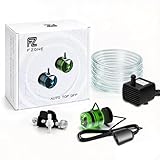
This FZONE model uses two optical sensors for reef and freshwater tanks. Dual sensing means one sensor holds the normal water level while the second acts as a backup, so a fouled or misaligned sensor is less likely to lead to a runaway fill. Optical sensors have no moving parts, which avoids the sticking that plagues float switches in salt creep. They also need a clean, clear window, so wipe the tips regularly to prevent algae from fooling the unit.
It is a good match for all-in-one aquariums where the sensor can sit in the rear chamber and the reservoir can live below the stand.
- Type: dual optical sensors
- Water types: reef and freshwater
- Sensor size and cable length: confirm on listing
- Pump flow and power: confirm on listing
- Color: green housing per listing name
When you install it, mount the two sensors at slightly different heights if the manual allows, so the lower one handles routine refills and the upper one acts as a high-level cutoff. Test the cutoff by lifting the water level with a cup of tank water while the pump is unplugged from the reservoir, and confirm the unit reacts. Do this test again after every deep clean.
Pros
- Two sensors add redundancy
- No float to stick or corrode
Cons
- Optical tips must stay clean
- No timer-based alarm is mentioned in the listing name
Against the Useek, it relies on hardware redundancy rather than on software logic, so it is simpler to understand.
4. Compact Sealed-Sensor ATO – Best for Small to Medium Sumps

This unit is listed with a compact probe, a sealed sensor, flood prevention and a long pump life. It targets saltwater and reef tanks that need steady top off without a large controller. The long pump life claim is worth checking, because small peristaltic or diaphragm pumps can wear and may fail slowly, delivering less water than expected. When a pump fades, salinity can drift up without any alarm, so check the reservoir level against the tank every week at first.
- Type: compact probe with a sealed sensor
- Flood prevention: listed, confirm the mechanism
- Pump type and flow: confirm on listing
- Intended tanks: saltwater and reef
- Brand: not stated in the listing name
Ask the same practical question of every compact unit: if the pump never shuts off, what stops the water? A sealed sensor is helpful, but it does not remove the need for a limited reservoir and a drip loop in the cord. Keep a spare tube and a spare adapter on hand, because small ATO pumps and tubing are the parts that usually wear out first and are easy to replace once you know the model.
Pros
- Compact probe fits small sumps
- Emphasizes flood prevention and pump life
Cons
- Brand and detailed specifications are unclear
- Failure alarms are not described
Against the Clscea, it is a more modern sealed design, though neither has a controller with learned timing.
5. Clscea Water Filler Compensator – Best Basic Option for Low-Stakes Tanks

The Clscea is listed simply as an aquarium auto top off system, water filler compensator, in blue, sold as one piece. The listing name gives no sensor type, pump rating or safety features, so it is the least documented pick here. It makes sense for a freshwater or lightly stocked tank where a stuck sensor would be an annoyance rather than a disaster. For a saltwater reef, we would put it behind the other five and add a backup float switch and a small reservoir before relying on it.
- Type: water filler compensator; sensor type not stated
- Color: blue per listing
- Quantity: one piece
- Pump flow and power: confirm on listing
- Safety features: confirm on listing
Because the listing is so brief, the sensible way to approach this unit is as an experiment on a spare tank first. Run it for a week in a bucket or a spare freshwater tank, watch how the level cycles, and listen for pump noise. If it behaves smoothly, it can be used on a main tank with a small reservoir. If it chatters, overfills or runs dry, return it and choose one of the documented models above.
Pros
- Simple concept and easy to understand
- Suitable for low-risk tanks
Cons
- Few published details
- Not our first choice for a valuable reef
Compared with the FZONE QST2.0, it offers far less documented protection, so it is a runner-up for reef use.
6. FZONE QST2.0 ATO Controller – Best Overall for Fault Protection

The QST2.0 is described as a smart ATO system with a precise controller for saltwater and freshwater tanks. Manufacturer information for this line explains that the controller learns your tank’s typical refill time and sounds an alarm and halts the pump if a refill takes far longer than expected, which guards against a stuck sensor, an empty reservoir or a leak in the tubing. Sources disagree on the exact time multiple that triggers the shutdown, so confirm it in the manual. This logic is the main reason to pick it over simpler probes.
It suits keepers who want to set the unit up once and trust it. The extra controller also gives a visible status and a button to pause or restart filling, which is handy during water changes.
- Type: optical sensor with smart controller
- Safety logic: learned refill timing with an over-time alarm and pump shutdown
- Fill control: start, pause and resume button on the controller
- Pump specifications: confirm flow, lift and voltage on listing
- Tanks: saltwater and freshwater
Pros
- Fault logic is stronger than on probe-only units
- Works with rimmed, rimless and sump tanks
Cons
- More parts to mount and more settings to learn
- Controller location needs to stay dry
Next to the dual-sensor FZONE, the QST2.0 adds the timing alarm, while the other model leans on two sensors for redundancy.
Specs Compared
| System | Sensor type | Safety logic | Intended tanks | Pump details | Controller |
|---|---|---|---|---|---|
| FZONE QST2.0 | Optical | Learned refill time with alarm and shutdown | Saltwater and freshwater | Confirm on listing | Yes |
| FZONE Dual Optical | Two optical sensors | Sensor redundancy | Reef and freshwater | Confirm on listing | Confirm on listing |
| Useek QST | Confirm on listing | Real-time anti-overflow | Saltwater, freshwater, reef | Confirm on listing | Confirm on listing |
| Sealed One-Piece Probe Mini | One-piece probe | Anti-overflow listed | Nano sump, reef | Confirm on listing | Confirm on listing |
| Compact Sealed-Sensor | Sealed sensor | Flood prevention listed | Saltwater, reef | Confirm on listing | Confirm on listing |
| Clscea Compensator | Confirm on listing | Confirm on listing | Aquariums in general | Confirm on listing | Confirm on listing |
How We Chose These
This is a research-based guide. We worked from the six ATO listings in this set, comparing the sensor type, the safety features each listing names, the tank types it targets and how much detail the seller provides. For the FZONE and Useek lines we also read manufacturer-level descriptions of how the sensors and controller logic work. Where a listing name did not state a value, we say to confirm it rather than guess. We favored systems that document failure handling, because the biggest risk with an ATO is not convenience but what happens when something goes wrong. We did not rely on star ratings or sales ranking, and the order reflects fit rather than measured results.
What to Look For
Sensor type: optical, float or conductive probe
Optical sensors detect the water surface with light and have no moving parts, so they resist sticking, but they must be kept clean. Float switches are mechanical and can jam from salt creep or snails. Conductive probes sense electrical contact with the water and can corrode in salt water. Dual sensors let a second device back up the first, which is a meaningful safety gain for a reef.
Failure protection and alarms
Look for a maximum run time, a reservoir-empty alarm and a way to cut power if the sensor reading looks wrong. A time-limit shutdown is the single most useful feature because it limits how much water a fault can add. An audible alarm helps but only if someone is home to hear it, so size your reservoir as if the alarm would never be noticed.
Reservoir size and worked example
Treat the reservoir as the worst-case spill. Suppose a 75 gallon system at 35 ppt salinity suffers a sensor failure and the pump empties a 5 gallon reservoir of fresh water into the tank. The new salinity is about 35 multiplied by 75 and divided by 80, or about 32.8 ppt, a drop of roughly 2 ppt that most hardy livestock survive but that is enough to stress corals. With a 20 gallon reservoir the result would fall to about 28 ppt, which is dangerous. Pick a reservoir that supplies several days of evaporation, not weeks.
Pump flow, tubing and placement
ATO pumps are low-flow by design, usually well under a gallon per minute, because a slow fill reduces the chance of overshoot. Use food-safe tubing, fit a check valve so water cannot siphon back, and keep the end of the tube above the water line. Mount the sensor where surface ripple will not trigger it, such as a calm sump chamber or a corner shielded from the return. Keep the reservoir below the fill point or use a pump that cannot siphon.
Electrical safety
These devices combine water and mains-powered adapters. Plug them into a ground-fault circuit interrupter outlet, form a drip loop in each cord, and keep the controller and adapter above any possible overflow. Never extend or modify low-voltage leads, and replace any cracked housing or damaged cable immediately. Adding a separate float switch as a secondary shutoff is a low-cost insurance policy.
Questions
Do I need an ATO on a small reef tank?
It is not required, but evaporation raises salinity faster on small tanks, so manual topping off becomes a daily chore. An ATO keeps salinity steady, which matters more to corals than almost any other parameter.
What should I put in the reservoir?
Use reverse osmosis or deionized water, never salt water, because only the fresh portion evaporates. Treat the reservoir like a drinking container for the tank and keep it covered and clean.
How do I calibrate the sensor height?
Set the water level where you want it, mount the sensor so its detection point is just at that level, and then let the system run a full cycle while you watch. Small adjustments of a few millimeters change the level noticeably.
Can an ATO fail and flood my floor?
Yes, which is why you need a limited reservoir, a drip loop and ideally a secondary shutoff. The device should only be able to add the volume of the reservoir, not an endless supply.
How often should I clean the sensor?
Wipe the sensor tip every couple of weeks and check it for algae, salt creep or coralline growth. A dirty optical window can read as water when it is not or the reverse.
Is a dual-sensor ATO safer than a single sensor?
Generally yes, because the second sensor can catch a failure of the first. It is not a substitute for a small reservoir and a time-limit shutoff, which protect against pump and tubing problems as well.
Update History
- October 20, 2026 – Initial publication; product set drawn from current catalog listings.
- Check the product page for current specifications and availability before buying.
Sources
- Manufacturer product and specification pages for FZONE and Useek auto top off systems
- Retailer listing titles and specification fields for each system
- General reef-keeping guidance on evaporation and salinity management





Write Your Review
No reviews yet. Be the first to share your experience!