

Key takeaways
- Best for: occasional home use, individual portions, steaks and poultry.
- Advantages: strong penetration, compact designs, and relatively simple operation.
- Limitations: blades can be difficult to clean and may struggle with meat that is too thick, too frozen, or heavily marbled.
Best Meat Tenderizer Machines
The best meat tenderizer machine for most home cooks is a compact stainless-steel blade tenderizer with adjustable or clearly stated thickness limits; choose a roller model instead when you need fast, repeatable tenderizing for large batches, thicker cuts, or frequent meal preparation.
Unlike a handheld mallet or needle tool, a machine creates a consistent pattern of cuts across the meat. That can help marinades penetrate more evenly and can make tough cuts easier to portion and cook. The right design depends less on headline power than on the thickness of your meat, the amount you process, how much counter space you have, and how willing you are to disassemble and clean the cutting assembly.
Our top picks


As an Amazon Associate we earn from qualifying purchases at no extra cost to you. Ratings are shown as listed on Amazon.
Blade versus roller: the decision that matters most
Blade tenderizers
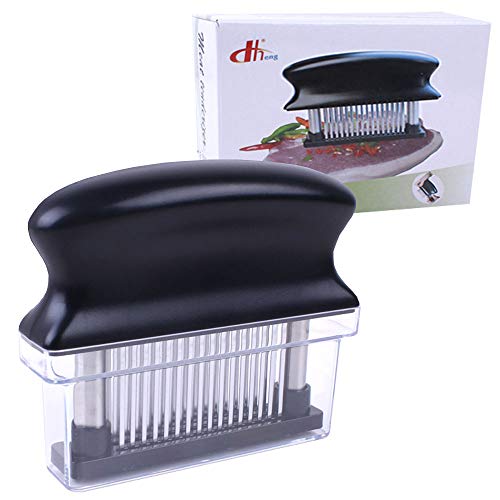
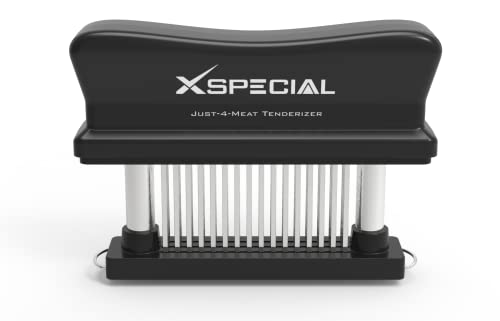
Blade machines use rows of narrow knives or blades that pass vertically through the meat. They are usually the better fit for steaks, cutlets, chicken breasts, pork chops, and other pieces that need a deep, even pattern of cuts. A blade assembly can produce a more noticeable tenderizing effect than shallow rollers, but it also creates more small crevices that require careful cleaning.
- Best for: occasional home use, individual portions, steaks and poultry.
- Advantages: strong penetration, compact designs, and relatively simple operation.
- Limitations: blades can be difficult to clean and may struggle with meat that is too thick, too frozen, or heavily marbled.
Roller tenderizers
Roller models draw meat between one or more rotating cylinders fitted with blades or cutting discs. They are designed for speed and repeatability. A roller machine is more attractive when you tenderize several kilograms at a time, prepare meat for jerky or schnitzel, or want every piece processed to a similar depth.
- Best for: frequent use, batch processing, food-service preparation, and uniform results.
- Advantages: higher throughput and fewer repetitive passes by hand.
- Limitations: larger footprint, more difficult access around the rollers, and greater risk from exposed moving parts if the guards are poorly designed.
Comparison of common machine formats
| Machine format | Typical meat thickness limit | Practical throughput | Approximate footprint | Cleaning effort |
|---|---|---|---|---|
| Manual blade press | Up to 20–25 mm | 3–6 kg per hour | 20–30 cm wide | Moderate; removable blade head is important |
| Electric blade tenderizer | Up to 25–35 mm | 20–60 kg per hour | 30–45 cm wide | Moderate to high; blades, guards, and feed area need attention |
| Manual roller tenderizer | Up to 15–25 mm | 10–30 kg per hour | 35–50 cm wide | High if rollers cannot be removed |
| Commercial electric roller unit | Up to 30–40 mm | 60–150 kg per hour | 45–70 cm wide | High; several food-contact parts require disassembly |
These are useful buying ranges rather than universal specifications. Always compare them with the manufacturer’s stated maximum thickness. A machine rated for 25 mm meat may not accept a 25 mm bone-in chop, and thickness limits often assume boneless pieces trimmed to a fairly even shape.
Best choices by situation
| Your situation | Best choice | What to prioritize |
|---|---|---|
| Occasional use and a tight budget | Manual blade press | Removable stainless-steel head, stable base, and replacement blades |
| Small kitchen or limited storage | Compact electric blade machine | Vertical storage, locking parts, and a footprint under 35 cm wide |
| Several meals per week | Heavy-duty electric blade machine | Duty cycle, motor cooling, overload protection, and easy disassembly |
| Large batches or catering | Electric roller tenderizer | Feed opening, kilograms-per-hour capacity, guarding, and washable components |
| New user concerned about safety | Enclosed blade or roller model | Interlock, pusher, non-slip feet, and no need to guide meat by hand |
What to look for in construction
Stainless steel is useful, but specify where it is used. A stainless-steel food-contact tray and cutting assembly resist staining and are easier to sanitize than painted mild steel. A stainless exterior is also easier to wipe clean, but it does not automatically mean the internal gears, fasteners, or frame are stainless. Look for food-contact parts identified as stainless steel, ideally with removable components that can be washed without exposing the motor.
Blade thickness and mounting matter more than a large motor number. Thin blades can bend when they meet connective tissue or a hard edge of cartilage. A well-supported blade cassette with a rigid frame is generally more valuable than excessive advertised wattage. If a manufacturer provides replacement blade sets, that is a positive ownership signal because blades eventually dull.
For roller machines, inspect the gap around the rollers and the access provided for cleaning. Narrow gaps may reduce the chance of fingers reaching the blades, but they can trap meat. A tool supplied for removing the roller assembly is preferable to improvising with a knife or screwdriver.
Thickness limits and throughput in real use
Thickness limits are not merely capacity figures. They determine whether you must butterfly or flatten meat before processing. If your usual chicken breasts are 35 mm thick but the machine accepts only 25 mm, you may need to split them first. That extra preparation can erase the time saved by automation.
Throughput claims also need context. A stated capacity of 60 kg per hour assumes a steady supply of evenly trimmed meat. At home, loading, rearranging, trimming, and cleaning reduce the useful rate. For example, a machine advertised at 60 kg per hour might process 15 kg during a 15-minute motor run, but if setup and cleaning take 20 minutes, the complete-session rate is closer to 26 kg per hour. This is why a smaller machine can be the sensible choice for a few steaks.
Cleaning and maintenance are part of the purchase
Meat tenderizers are not appliances to rinse casually. Protein, fat, and juices can collect around blade shafts, roller bearings, guards, and feed chutes. Before buying, confirm which parts can be removed without tools and whether the manufacturer permits dishwashing. Even when a part is dishwasher-safe, hand washing may better protect sharp edges and reduce dulling.
- Unplug the machine and remove the pusher, guard, tray, and cutting assembly.
- Scrape away residue with a dedicated plastic tool rather than a metal utensil.
- Wash food-contact parts in hot detergent solution, paying attention to every blade slot.
- Sanitize according to the product instructions and local food-safety guidance.
- Dry parts completely before reassembly; moisture left around shafts can encourage corrosion.
- Wipe the motor housing only with a damp cloth and never immerse it.
Do not push meat through with your fingers, even when the feed opening appears wide. Use the supplied pusher, keep the guard installed, and unplug the unit before clearing a jam. A reverse function can help on some roller machines, but it is not a substitute for disconnecting power before reaching near moving parts.
Common ownership problems
- Dull blades: frequent processing of sinew, bones, or partially frozen meat accelerates wear. Replace the blade cassette if sharpening is not approved.
- Motor overheating: continuous operation beyond the stated duty cycle can trip thermal protection or shorten motor life. Process in batches with cooling breaks.
- Uneven tenderizing: irregularly cut meat, overloaded feed openings, and incorrect thickness are more common causes than motor weakness.
- Corrosion: leaving wet stainless parts assembled can still cause staining around joints and fasteners.
- Cross-contamination: using the machine for raw meat and then cooked food without complete cleaning is unsafe.
Are recognizable brands worth considering?
Established food-equipment brands such as Weston and LEM Products have offered meat-processing equipment and accessories, but their ranges and specifications vary by model and market. Treat the brand name as a starting point, not proof that every machine suits your needs. The useful questions are whether replacement cutting parts remain available, whether the manual states a duty cycle, and whether the food-contact assembly can be removed for cleaning.
Final buying recommendation
Choose a manual blade press if you tenderize only a few portions and want the lowest cost and smallest storage requirement. Choose a compact electric blade machine for regular household batches, provided its thickness limit matches your cuts and its blade head can be removed. Choose a roller machine only when its throughput justifies the larger footprint and more involved cleaning routine. In every case, prioritize a guarded cutting path, stainless food-contact parts, secure feet, overload protection, and replacement parts over decorative controls or an inflated power rating.

Write Your Review
No reviews yet. Be the first to share your experience!