

Key takeaways
- Blade guard: The exposed cutting edge should be covered whenever food is not being sliced.
- Carriage lock: A lock or “home” position keeps the carriage from sliding while loading and cleaning.
- Non-slip feet: Rubber feet or suction-style support reduce movement on smooth counters.
- Hand protection: The food pusher should keep fingers away from the blade and remain attached during operation.
- Two-stage controls: Separate power and carriage controls reduce accidental starts on some commercial machines.
- Thermal protection: Automatic overload shutoff helps prevent motor damage during long or difficult cuts.
The best deli meat slicers for most homes are 7.5- to 10-inch electric machines with adjustable thickness, a removable food-contact carriage, and enough power to slice chilled meat without forcing it; small shops should move up to a 10- or 12-inch commercial slicer with a continuously rated motor and stainless-steel food-contact parts.
Our top picks


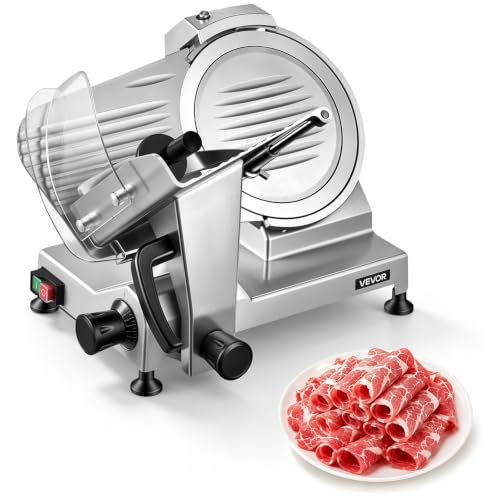
As an Amazon Associate we earn from qualifying purchases at no extra cost to you. Ratings are shown as listed on Amazon.
Best deli meat slicers by situation
| Situation | Best fit | Blade size | Typical price range | Why it makes sense |
|---|---|---|---|---|
| Occasional home use | Compact home slicer | 7–8 inches | $80–$180 | Smaller footprint, adequate for lunch meat, cheese, and cooked roasts |
| Weekly meal preparation | Heavy-duty home slicer | 8–10 inches | $180–$400 | More stable carriage and better performance on larger cuts |
| Frequent entertaining or bulk cooking | Premium home or light-commercial slicer | 10 inches | $300–$700 | Longer runs, stronger drive system, and more durable components |
| Small deli, café, or farm shop | Commercial gravity-feed slicer | 10–12 inches | $900–$3,000+ | Built for repeated service, faster cleanup, and replaceable commercial parts |
Our practical picks
Best for occasional home use: a 7- to 8-inch compact slicer
A compact slicer is the sensible choice if you prepare a roast or block of cheese every few weeks. Models such as the Chef’sChoice 615A represent this category: they use a roughly 7-inch blade, a compact carriage, and a modest motor suitable for short sessions.
The main trade-off is capacity. A smaller blade and narrower carriage work well with a turkey breast, cooked ham, salami, or cheese, but they are less comfortable with a wide brisket or a large roast. Compact machines also tend to have more plastic around the carriage and food deflector. That keeps weight and price down, but it means careful cleaning and storage matter more.
Best all-round home choice: a 10-inch slicer
A 10-inch slicer is the better long-term choice for a household that slices meat weekly. The larger blade reaches through wider products with fewer passes, while a heavier base reduces movement when cutting firm or semi-frozen food. The BESWOOD 10-inch slicer is one recognizable example of this style, with a chromium-plated steel blade and an aluminum-alloy body.
Look for a thickness control that reaches at least 10 mm. A range of approximately 0–12 mm covers paper-thin prosciutto-style slices, ordinary sandwich meat, and thicker servings for platters. Many home machines advertise a high maximum setting but become difficult to control near the thinnest setting, so smooth adjustment is more important than the largest number.
Best for a small shop: a commercial gravity-feed slicer
For a café, butcher counter, or farm shop, choose a commercial slicer rather than simply buying the most powerful home model. Commercial machines commonly use 10- or 12-inch blades, metal food-contact assemblies, stronger motors, and components designed for repeated daily cleaning.
Commercial capacity is determined by more than wattage. A larger product tray, longer carriage stroke, and a motor rated for continuous or extended duty let the operator process several pounds without frequent pauses. A 12-inch slicer is especially useful when products are wide, but it requires more counter depth, more clearance around the carriage, and a safe storage plan for the heavier blade.
Blade size, motor power, and slice control compared
| Slicer class | Typical motor rating | Useful thickness range | Food-contact construction | Practical batch size |
|---|---|---|---|---|
| Compact home | 100–150 W | About 0–10 mm | Stainless blade; coated or aluminum carriage; some plastic guides | Up to about 1–2 lb per session |
| Heavy-duty home | 150–250 W | About 0–12 mm | Stainless or chromium-plated blade; aluminum carriage | About 2–5 lb per session |
| Light commercial | 250–400 W | About 0–15 mm | Stainless-steel food-contact parts; anodized aluminum frame | Several pounds per service period |
| Commercial 12-inch | 400 W and above | About 0–20 mm | Stainless steel and anodized aluminum | Repeated batches throughout the day |
Wattage is a rough guide, not a performance guarantee. A slicer with a sharp blade, rigid carriage, and suitable gear ratio can outperform a higher-wattage machine with a flexible tray. For home use, a motor in the 150–250 W range is usually enough if meat is properly chilled and the machine is used in short runs.
Blade diameter affects both product size and comfort. An 8-inch blade is easier to store and cheaper to replace. A 10-inch blade gives more usable cutting depth and usually pairs with a sturdier carriage. A 12-inch blade is excessive for most kitchens unless the machine will process broad commercial cuts.
Safety features worth paying for
- Blade guard: The exposed cutting edge should be covered whenever food is not being sliced.
- Carriage lock: A lock or “home” position keeps the carriage from sliding while loading and cleaning.
- Non-slip feet: Rubber feet or suction-style support reduce movement on smooth counters.
- Hand protection: The food pusher should keep fingers away from the blade and remain attached during operation.
- Two-stage controls: Separate power and carriage controls reduce accidental starts on some commercial machines.
- Thermal protection: Automatic overload shutoff helps prevent motor damage during long or difficult cuts.
No slicer should be treated like a food processor. Keep the carriage handle in place, use the pusher rather than your hands, and unplug the machine before removing the blade or reaching near the cutting area. Children and untrained helpers should not operate it.
Food-contact materials and cleanup
Stainless steel is the easiest material to live with because it resists staining and tolerates repeated wiping. Anodized aluminum is also common and is lighter than stainless steel, but it should be cleaned according to the manufacturer’s instructions rather than soaked indefinitely. Painted metal and plastic are acceptable for low-volume home use when their surfaces are smooth and intact.
The most important design feature is removable access, not a particular finish. Prefer a removable carriage, removable blade cover, and a removable or easily accessible food deflector. Crevices behind the blade and under the carriage collect meat residue quickly. If those areas cannot be reached without partial disassembly, routine cleaning will become a burden.
A safer cleaning routine
- Turn the thickness control to zero, switch off the machine, and unplug it.
- Move and lock the carriage in the manufacturer’s cleaning position.
- Remove scraps with a paper towel or soft brush before adding water; this prevents greasy residue from spreading.
- Wash removable food-contact parts with warm water and dish detergent, following the manual for dishwasher compatibility.
- Wipe the fixed body without flooding the motor, switch, or ventilation openings.
- Dry every part completely before reassembly, then apply food-safe lubricant only where the manual specifies.
Sanitize only with a product approved for food-contact equipment and used at its labeled concentration. Do not spray cleaner directly into the blade hub or motor housing.
Ownership costs and common failure points
The blade is the main consumable. Frequent slicing of crusty salami, frozen food, or bone-in products dulls it faster than chilled boneless meat. A sharpening service or replacement blade may cost roughly $30–$150 for home machines and substantially more for commercial models. Confirm that a replacement blade is available before buying an obscure slicer.
Carriage guides, drive belts, plastic food pushers, and thickness-control components usually wear before the motor. A loose carriage can produce uneven slices even when the blade is sharp. Before purchase, check whether these parts are sold separately and whether the manufacturer provides a parts diagram.
As a simple cost calculation, suppose a $250 slicer is used twice a month for three years: 72 uses. The machine cost alone is about $3.47 per use. Add a $60 replacement blade and $20 of lubricant or small parts, and ownership rises to about $4.58 per use. That is reasonable for a household that otherwise buys specialty sliced meat, but poor value if the machine will sit unused after a single holiday meal.
Final buying checklist
- Choose 7–8 inches for occasional, narrow products and limited storage.
- Choose 10 inches for the best balance of capacity, stability, and home practicality.
- Choose 12 inches only when the slicer will handle wide products or repeated commercial batches.
- Prioritize a smooth 0–10 or 0–12 mm adjustment over an exaggerated maximum thickness.
- For home use, look for roughly 150–250 W and short-session thermal protection.
- For a shop, prioritize duty rating, carriage size, stainless food-contact parts, and parts availability.
- Verify that the blade, carriage, deflector, and food pusher can be cleaned safely and replaced when worn.
For most households, a sturdy 10-inch slicer is the best deli meat slicer category to buy once and keep. A compact 7- or 8-inch machine wins on price and storage, while a commercial 10- or 12-inch gravity-feed model is the right answer when slicing is part of daily food service rather than an occasional kitchen task.

Write Your Review
No reviews yet. Be the first to share your experience!