

Key takeaways
- Butane: compact, relatively clean-burning, and well suited to desserts, toast, and small baking tasks.
- Propane: hotter and more powerful, with longer practical sessions from a cylinder, but bulkier and less forgiving indoors.
- Refillable reservoirs: convenient for frequent use, though they require careful filling and periodic cleaning.
- Canister-mounted torches: generally simpler to connect and less prone to filling errors, but dependent on compatible fuel cans.
The best culinary torches are the Iwatani PRO2 for crème brûlée and general kitchen use, the Bernzomatic TS8000 for maximum searing power, and a refillable butane torch such as the Blazer GT8000 when you want a durable, high-output tool for frequent cooking.
Our top picks


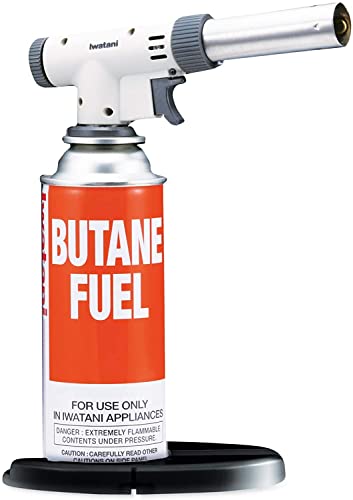

As an Amazon Associate we earn from qualifying purchases at no extra cost to you. Ratings are shown as listed on Amazon.
Best culinary torches at a glance
| Torch | Fuel | Approx. heat | Fuel capacity or runtime | Best for |
|---|---|---|---|---|
| Iwatani PRO2 Culinary Torch | Disposable butane canister | Up to about 1,300°C / 2,370°F | About 70–110 minutes per 250g canister, depending on setting | Crème brûlée, small baking jobs, controlled finishing |
| Bernzomatic TS8000 | Propane cylinder | Up to about 2,010°C / 3,650°F in air | Typically 30–60 minutes with a 14.1–16 oz cylinder | Searing steaks, large batches, outdoor cooking |
| Blazer GT8000 | Refillable butane | Up to about 1,300°C / 2,500°F | Roughly 20–35 minutes per fill, depending on flame size | Frequent users who want a self-contained torch |
| Refillable kitchen butane torch | Refillable butane reservoir | Usually 1,300–1,370°C / 2,370–2,500°F | Usually 10–30 minutes per fill | Low-cost crème brûlée and baking work |
Temperatures in this table describe the hottest part of the flame, not the temperature that food reaches. Actual results depend on the distance from the food, the flame pattern, the pan or sugar surface, and how quickly you move the torch.
Our picks by cooking situation
Best for crème brûlée: Iwatani PRO2
The Iwatani PRO2 is a strong choice for brûlée because it uses a replaceable butane canister, has a broad adjustable flame, and balances more like a small kitchen appliance than a workshop torch. Its fuel connection is simpler than a refill valve: you attach the torch to a compatible canister, lock it in place, and remove it after use.
The wide flame is useful when caramelizing several ramekins, but it still offers enough control for working around the rim without scorching one spot. A canister-mounted design also avoids the fuel seepage and inconsistent filling that can affect inexpensive refillable torches.
Best for high heat and searing: Bernzomatic TS8000
The Bernzomatic TS8000 produces substantially more heat than a typical handheld butane torch and works with standard propane cylinders. Its trigger ignition, flame adjustment, and continuous-lock control make it practical for searing a thick steak, browning a large meringue, or finishing several portions in succession.
Its main disadvantage is scale. A propane cylinder makes the tool tall and top-heavy, and the flame can be excessive for a single dessert. Use it outdoors or in a well-ventilated area according to the manufacturer’s instructions, and keep the cylinder upright. For indoor brûlée, a smaller butane torch is usually easier to control.
Best refillable torch: Blazer GT8000
The Blazer GT8000 is a robust refillable butane torch with a hot, focused flame and a larger body than many inexpensive dessert torches. It is convenient for cooks who use a torch several times a week and do not want to attach a canister for every session.
Refillability reduces packaging waste and can lower operating cost, but it adds maintenance. Use filtered, high-quality butane, purge the reservoir before refilling, and let the torch cool completely. A clogged jet or poorly filled reservoir can cause sputtering, a weak flame, or fuel odor.
What matters more than the advertised flame temperature
Flame control
Look for two separate adjustments: a gas-flow control and an air-mix or flame-shape control. A narrow blue jet concentrates heat for searing or browning a small area. A softer, wider flame is better for evenly caramelizing sugar. A torch with only an on/off switch may be hot enough, but it is harder to use without dark patches.
Fuel type
- Butane: compact, relatively clean-burning, and well suited to desserts, toast, and small baking tasks.
- Propane: hotter and more powerful, with longer practical sessions from a cylinder, but bulkier and less forgiving indoors.
- Refillable reservoirs: convenient for frequent use, though they require careful filling and periodic cleaning.
- Canister-mounted torches: generally simpler to connect and less prone to filling errors, but dependent on compatible fuel cans.
For food, use fuel intended for the appliance and follow its instructions. Keep the torch moving over food; a stationary flame can char sugar, oil, or a thin crust in seconds.
Ignition and safety
A piezoelectric push-button ignition is preferable to a separate lighter because it keeps your hands away from the jet. The best designs also include a safety lock, a trigger that must be deliberately held or locked, and a stable base when the torch is not attached to a cylinder.
Before buying, check that the torch can be shut off completely, that the flame-control dial does not turn accidentally, and that the fuel connection does not wobble. Never leave a lit torch unattended. Let it cool before placing it in a drawer, and store fuel away from heat, sunlight, and ignition sources.
Balance and ergonomics
A torch for crème brûlée should be light enough to sweep across several ramekins without wrist fatigue. A cylinder-mounted propane torch has greater output but its weight sits below the handle, which can make fine work awkward. For searing, that extra size matters less because you generally hold the torch farther from the surface and work over a larger area.
Rubberized grip panels help, but they can deteriorate if exposed to heat, grease, or solvents. A metal body is often more durable, while a plastic body can remain cooler and lighter. Neither construction makes the torch safe to touch immediately after use.
Decision matrix: which type fits your kitchen?
| Your situation | Best choice | Why | Accept the trade-off |
|---|---|---|---|
| Beginner, occasional brûlée | Adjustable butane torch with safety lock | Small, inexpensive to operate, and easy to aim | Less power and shorter sessions than propane |
| Weekly desserts and baking | Iwatani PRO2 or a quality refillable butane torch | Better flame consistency and more comfortable handling | Higher purchase price or more maintenance |
| Frequent steak searing | Bernzomatic TS8000 or another propane torch with adjustable flame | Higher heat output and a larger working area | Bulk, ventilation requirements, and more fuel intensity |
| Very little storage space | Compact refillable butane torch | Small footprint and no separate cylinder | Lower fuel capacity and more attention to refilling |
| Several portions in one session | Canister-mounted butane or propane torch | Less interruption for refueling | Heavier and less portable |
Operating cost: why refillability is not the whole calculation
Suppose a refillable torch uses 10 grams of butane during a session and a 300-gram can costs $6–$10. The fuel cost is approximately 20–33 cents per use:
$6 to $10 ÷ 300g × 10g = $0.20 to $0.33 per session.
A canister-mounted system may cost more per fuel container but waste less fuel during filling and produce more consistent starts. If you use a torch only four times a year, the convenience and reliability of the ignition may matter more than saving a few cents per use. If you use it several times a week, refillability and readily available fuel become more persuasive.
Using a torch for the three common jobs
Crème brûlée
Chill the custard first, spread a thin even layer of sugar, and keep the flame moving in small circles. Start several inches away, then move closer as the sugar melts. Stop when the surface is amber and glassy; residual heat continues darkening it briefly.
Searing
Pat the food dry and use a broad, hot flame rather than holding a narrow jet in one place. A torch improves browning but does not cook the center reliably, so bring thick meat to the desired internal temperature by another method before or after torching.
Baking and meringue
Use the lowest stable flame that gives an even color. Keep the nozzle moving across peaks and edges, where thin meringue browns fastest. A high-output propane torch can work, but its extra heat makes scorching easier for beginners.
Maintenance and ownership realities
- Wipe cooled exterior surfaces with a barely damp cloth; do not immerse the torch.
- Keep the burner jet free of crumbs, sugar, and grease. Do not poke the jet with a needle, which can damage its opening.
- For refillable models, purge remaining gas before refilling, fill outdoors or in strong ventilation, and wait several minutes before ignition.
- Inspect seals, the fuel connection, and the hose or valve area for damage or odor before every use.
- Replace a torch that develops persistent leaks, an uncontrollable flame, or repeated ignition failure rather than attempting an improvised repair.
For most home cooks, choose an adjustable butane torch with piezo ignition for desserts and baking. Choose the Bernzomatic TS8000 or a similar propane model only when you need its extra output for searing or larger batches. The best culinary torch is the one whose flame you can control comfortably, whose fuel system you will maintain correctly, and whose size matches the food you actually prepare.

Write Your Review
No reviews yet. Be the first to share your experience!