

Key takeaways
- Fine pepper for sauces, eggs, and marinades.
- Medium pepper for general cooking and soups.
- Coarse pepper for steaks, salads, and finishing.
The best manual salt and pepper mill set for most kitchens is a paired, adjustable ceramic-and-steel set: ceramic for salt, a hardened steel mechanism for pepper, with at least 20 grind settings, a refill opening of roughly 18 mm or more, and a body that feels comfortable in one hand.
Our top picks


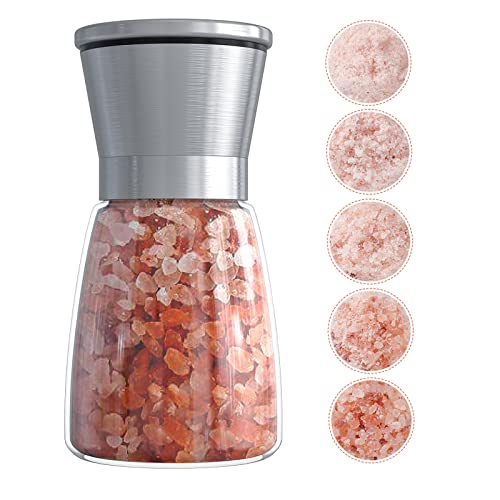

As an Amazon Associate we earn from qualifying purchases at no extra cost to you. Ratings are shown as listed on Amazon.
Best manual salt and pepper mill sets by situation
| What matters most | Best choice | Why |
|---|---|---|
| Lowest purchase cost | Compact ceramic-mechanism set | Usually costs about $20–$35 and is easy to replace, although capacity and adjustment precision are limited. |
| Frequent everyday cooking | Wood or stainless-steel set with separate grind controls | Better grip, larger reservoirs, and less frequent refilling. |
| Coarse finishing salt | Adjustable ceramic mechanism | Ceramic is corrosion-resistant and handles salt crystals without the rust risk of ordinary steel. |
| Freshly ground pepper at the table | Hardened-steel pepper mill with a wide adjustment range | Steel teeth bite peppercorns efficiently and provide a more consistent coarse grind. |
| Limited counter space | Set under 18 cm tall or a dual-ended mill | It fits beneath cabinets and occupies less shelf area, but usually holds less seasoning. |
| One-handed seasoning | Ratchet, lever, or electric-assisted manual design | It can be operated while stirring, but the mechanism is often less familiar and more expensive. |
Ceramic versus steel: which mechanism should you choose?
Ceramic is the safer all-purpose material for a salt mill. Salt attracts moisture, and untreated steel can corrode when damp crystals or humid air reach the mechanism. A ceramic grinder does not rust, so it is especially suitable for sea salt, wet salt, and kitchens near the coast. Ceramic is also hard enough for salt and is commonly used in affordable manual sets.
Steel is usually preferable for pepper. Peppercorns are firm and oily, and a hardened-steel mechanism can crack them quickly while producing a clean, aromatic grind. Look for wording such as “hardened steel” rather than simply “metal”; a generic soft-metal mechanism may wear or deform sooner.
There is no need for both mills to use the same mechanism. The most practical pairing is often a ceramic salt mill and a steel pepper mill. A set using ceramic for both can still be a good value, particularly if you primarily use table salt and want corrosion resistance. A steel salt mechanism is acceptable only when the manufacturer specifically protects it against corrosion and recommends it for salt.
Comparison of useful mill specifications
| Mill type | Typical height | Approximate capacity | Adjustment range | Refill opening | Best use |
|---|---|---|---|---|---|
| Compact ceramic set | 12–16 cm | 20–35 g pepper; 30–50 g salt | 6–12 positions | 10–15 mm | Small kitchens and occasional use |
| Standard wooden or stainless-steel set | 18–22 cm | 35–60 g pepper; 50–90 g salt | 12–24 positions | 18–25 mm | Daily cooking and table use |
| Large restaurant-style mill | 25–30 cm | 70–110 g pepper; 100–160 g salt | 16–30 positions | 22–30 mm | Frequent cooking and fewer refills |
| Ratchet or one-handed manual mill | 14–20 cm | 25–50 g pepper or salt | Usually 3–8 positions | 12–20 mm | Cooking while holding a pan or utensil |
Capacity figures vary with the size and density of the crystals, so treat them as useful planning estimates rather than fixed specifications. A 20 cm pepper mill may hold around 45 g of peppercorns. If a typical meal uses approximately 0.5 g of freshly ground pepper, that is about 90 seasoning sessions before refilling. At two meals per day, that is roughly 45 days; a household that uses pepper more heavily may refill it every two to three weeks.
Adjustment range matters more than the number of clicks
Many mills advertise several grind settings, but the useful question is whether the adjustment creates a noticeable difference between fine, medium, and coarse output. A practical set should handle at least three jobs:
- Fine pepper for sauces, eggs, and marinades.
- Medium pepper for general cooking and soups.
- Coarse pepper for steaks, salads, and finishing.
Top-adjusting mills are simple: tighten the knob for a finer grind and loosen it for a coarser grind. Their disadvantage is that the knob can loosen during use, and changing settings may require two hands. Bottom-adjusting mills often preserve the chosen setting more reliably, but the base can collect stray grounds on the counter.
Numbered collars are convenient when two people use the same set, but numbers are not universal. “1” on one mill may be finer or coarser than “1” on another. Choose a mechanism that adjusts gradually and does not wobble rather than selecting a model solely because it claims 30 settings.
Refilling, moisture resistance, and everyday ownership
A wide refill opening is one of the most overlooked features. An opening of 18 mm or more lets you pour peppercorns from a small bowl with less spillage. Narrow openings often require a funnel, especially with irregular sea-salt flakes. A transparent window or clear body shows when the reservoir is nearly empty, while opaque wood looks better but makes planning refills harder.
For moisture resistance, prioritize a covered grinding outlet, a non-porous body, and a ceramic salt mechanism. Do not store a salt mill beside a steaming kettle or over a dishwasher vent. Even a corrosion-resistant mechanism can clog when salt absorbs humidity and forms a paste.
Keep the mill dry. Do not rinse the grinding mechanism or immerse the body unless the manufacturer explicitly allows it. Wipe the exterior with a barely damp cloth, then dry it. To clear stale particles, empty the reservoir and grind a small amount of dry uncooked rice only if the instructions permit it; some manufacturers warn that hard grains can damage the mechanism. A safer general method is to brush loose residue from the outlet with a dry, soft brush.
The part most likely to wear first is usually the adjustment thread or the grinding teeth, not the outer shell. Over-tightening the adjustment can place unnecessary pressure on the burrs. Another common mistake is filling a pepper mill with pre-ground pepper: fine powder can compact around the mechanism and reduce its performance. Fill it with dry, whole peppercorns and leave a little headspace so the contents can move.
Manual mills versus one-handed designs
Traditional twist mills give the best control and are usually the easiest to repair or replace. They require two hands: one to hold the body and one to turn the top. That is not ideal when you are stirring, carving, or holding a serving dish.
One-handed options use a squeeze lever, ratchet, pump, or vertically operated handle. They are useful for cooks with limited grip strength or for seasoning while the other hand is occupied. Their trade-offs include a smaller capacity, fewer grind settings, more moving parts, and a less direct sense of how much pepper has been released. A ratchet mechanism can also feel slower when a recipe requires a large quantity.
For one-handed use, check the force required to activate the mechanism, not only the handle shape. A short lever may look compact but demand more pressure. A broad, textured grip and a stable base are more useful than a decorative finish. If possible, select a design with a clearly marked adjustment ring that can be changed without disassembling the mill.
Brands and product families worth comparing
Peugeot is a long-established choice for traditional pepper mills, including the Paris-style wooden range, and is known for pairing different mechanisms to different seasonings. Cole & Mason offers manual sets in wood, acrylic, and stainless steel, with several designs emphasizing numbered adjustment collars and visible reservoirs. Zassenhaus is another established brand to consider for traditional pepper and salt mills, including larger wooden formats.
These brands are not automatically the best fit for every kitchen. Compare the actual height, refill opening, mechanism material, and adjustment method of the specific model. A familiar brand with a narrow opening may be less convenient than a less decorative mill with a ceramic salt grinder and a 22 mm refill port.
A simple buying checklist
- Choose ceramic for salt, or confirm that a steel salt mechanism is corrosion-protected.
- Choose hardened steel for pepper when coarse, frequent grinding is important.
- Look for at least 12 meaningful grind positions, or a smooth continuous adjustment.
- Prefer a refill opening of 18 mm or wider for easy filling.
- Choose 18–22 cm mills for a balance of capacity, grip, and cabinet clearance.
- Check whether the salt and pepper mills have separate adjustment systems.
- For one-handed use, prioritize low operating force and a non-slip grip over maximum capacity.
- Confirm that the mill can be cleaned without washing the mechanism.
Final recommendation
The best manual salt and pepper mill set is a matched pair with a ceramic salt grinder, a hardened-steel pepper grinder, independent adjustment controls, a wide refill opening, and enough capacity for several weeks of normal use. Choose a compact set for occasional seasoning and limited storage; choose 18–22 cm mills for everyday cooking; and choose a ratchet or lever design only when one-handed operation solves a real need. The mechanism and maintenance design will affect your experience far more than the color or exterior finish.

Write Your Review
No reviews yet. Be the first to share your experience!