

Key takeaways
- Compare the best aquarium water changers: faucet-powered kits and hand-started gravel vacuums by hose length, refill ability and tank size.
The Python No Spill Clean and Fill 25 foot system is the best overall aquarium water changer in this group for anyone who can reach a sink: it uses faucet pressure to drain the tank and refill it, so no buckets are needed. If your tank is far from a faucet or your faucet will not take the adapter, the hand-started gravel vacuums are the practical alternatives. An aquarium water changer is a siphon or hose system that removes old water, often vacuums the gravel and puts fresh water back.
Quick List
- enomol Gravel Vacuum (30 ft) – best for a hand-started siphon and drain hose for a mid-size tank
- Python No Spill Clean and Fill (25 ft) – best overall for bucket-free draining and refilling from a faucet
- enomol Gravel Vacuum (50 ft) – best for tanks far from a drain or sink
- Tetra Water Cleaner Gravel Siphon – best for small to mid tanks up to 55 gallons that need a simple siphon
- hygger Bucket-Free Water Change Kit (25 ft) – best for a faucet-connected drain and fill kit with a metal connector
- GADFISH Gravel Vacuum (50 ft) – best for long-reach siphoning with a hand-started pump
Which One Is Right for You?
| If you… | Choose |
|---|---|
| Want to avoid hauling buckets and your faucet accepts an adapter | Python No Spill Clean and Fill 25 ft |
| Prefer a faucet-connected kit with a metal connector | hygger Bucket-Free Kit 25 ft |
| Have a small tank and just need a basic gravel siphon | Tetra Water Cleaner Gravel Siphon |
| Need a long hose to reach a sink, a window or a garden | enomol 50 ft |
| Want a long hose with a hand-started pump from another brand | GADFISH 50 ft |
| Have a 30-ish foot run and a mid-size tank | enomol 30 ft |
The main fork is whether you will connect to a faucet. A faucet-powered kit is the fastest way to change a lot of water, but it needs a compatible faucet and care with tap-water conditioning. Hand-started siphons are more flexible but depend on gravity, so the drain point must be lower than the tank.
Also consider storage and who will do the work. A coiled 50 foot hose needs a hook or bin, a faucet kit needs a spot near the sink for its adapter, and a basic siphon fits in a drawer. If several people share the chore, the system with the fewest steps is the one most likely to be used every week, and consistent small changes beat occasional big ones.
All 6 Picks in Detail
1. enomol Gravel Vacuum (30 ft) – Best Hand-Started Siphon
As an Amazon Associate we earn from qualifying purchases at no extra cost to you.
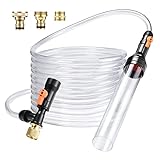
The enomol is a gravel vacuum and water changer with a quick pump to start the siphon, sold in a 30 foot length. The listing calls it universal, but the title leaves out the tube diameter and the pump style, so check those on the product page.
Who it suits: owners of a 20 to 75 gallon tank with a drain, bathtub or garden within about 30 feet. It relies on gravity, so the outlet end must sit below the bottom of the tank.
To start the flow, submerge the tube so it fills with water, follow the starter instructions on the pump and lower the outlet below the tank base. Once water runs, keep the end of the hose in a sink, tub or large container and never above the waterline. Because the length is generous, you can reach most rooms without moving the tank, but it is worth coiling the hose neatly so a kink does not stop the flow mid-change.
- 30 foot hose
- Gravel vacuum tube
- Quick pump to start the siphon
- Marketed as universal for fish tanks
- Tube diameter and fittings: confirm on listing
Pros
- No faucet adapter required
- Hose long enough for most rooms
Cons
- Does not refill the tank by itself
- Drain speed depends on tank height
It is the shorter version of the 50 foot enomol.
2. Python No Spill Clean and Fill, 25 ft – Best Overall

The Python system connects to your faucet with an adapter, siphons old water into the sink or drain and then, with a switch change, refills the tank with tap water. Product information states the kit includes a hose, gravel tube, switch, connectors, a faucet pump and a brass adapter, with the gravel tube about 10 inches long and 2 inches wide.
Who it suits: owners of larger tanks and anyone changing water weekly who can reach a sink. Check that your faucet has a thread the adapter fits, and always condition the water, since a fill straight from the tap adds chlorine or chloramine.
A practical routine is to shut off the filter, drain to the level you want while vacuuming a portion of the substrate, then switch to fill. Add dechlorinator to the tank for the volume you are replacing before the fresh water arrives, and adjust the faucet to a temperature close to the tank. Watch the water level continuously during the fill and keep a hand near the valve, since an unattended refill is the usual way tanks overflow.
- 25 foot hose
- Faucet-powered drain and fill
- Kit with gravel tube, switch, connectors and brass adapter
- Available in other lengths according to the manufacturer
- Faucet compatibility: confirm on listing
Pros
- Fastest way to change a lot of water
- No buckets and fewer spills
Cons
- Needs a compatible faucet
- Tap water goes in directly, so conditioning must be planned
Compared with the hygger kit, it is the better-known design of the same type.
3. enomol Gravel Vacuum (50 ft) – Best for Long Reach
This is the same hand-started vacuum as the 30 foot version, with a longer hose. It suits keepers whose tank sits far from any drain, such as a basement or upstairs room where water must be carried outdoors.
Who it suits: owners of a tank in a living room or an office with a long path to the nearest outlet. Longer hoses hold more water and can be bulky, so coil the hose in a bucket or tub when not in use.
With this much hose, drain speed depends heavily on the height difference between the tank and the outlet. A tank on a stand draining into an outdoor spot will move water quickly, while a tank near floor level draining to a counter-height sink may barely flow. Test the setup with a small amount of water before the first full change, and rinse the hose after use so algae and mulm do not build up inside.
- 50 foot hose
- Gravel vacuum tube
- Quick pump to start the siphon
- Marketed as universal for fish tanks
- Tube diameter and fittings: confirm on listing
Pros
- Reaches far-off drains or outdoor spots
- Simple, flexible setup
Cons
- Long hose is awkward to store
- No built-in refill function
Choose it over the 30 foot version only if you really need the extra reach.
4. Tetra Water Cleaner Gravel Siphon – Best Simple Siphon for Small Tanks
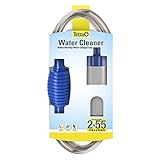
This is a conventional gravel siphon from Tetra for aquariums up to 55 gallons. The listing says it makes water changes easier, removes debris from gravel and removes about 30 percent of the tank water, though the title cuts off the timing, so confirm on the product page.
Who it suits: owners of small to mid tanks who change water into a bucket and want a dependable, no-frills tool. It does not include a faucet attachment, so you still need to refill with a bucket or jug.
Small and mid-size tanks are where a simple siphon shines. Use a clean bucket reserved for aquarium work only, keep soaps and cleaners away from it, and aim to remove about a fifth to a third of the water per change. Move the tube slowly through the gravel in a different section each time, so beneficial bacteria in the untouched areas keep supporting the filter.
- Rated for aquariums up to 55 gallons
- Gravel siphon design
- Removes debris from gravel
- Roughly 30 percent water removal is mentioned
- Hose length and starter mechanism: confirm on listing
Pros
- Familiar brand and simple design
- Good fit for small tanks
Cons
- Requires buckets for refilling
- Hose reach is limited compared with long kits
It is the simplest option next to the hygger kit.
5. hygger Bucket-Free Water Change Kit, 25 ft – Best Faucet Kit with Metal Connector

The hygger kit uses a metal faucet connector, a vacuum siphon gravel cleaner and a 25 foot hose for draining and filling. It resembles the Python design, so it competes directly with it.
Who it suits: owners who want a faucet-based system and like a metal connector at the tap. Before buying, confirm the thread sizes and whether your faucet will accept the connector, since bathroom and kitchen faucets vary.
Before use, unscrew the faucet aerator, test-fit the metal connector and run the water at a gentle stream to look for leaks. Faucet kits like this one are best used with the tank at a comfortable height so the hose does not stretch tight. Store the connector and any small parts together after each change, since losing a washer is the most common reason these kits stop sealing.
- 25 foot hose
- Metal faucet connector
- Vacuum siphon gravel cleaner
- Drain and fill function
- Included adapters and valves: confirm on listing
Pros
- Bucket-free draining and filling
- Metal connector at the faucet
Cons
- Faucet fit is not guaranteed
- Less long-term track record than Python
It is the alternative to Python if the connector design appeals to you.
6. GADFISH Gravel Vacuum (50 ft) – Best Alternative Long-Reach Siphon

The GADFISH is another hand-started gravel vacuum with a 50 foot hose and quick pump. It closely mirrors the longer enomol, so choose by the details on the product page: tube diameter, pump style and what accessories are in the box.
Who it suits: owners who need a long hose and want a second option to compare with the enomol. Because the listings are so similar, included accessories and the return policy are good tie-breakers.
Like other hand-started siphons, it works best if the tube is held vertically in gravel and tilted just enough to let debris rise and drain. Before you buy, compare the listing to the other 50 foot kit on tube diameter, the starter pump and any included clamps, then decide by what the box actually contains.
- 50 foot hose
- Gravel vacuum tube
- Quick pump for starting the flow
- Marketed as universal for fish tanks
- Included accessories: confirm on listing
Pros
- Long reach
- Simple setup
Cons
- No refill function
- Similar to other generic kits, so differences are small
Treat it as an interchangeable alternative to the 50 foot enomol.
Specs Compared
| Product | Hose length | Drain method | Refill function | Faucet connection | Notes |
|---|---|---|---|---|---|
| enomol 30 ft | 30 ft | Siphon, quick pump start | No | No | Gravel vacuum |
| Python No Spill 25 ft | 25 ft | Faucet pressure siphon | Yes, via faucet | Yes, brass adapter | 10 in x 2 in gravel tube per manufacturer |
| enomol 50 ft | 50 ft | Siphon, quick pump start | No | No | Gravel vacuum |
| Tetra Water Cleaner | Confirm on listing | Siphon | No | No | Up to 55 gallons |
| hygger Bucket-Free 25 ft | 25 ft | Faucet-connected siphon | Yes, via faucet | Yes, metal connector | Vacuum siphon |
| GADFISH 50 ft | 50 ft | Siphon, quick pump start | No | No | Gravel vacuum |
How We Chose These
We started with the water changers and gravel vacuums currently listed for aquariums and grouped them by how they move water: hand-started siphons and faucet-connected kits. We read the listing titles and specification fields, and for the Python kit we also checked the manufacturer-style product information on how the faucet pump and adapter work. We compared them against common hobbyist guidance on how much water to change and how to avoid shocking fish. This is a research-based guide, not a product trial, and anything the title does not state is marked to confirm.
What to Look For
Hand-started siphon or faucet-powered kit
A hand-started siphon uses gravity: once the flow starts, water leaves the tank as long as the outlet is lower than the water surface. A faucet-powered kit uses water passing through a pump at the sink to create suction, then reverses to fill the tank. The faucet type is faster for large tanks and removes bucket lifting, but only works with compatible faucets and needs more attention to water conditioning.
Hose length and drain location
Measure the path from the tank to the drain with a tape measure and add several feet for slack. A hose that is too short makes you move the outlet to awkward spots, while one that is too long adds weight and storage trouble. Remember that the outlet must stay lower than the tank bottom for a hand-started siphon to run, so a sink at counter height may not work for a stand-mounted tank.
Gravel tube size and substrate
Wider tubes move more water and lift more debris, but they can pull up fine sand. For sand, keep the tube hovering just above the surface and use the lightest suction. For gravel, push the tube into the bed to lift mulm, then release it as the water in the tube clears. Avoid vacuuming deeply in planted areas, where roots grow, and clean only a portion of the substrate at each change.
How much water to change, with a worked example
A common routine is 20 to 30 percent weekly for a stocked tank. Worked example: a 55-gallon tank at 25 percent is about 14 gallons. With a 3-gallon bucket, that is about five trips to drain and five more to refill, roughly ten trips. A faucet-powered kit removes most of that carrying, which is why it appeals to owners of large tanks.
Cleaning the tool and avoiding cross-contamination
Rinse the tube and hose with plain hot tap water after each use and let them drain and dry. Do not use soap, detergent or bleach on equipment that touches aquarium water unless you rinse it very thoroughly, since residues are harmful to fish and bacteria. Keep a labeled bucket for fish-only use, and never use the same hose for chemicals or garden sprays. If you work with several tanks, wash and dry the gear between them to avoid moving disease or algae from one to another.
Water conditioning, temperature and safety
Treat tap water with a dechlorinator that also handles chloramine, and match the temperature of the new water to the tank within a few degrees. If you fill directly from the faucet, add conditioner to the tank for the volume being replaced before or during the refill. Keep the filter and heater off or covered while the water level is low, because exposed heaters can crack and exposed filter intakes can run dry. Mind the cord and outlet area when working with water, and never leave a draining hose unattended.
Questions
How often should I change aquarium water?
Many hobbyists change 20 to 30 percent weekly, but the right amount depends on stocking, plants and test results. Heavily stocked tanks may need more, while lightly stocked planted tanks may need less.
Is it safe to fill a tank directly from the faucet?
It can be, if you condition the water and match the temperature closely. Add dechlorinator as the tank fills, and check the temperature with your hand or a thermometer before you start.
Will a gravel vacuum suck up my sand?
It can if the tube is pressed into the sand or the flow is strong. Hover above the surface, pinch the hose to slow the flow or choose a narrower tube.
Do I need to remove fish while changing water?
Not normally. Keep movements slow, avoid chasing fish with the tube, and make sure small fish cannot get sucked into the intake.
Why won’t my siphon start?
The most common reasons are an air leak in a fitting, an outlet higher than the tank or a kink in the hose. Re-seat the connectors, lower the outlet and prime the hose again.
Can I use a faucet kit on any sink?
Not always. Faucets with built-in sprayers, odd threads or no removable aerator may not take the adapter, so check the thread and the aerator before you buy.
Update History
- October 14, 2026 – Initial publication; product set drawn from current catalog listings.
- Check the product page for current specifications and availability before buying.
Sources
- Manufacturer-style product information for the Python No Spill Clean and Fill system
- Retailer listing titles and specification fields for each product
- General aquarium hobby guidance on water change routines and water conditioning
Write Your Review
No reviews yet. Be the first to share your experience!