

Key takeaways
- PAR figures at depth. If the maker publishes readings at 12 or 18 inches, they tell you much more than wattage.
- Spectrum charts. Plants use mostly red and blue wavelengths, while white light helps humans see color. Fixtures with discrete channels give you control.
- Dimming range. A light that can run at 20 to 30 percent is useful for new tanks and low-tech setups. A light that cannot dim is hard to tame.
- Controller type. Bluetooth apps are flexible but depend on your phone. Built-in controllers are simpler. Manual dimmers need an outlet timer.
- Mounting. Rim brackets, adjustable arms and hanging kits all suit different tanks. Rimless tanks often need legs or a hanging kit.
The best aquarium light for most freshwater planted tanks in 2026 is the Fluval Plant 3.0, because it pairs a full-spectrum LED with app-based sunrise and sunset scheduling in sizes that match standard tank lengths. For fish-only tanks, a simple budget LED such as the Nicrew ClassicLED Plus is enough, and for demanding red plants under CO2, the Chihiros WRGB II is the common upgrade. The right choice depends on tank length, plant demands and how much control you want over color and timing.
Our top picks


As an Amazon Associate we earn from qualifying purchases at no extra cost to you.
Quick Comparison of the Top Aquarium Lights
| Light | Best for | Sizes | Control | Price tier |
|---|---|---|---|---|
| Fluval Plant 3.0 | Best overall planted tank light | Roughly 15 to 60 inches | Bluetooth app, 24-hour scheduling | Mid-range |
| Chihiros WRGB II / WRGB II Pro | High-tech tanks with red plants | Roughly 12 to 60 inches | App with per-channel control | Upper-mid to premium |
| Twinstar S Series | Best looking, natural spectrum | Tank-specific rounded sizes | Manual dimmer, timer sold separately | Premium |
| Finnex Planted+ 24/7 | Best built-in automation | Roughly 18 to 48 inches | Built-in controller | Mid-range |
| Fluval Aquasky 2.0 | Best for mixed fish and plants | Roughly 12 to 60 inches | Bluetooth app | Mid-range |
| Nicrew ClassicLED Plus | Best budget | Roughly 18 to 48 inches | Simple dimmer and modes | Budget |
Sizes are approximate and vary by retailer. Match the light to your tank’s inside length, not the glass total, and check the manufacturer’s size chart before ordering.
How Much Light Does Your Tank Actually Need?
Light output is usually discussed in PAR (photosynthetically active radiation) measured at the substrate, in micromoles per square meter per second. The following are generally used guideposts in planted tank guides, not guarantees, because every fixture, depth and lens differs.
| Tank style | Typical PAR at substrate | Photoperiod | CO2 | Example plants |
|---|---|---|---|---|
| Fish-only | Not critical | 6 to 8 hours | No | Plastic or low-demand java fern |
| Low-tech planted | About 15 to 30 | 6 to 8 hours | No | Anubias, java fern, cryptocoryne |
| Medium-tech planted | About 30 to 50 | 7 to 8 hours | Optional | Vallisneria, amazon sword, stem plants |
| High-tech planted | About 50 to 100 | 6 to 8 hours | Yes | Carpeting plants, red stem plants |
A worked example: a 20 gallon long tank is about 30 inches long. A 24 to 36 inch light, sized to the tank’s length, spreads evenly. If your light is too short, the ends will be dim and algae tends to appear where nutrients and light are unbalanced. Start at around 50 percent intensity and increase only if the plants need it.
The Best Aquarium Lights
Best overall: Fluval Plant 3.0
The Plant 3.0 remains the default recommendation for planted tanks because it is strong, sleek and easy to program. The FluvalSmart app handles on and off times, ramping and weather effects, and the unit comes in sizes covering roughly 15 to 60 inches. Fluval publishes the spectrum for plant growth, and many independent reviews place its output near the top for its price class. A newer 4.0 line has also appeared in some retailers, so check whether the listing is for the version you intend to buy.
Trade-off: the app and bundled mount arms are fine, but intensity can be high for low-tech tanks, so dim it from day one.
Best for demanding aquascapes: Chihiros WRGB II
Chihiros’s WRGB II and WRGB II Pro lights use separate white, red, green and blue channels you can tune in the app. That helps bring out red plants and fine-tune color for scaping contests or for a CO2-injected, high-tech tank. They are popular in the planted tank community and sit toward the higher end of pricing.
Trade-off: they are easy to over-light, and in a tank without CO2 and fertilizer, the extra power mostly feeds algae.
Best natural look: Twinstar S Series
Twinstar lights are known for a rounded look and a spectrum that makes fish and plants look natural. They hang over a tank in a way that shows off rimless aquariums. They are not the cheapest and offer fewer smart controls, so many keepers run them with a separate outlet timer.
Trade-off: premium pricing, a manual dimmer and a smaller range of sizes.
Best built-in automation: Finnex Planted+ 24/7
The Planted+ 24/7 includes a controller that handles sunrise, daytime, sunset and moonlight automatically, with no phone needed. For a family tank that you do not want to babysit, that simplicity is its biggest selling point. It supports a variety of plants in low to moderate setups.
Trade-off: less fine-tuning than app-based lights.
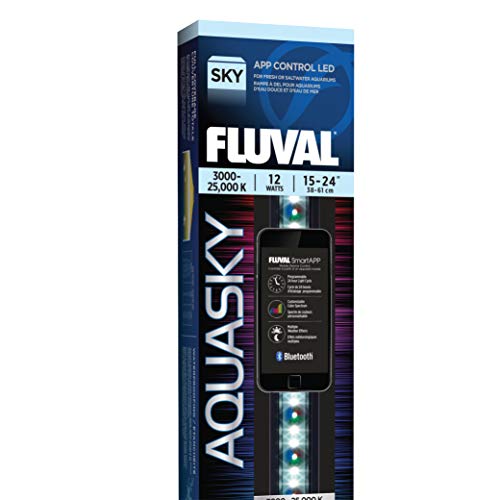
Best for mixed tanks: Fluval Aquasky 2.0
The Aquasky 2.0 is aimed at freshwater and saltwater aquariums where you want attractive color and some plant support rather than maximum growth. It has Bluetooth control and an extendable bracket on many sizes. It suits a community tank with a few hardy plants.
Trade-off: it is not the strongest option for dense, high-light carpets.
Best budget: Nicrew ClassicLED Plus
The ClassicLED Plus is a slim, adjustable-bracket light that gives acceptable brightness for fish tanks and easy plants. It has a simple remote or dimmer, depending on version, and an affordable price. For anubias, java fern and moss, it does the job.
Trade-off: limited spectrum tuning and lower output for demanding plants.
Matching a Light to Your Tank Length
Most lights are sold by length, and the match is not optional. A fixture much shorter than the tank leaves dark ends where algae and weak plant growth show up first. A fixture longer than the tank simply will not sit on the rim. Measure the outside length of the tank from rim to rim, then compare with the manufacturer’s size chart.
| Tank (approx. US gallons) | Typical length | Light length to look for | Notes |
|---|---|---|---|
| 10 gallon | 20 inches | 18 to 24 inches | Low output is enough, dimming helps |
| 20 gallon long | 30 inches | 24 to 36 inches | Good size for first planted tank |
| 29 to 40 gallon breeder | 30 to 36 inches | 30 to 36 inches | Wide footprint may need two fixtures or a wider spread |
| 55 gallon | 48 inches | 48 inches | Depth of 21 inches means output matters |
| 75 gallon | 48 inches | 48 inches | Often run two lights for even coverage |
For tanks that are wide as well as long, a single bar light can leave the back or front corners shaded. Mount it slightly forward of center when you keep taller plants at the back, or use two shorter lights to even things out.
Reading the Specs: What Matters and What Does Not
Product pages often lead with lumens or watts. For planted tanks, those figures are the least useful. Look instead for these items.
- PAR figures at depth. If the maker publishes readings at 12 or 18 inches, they tell you much more than wattage.
- Spectrum charts. Plants use mostly red and blue wavelengths, while white light helps humans see color. Fixtures with discrete channels give you control.
- Dimming range. A light that can run at 20 to 30 percent is useful for new tanks and low-tech setups. A light that cannot dim is hard to tame.
- Controller type. Bluetooth apps are flexible but depend on your phone. Built-in controllers are simpler. Manual dimmers need an outlet timer.
- Mounting. Rim brackets, adjustable arms and hanging kits all suit different tanks. Rimless tanks often need legs or a hanging kit.
A Sensible Setup Routine for a New Light
- Start dim. Run at about 40 to 50 percent for the first two weeks.
- Set a six-hour photoperiod. Use a timer or the built-in schedule.
- Watch the glass and plants. Green spot algae on the glass or hair algae on leaf tips signals too much light or too little nutrient.
- Increase slowly. Raise intensity or time by small steps every week and only if plants are growing well.
- Keep notes. A simple log of intensity, hours and what changed makes it easy to find the cause of any problem.
Common Lighting Mistakes
- Running the light all day. Eight hours is plenty; more simply feeds algae. A midday break, called a siesta, helps some tanks.
- Ignoring tank depth. Light weakens with water depth. Deep 24 inch tanks need more output than 12 inch shallow trays.
- Buying by wattage. LED wattage says little about plant growth. Look for PAR data or manufacturer spectrum charts.
- Neglecting nutrients. More light without balanced fertilizer and CO2 is the usual cause of algae outbreaks.
- Placing the light too close to the water. Heat and splash can shorten life. Follow the bracket distance in the manual.
Frequently Asked Questions
How many hours a day should an aquarium light be on?
Six to eight hours is the usual recommendation for planted tanks. Start with six if your tank is new, then add time only if plants are healthy and there is no algae. Fish-only tanks do fine with a similar schedule.
Do fish need aquarium lights?
Fish benefit from a regular day and night cycle, but they do not need strong light. A room light and window can suffice, though an LED gives consistent timing and helps you see them.
What color light is best for plants?
A full-spectrum white around 6,500 K is a safe starting point. Extra red and blue channels can enhance plant color, but balanced white handles most tanks.
Can a light that is too bright harm fish?
Very bright lights can stress some species, especially those that prefer shaded water such as bettas and many tetras. Floating plants or dimming settings help.
How long do LED aquarium lights last?
Quality LEDs are often rated for tens of thousands of hours, but power supplies and moisture exposure often fail first. Keep cords dry and drip loops in place.
Do I need a timer?
Yes, unless the light has one built in. A consistent schedule prevents algae and reduces stress. Cheap outlet timers work well.
Which Light Should You Buy?
Pick the Fluval Plant 3.0 for most planted tanks, the Chihiros WRGB II for CO2-driven scapes, the Twinstar S for a showpiece, the Finnex Planted+ 24/7 for set-and-forget automation, the Aquasky 2.0 for mixed tanks and the Nicrew ClassicLED Plus when you need a low-cost fish-tank light. Recommendations reflect manufacturer specifications and published aquarium reviews; confirm size and compatibility with your own tank before buying.

Write Your Review
No reviews yet. Be the first to share your experience!