

Key takeaways
- Best budget all-rounder: Radiomaster Pocket 4-in-1 or ELRS.
- Best for growing into advanced models: Radiomaster Boxer.
- Best for maximum model flexibility: Radiomaster TX16S Mark II.
- Best simple surface transmitter: Spektrum DX5C.
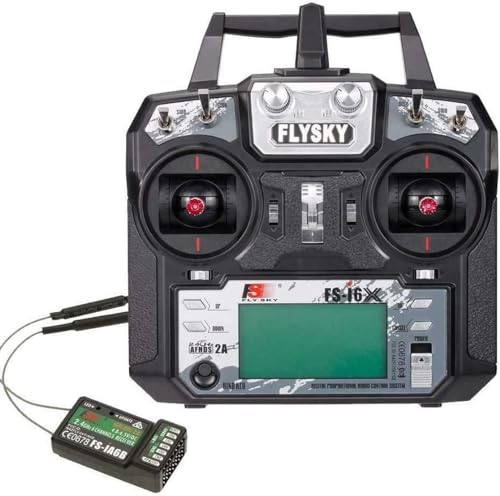
- Best inexpensive conventional system: FlySky FS-i6X.
- Best traditional premium surface radio: Futaba 4PM Plus.
The best RC transmitters are the Radiomaster Pocket for affordable versatility, the Radiomaster Boxer for most serious hobbyists, and the Spektrum DX5C for a simple surface-model setup with broad club support.
The right choice depends less on the maximum channel count than on four practical questions: which receiver protocol your model uses, how many independent functions you need, how often you will use the transmitter, and whether the controls feel comfortable after an hour. For RC boats, watercraft, crawlers, and other surface models, these are the strongest options by situation.
Our top picks



As an Amazon Associate we earn from qualifying purchases at no extra cost to you. Ratings are shown as listed on Amazon.
Quick picks for different RC hobbyists
- Best budget all-rounder: Radiomaster Pocket 4-in-1 or ELRS.
- Best for growing into advanced models: Radiomaster Boxer.
- Best for maximum model flexibility: Radiomaster TX16S Mark II.
- Best simple surface transmitter: Spektrum DX5C.
- Best inexpensive conventional system: FlySky FS-i6X.
- Best traditional premium surface radio: Futaba 4PM Plus.
Best RC transmitters compared
| Transmitter | Channels | Protocol compatibility | Power and typical runtime | Approx. weight | Typical market range |
|---|---|---|---|---|---|
| Radiomaster Pocket | 16 | 4-in-1 version supports several 2.4 GHz protocols; ELRS version uses ExpressLRS | 2 x 18650 cells; roughly 12–20 hours depending on module and screen use | About 288 g without batteries | $60–$100 |
| Radiomaster Boxer | 16 | 4-in-1 or ExpressLRS versions | 2 x 18650 cells; roughly 12–20 hours | About 532 g without batteries | $130–$220 |
| Radiomaster TX16S Mark II | 16 proportional channels | 4-in-1 or ExpressLRS versions, depending on configuration | 2 x 18650 cells; roughly 8–15 hours | About 750 g without batteries | $180–$300 |
| Spektrum DX5C | 5 | Spektrum DSMR surface receivers | 4 x AA cells; commonly 8–15 hours | About 350–400 g with batteries | $100–$170 |
| FlySky FS-i6X | 10 software-enabled channels | FlySky AFHDS 2A receivers | 4 x AA cells; commonly 10–20 hours | About 392 g with batteries | $45–$80 |
| Futaba 4PM Plus | 4 | Futaba T-FHSS, S-FHSS, and compatible surface receivers | 4 x AA cells; commonly 8–15 hours | About 600 g with batteries | $220–$350 |
Weights, runtimes, and prices vary with battery type, firmware, screen brightness, and regional package contents. Treat the figures as buying guidance rather than laboratory measurements. A transmitter’s advertised range is also not a guaranteed usable distance: antenna orientation, receiver installation, water, buildings, interference, and local radio regulations all matter.
Which channel count do you actually need?
Channel count describes independent control signals, not the number of buttons. A basic RC boat normally uses two channels: throttle and steering. A third channel can operate lights, a bilge pump, a sound unit, or a remotely switched accessory. Four to six channels become useful when a model has navigation lights, a bow thruster, ballast, a camera pan function, or separate auxiliary controls.
- 2–4 channels: simple boats, cars, and starter models.
- 5–8 channels: boats with lighting, pumps, thrusters, winches, or multiple accessories.
- 9–16 channels: complex scale vessels, aircraft, robotics, or several mixes and mode switches.
Extra channels do not automatically improve steering or range. They are valuable only when the receiver, electronic speed controller, servos, and model wiring can use them. For an ordinary pond boat, paying for 16 channels may be less useful than buying a transmitter with better switches and more comfortable grips.
Head-to-head: Pocket, Boxer, and TX16S
Radiomaster Pocket: the sensible first programmable radio
The Pocket is compact, inexpensive, and offers far more programming potential than its price suggests. The 4-in-1 version is particularly useful if you already own models using several older protocols; the ELRS version is the better fit when you are building a new ExpressLRS fleet. Its smaller gimbals and compact case suit smaller hands or occasional use.
The compromises are limited space, a smaller display, and fewer full-size controls than the Boxer or TX16S. It is excellent for a small collection of boats and vehicles, but less pleasant if you frequently adjust mixes, timers, or auxiliary functions beside the water.
Radiomaster Boxer: the best balance for most enthusiasts
The Boxer adds full-size controls, a larger case, strong battery life, and a more comfortable grip without reaching TX16S bulk. Its EdgeTX operating system supports model memories, throttle limits, timers, mixes, logical switches, telemetry, and custom alerts. Those features are helpful when a boat has a pump or lighting circuit that should operate only in a particular driving mode.
Choose 4-in-1 for broad legacy compatibility or ELRS for a new, consistent fleet. Do not assume the two versions are interchangeable: the transmitter and receiver must use compatible protocols, and an ELRS radio will not directly bind to a DSMR or AFHDS 2A receiver.
Radiomaster TX16S Mark II: maximum control at maximum complexity
The TX16S is suited to hobbyists managing many models and complicated control layouts. Its large color screen, numerous switches, and multi-protocol options make programming and telemetry easier to inspect. The cost is size and weight. For a small RC boat used for 20 minutes at a time, the extra controls may be unnecessary; for a scale vessel with lights, pumps, thrusters, sound, and winches, they can be worthwhile.
When a conventional radio is the better choice
The Spektrum DX5C is a good fit when your models already use Spektrum DSMR receivers or you want a focused surface-radio interface. It has fewer channels than the Radiomaster options, but its menus are less intimidating for someone who wants to bind a receiver, set steering travel, adjust throttle, and drive.
The FlySky FS-i6X offers unusually high channel capacity for its price, but its AFHDS 2A ecosystem is narrower. It is attractive for a budget fleet built around compatible FlySky receivers, not as a universal replacement for radios from other brands.
The Futaba 4PM Plus costs more, but it is aimed at drivers who value refined controls, dependable model memory, and a traditional surface-radio layout. Four channels are enough for many boats and cars, although a complex vessel may outgrow it.
Decision matrix: match the transmitter to your situation
| Your situation | Recommended type | Why |
|---|---|---|
| One basic boat, low budget, occasional use | FlySky FS-i6X or basic compatible 4-channel radio | Low entry cost and enough channels for steering, throttle, and accessories |
| Several brands of older models | Radiomaster Pocket 4-in-1 or TX16S 4-in-1 | Multi-protocol hardware can reduce the need for separate transmitters |
| New fleet using one modern protocol | Radiomaster Pocket ELRS or Boxer ELRS | Consistent receivers, strong telemetry options, and long battery life |
| Large scale boat with pumps, lights, and thrusters | Radiomaster Boxer or TX16S | More switches, mixes, timers, and channel capacity |
| Club models already using Spektrum DSMR | Spektrum DX5C | Simple compatibility without changing every receiver |
| Frequent long sessions and maximum comfort | Boxer or a premium conventional radio | Full-size gimbals and a larger battery compartment reduce fatigue |
Range, programming, and protocol: what matters in practice
For most pond and lake use, the limiting factor is visual control of the model rather than the transmitter’s headline range. Install the receiver antenna above motors, batteries, carbon fiber, and metal wherever possible. Keep it dry, avoid sharp bends, and perform a range check with the model stationary before each new installation.
Programmable radios are powerful but demand careful setup. Set a model-specific throttle cut or motor-safe switch, limit servo travel to prevent binding, and assign a timer so a battery is not run until the boat loses propulsion. Save a backup of the model file before changing firmware or reorganizing mixes.
Battery life and ownership costs
A useful runtime estimate is simple: if a transmitter draws about 250 mA and uses a 2,000 mAh battery pack, ideal runtime is 2,000 ÷ 250 = 8 hours. Real use is lower because lithium cells should not be completely discharged and screens or internal RF modules change consumption. Two 18650 cells in a Boxer or Pocket commonly provide a full day of intermittent sessions, while AA-powered radios are convenient when you want to carry spare cells.
Budget for more than the transmitter. A new system may require a compatible receiver for every model, a safe battery charger, spare antenna tubes, and replacement sticks or switches after years of use. Receiver cost and availability can matter more than saving $30 on the initial radio.
Durability and maintenance mistakes to avoid
- Remove wet transmitters from damp bags promptly; condensation can corrode switches and charging ports.
- Do not charge removable lithium cells inside a transmitter unless the manufacturer explicitly supports that method.
- Inspect gimbal tension, switch operation, and battery contacts before launching a boat.
- Keep firmware and receiver versions documented rather than updating immediately before an event.
- Never rely on a throttle curve or software setting as the only motor safety measure; use a physical throttle-cut control and disconnect the propulsion battery during maintenance.
For most buyers, the best RC transmitter is the Radiomaster Boxer in the protocol version that matches your receivers. Choose the Pocket when size and price matter most, the TX16S when you need extensive controls, or the Spektrum DX5C when compatibility and simplicity outweigh channel count.





Write Your Review
No reviews yet. Be the first to share your experience!