

Key takeaways
- A 30-inch range rated at 50,000 total BTU suggests about 500 CFM for demanding cooking.
- A 36-inch range rated at 75,000 total BTU suggests about 750 CFM.
- A standard 30-inch range used mainly for simmering and boiling may work well with 250–400 CFM.
The best range hoods for gas stoves are usually 30- to 36-inch, externally vented models delivering about 300–600 CFM for everyday cooking, with higher airflow reserved for powerful burners, frequent high-heat cooking, or wider ranges.
Gas cooking produces heat, combustion by-products, grease, and moisture, so the right hood is not simply the one with the largest fan. CFM, capture area, duct size, sound level, makeup air, and installation height all affect how well it performs. The picks below are organized by kitchen situation rather than by one universal winner.
Our top picks


As an Amazon Associate we earn from qualifying purchases at no extra cost to you. Ratings are shown as listed on Amazon.
Quick picks by kitchen situation
| Kitchen situation | Best hood type | Useful target | Why it fits |
|---|---|---|---|
| Small kitchen, 30-inch gas cooktop | 30-inch under-cabinet hood | 250–400 CFM | Uses existing cabinet space and avoids excessive noise |
| Frequent frying or searing | 30- or 36-inch wall chimney hood | 400–600 CFM | Better capture area and stronger smoke removal |
| 36-inch range with several high-output burners | 36-inch professional-style hood | 600–900 CFM | Matches the larger heat plume and wider cooking surface |
| Island gas range | Island canopy hood | 600–900 CFM | Provides capture from more than one direction |
| Apartment or rental with no duct route | Convertible hood with charcoal filtration | 200–400 CFM | Practical installation, but less effective than true exhaust |
Best overall for most gas stoves: a 30-inch externally vented under-cabinet hood
For a standard 30-inch gas range, a well-fitted under-cabinet hood is the sensible default. Broan-NuTone and Faber offer several 30-inch models in this category, while Hauslane’s under-cabinet products are aimed at homeowners who want a more polished stainless-steel appearance without moving to a large professional hood.
Look for at least 250 CFM for normal boiling, sautéing, and occasional frying. Around 400 CFM is a better target if you cook with a wok, sear meat often, or use multiple burners at once. A hood should be at least as wide as the cooktop; making it 3 to 6 inches wider can improve capture when the surrounding cabinets allow it.
The main advantage is installation fit. These hoods can often use a 6-inch round duct, fit beneath standard wall cabinets, and avoid the visual bulk of a chimney hood. The limitation is depth: a shallow hood may not capture the front burners as well as a deeper canopy.
Best upgrade for frequent high-heat cooking: a wall chimney hood
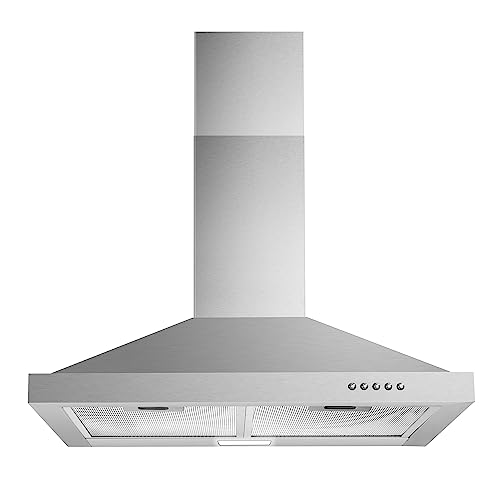
A 36-inch wall-mounted chimney hood is a stronger choice for cooks who fry, grill on a range-top griddle, or routinely use several gas burners together. Zephyr, Faber, Bosch, and Hauslane all sell wall-mounted chimney-style products in various sizes and airflow classes.
For a 30-inch cooktop, a 36-inch hood gives the rising plume more room to spread before it escapes. For a 36-inch cooktop, use a hood at least 36 inches wide; a 42-inch hood can be preferable when there is adequate wall space.
Many chimney hoods advertise 600 CFM or more. That capacity is useful only when the ductwork can support it. A long, narrow, or bend-heavy duct run can make a powerful hood loud while moving less air than expected. Favor a short, smooth, rigid-metal duct with the diameter specified by the manufacturer, commonly 6, 7, or 8 inches.
Best for an island: an island canopy with generous depth
Island cooking is harder to ventilate because there are no upper cabinets or walls to contain the plume. Choose an island hood at least as wide as the cooktop, and consider going 6 inches wider when the kitchen layout permits. A 36-inch island range generally deserves a 36- to 42-inch hood with roughly 600–900 CFM, depending on burner output and cooking habits.
Do not substitute a slim decorative hood with a tiny capture area merely because it matches the kitchen design. Island models need adequate front-to-back depth as well as width. A canopy that extends over the main burner area is often more effective than a narrow, high-airflow model.
CFM: how much airflow does a gas stove need?
A practical starting estimate for a wall-mounted gas range is about 100 CFM per linear foot of cooking surface. This gives a 30-inch range a baseline of approximately 250 CFM and a 36-inch range approximately 300 CFM. That rule is only a starting point: gas burner output, hood type, duct design, and cooking style matter more than the arithmetic alone.
For a powerful professional-style range, use burner output as a second check. A common planning estimate is 1 CFM per 100 BTU of maximum burner output, though local building rules and manufacturer instructions take priority. For example:
- A 30-inch range rated at 50,000 total BTU suggests about 500 CFM for demanding cooking.
- A 36-inch range rated at 75,000 total BTU suggests about 750 CFM.
- A standard 30-inch range used mainly for simmering and boiling may work well with 250–400 CFM.
Above roughly 400 CFM, some homes may require dedicated makeup air or additional ventilation provisions. A kitchen professional or building official can confirm what applies in your area, particularly in a tightly sealed home.
Head-to-head comparison of useful hood types
| Hood type | Typical width | Typical airflow | Noise expectation | Installation difficulty | Typical market range |
|---|---|---|---|---|---|
| Basic under-cabinet | 24–36 inches | 200–400 CFM | About 5–7 sones on high | Low to moderate | $100–$350 |
| Premium under-cabinet | 30–36 inches | 300–600 CFM | About 3–6 sones on high | Moderate | $300–$800 |
| Wall chimney | 30–48 inches | 400–900 CFM | About 3–7 sones on high | Moderate to high | $400–$1,500 |
| Island canopy | 36–60 inches | 500–1,200 CFM | About 4–8 sones on high | High | $700–$2,500 |
| Recirculating convertible | 24–36 inches | 150–400 CFM claimed | Often louder for the airflow achieved | Low | $100–$500 |
Sone figures vary by speed and measurement method, so compare published sound levels at the same airflow rather than choosing the lowest headline number. A hood with a remote blower can place the motor farther from the kitchen and reduce perceived noise, but it costs more and requires a suitable installation path.
Venting options: ducted is better when you can achieve it
A ducted hood exhausts air outdoors and is the preferred option for gas cooking. It removes heat, moisture, odors, and airborne grease instead of passing them through a filter and returning them to the room.
- Wall venting: Usually the shortest route for a wall range and often the quietest, most efficient arrangement.
- Roof venting: Useful when the kitchen is below an attic or roof space, but the run should be planned carefully to limit bends and condensation problems.
- Recirculating operation: Suitable when ducting is impossible, but charcoal filters must be replaced regularly and the system does not remove heat or combustion gases outdoors.
Avoid reducing an 8-inch outlet to a small flexible hose. That restriction increases turbulence and noise. Rigid metal ducting, sealed joints, and an exterior backdraft damper usually produce better real-world results than simply buying a higher-CFM motor.
Installation fit and sizing checklist
- Measure the cooktop: Record its actual width and the distance from the wall or cabinet edge.
- Measure the available hood space: Check cabinet width, ceiling height, chimney clearance, and front-to-back depth.
- Confirm mounting height: Follow the hood manual and range manual. Many installations fall around 24–30 inches above the cooking surface, but gas appliances can require different minimums.
- Trace the duct route: Count bends, measure the route length, and confirm the outlet diameter before purchasing.
- Check electrical requirements: Some higher-capacity hoods need a dedicated circuit or hardwiring rather than a nearby receptacle.
- Plan makeup air: Ask a qualified installer about local requirements when airflow exceeds approximately 400 CFM.
As a fit example, a 30-inch range beneath a 33-inch cabinet opening can accept a 30-inch hood but not necessarily a 36-inch model. If the hood is 30 inches wide and mounted 27 inches above the range, its lower edge should still cover the burner area without interfering with cabinet doors. A wider hood is useful only if the surrounding construction allows the required clearance.
Ownership realities: what wears out first
Grease filters are the first parts to require attention. Wash stainless-steel baffle or mesh filters about monthly during regular cooking, and more often when frying. Dishwasher-safe filters are convenient, but confirm the manufacturer’s instructions because harsh detergent can dull some finishes.
Recirculating hoods also use charcoal filters, commonly replaced every three to six months depending on cooking frequency. A clogged grease filter reduces airflow, increases fan noise, and can leave grease on the cabinet underside. Clean the hood’s exterior with a suitable nonabrasive cleaner, and keep the blower intake free of buildup.
The most common installation mistakes are choosing a hood narrower than the range, using undersized flexible ducting, mounting the hood too high, and assuming a large CFM number compensates for poor capture design. For a gas stove, a correctly sized, externally vented hood with a short duct route is usually a better long-term choice than the most powerful model on the specification sheet.
Final recommendation
Choose a 30-inch ducted under-cabinet hood around 250–400 CFM for a compact kitchen and ordinary cooking. Move to a 36-inch wall chimney hood around 400–600 CFM for frequent frying or searing. For a high-output 36-inch range or an island installation, plan on a deeper canopy and approximately 600–900 CFM, with professional attention to ducting and makeup air. The best range hoods for gas stoves are the ones whose width, capture area, airflow, and duct route match the burners and the room—not simply the ones with the largest advertised motor.





Write Your Review
No reviews yet. Be the first to share your experience!