

Key takeaways
- Ratchet locks: Fast to adjust and convenient for home use. Inspect the teeth, pawl, and release handle for full engagement; never rely on the ratchet’s friction alone.
- Pin locks: A steel pin passes through the post and base. They take longer to adjust but offer a clear physical stop and are often preferred for heavy-duty work.
- Combination locks: Some stands use a ratchet post with a secondary pin or locking tab. This can provide convenience and redundancy, provided both systems are engaged correctly.
Best Jack Stands for Home and Professional Garages
The best jack stands for most home garages are a pair of ratchet-lock stands rated at least 3 tons, with a wide welded-steel base, a height range that fits your vehicle, and a saddle that supports the manufacturer-approved lift points without contacting brake lines, fuel tanks, or body panels.
Choose heavier 6- or 12-ton stands for trucks, vans, commercial vehicles, or frequent shop use. For low sports cars, the critical specification is not the maximum rating but the minimum height and whether the saddle can reach the correct support point after the vehicle is lifted.
Our top picks

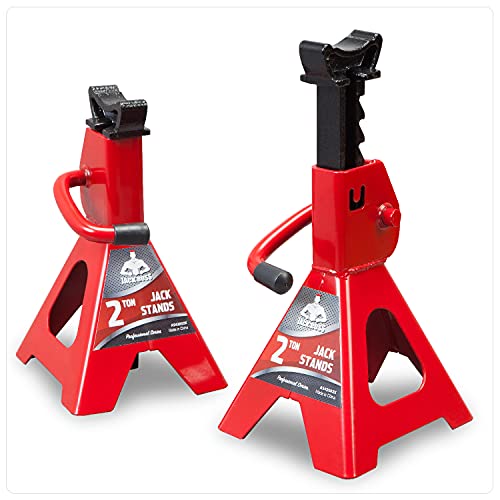


As an Amazon Associate we earn from qualifying purchases at no extra cost to you. Ratings are shown as listed on Amazon.
Best jack stands by situation
| Situation | Best stand type | Useful specifications | Why it fits |
|---|---|---|---|
| Occasional work on a sedan or crossover | 3-ton ratchet-lock pair | 2.8–4.3 in minimum height; 16–25 in maximum height; 12–18 lb per pair | Good reach and manageable storage without excessive cost |
| Low sports car or modified vehicle | Low-profile 3-ton or 6-ton stand | 2.5–3.0 in minimum height; 15–24 in maximum height | Fits beneath low lift points while still providing useful working clearance |
| Pickup truck, SUV, or full-size van | 6-ton ratchet or pin-lock stand | 3.9–5.8 in minimum height; 23–36 in maximum height; 25–45 lb per pair | Greater height and a larger load margin for heavier vehicles |
| Professional garage and frequent service | 6-ton or 12-ton pin-lock stand | Heavy welded base; 4–6 in minimum height; 24–42 in maximum height | More resistant to wear, impacts, and repeated height adjustments |
| Limited storage space | Compact ratchet-lock stand with folding or nesting design | Approximately 10–14 in stored height; 3-ton rating | Easier to keep in a small garage, though stability and locking quality still come first |
These figures describe useful stand classes rather than a guarantee for every product in a category. Always verify the manufacturer’s label, instruction manual, and rating for the exact pair you buy. A “3-ton” label normally refers to the stand’s rated capacity, but buyers should confirm whether that rating is stated per stand or per pair.
What separates a good jack stand from a risky one?
Rated capacity
Capacity is a starting point, not a target. A vehicle’s curb weight is distributed among four wheels, but the load is not divided perfectly when one end is raised, the engine is at one end, or components are removed. Suspension movement and shifting loads also matter.
For a typical 3,200–4,200-pound passenger vehicle, a pair of 3-ton stands is usually the appropriate class when placed at the correct support points. A 6-ton pair provides a larger margin and is better suited to trucks or repeated professional use. Do not use two stands rated at 3 tons each to support a vehicle that exceeds the combined rating, and never support a vehicle with only one stand when the job requires two.
Height range
Measure the distance from the floor to the approved support point before shopping. Then account for the jack’s lifting height and the amount of clearance needed to position the stand. A tall stand is not automatically better: if its minimum height is greater than the available clearance, it cannot be used safely.
For example, suppose a vehicle’s support point is 15 inches above the floor and you want a stand adjusted to 13 inches. A stand with a 2.8–4.3-inch adjustment range is too short, while one with a 12–20-inch range may fit. The latter is useful only if your floor jack can lift the vehicle high enough to place it without overextending the jack or working on an unstable slope.
Locking mechanism
- Ratchet locks: Fast to adjust and convenient for home use. Inspect the teeth, pawl, and release handle for full engagement; never rely on the ratchet’s friction alone.
- Pin locks: A steel pin passes through the post and base. They take longer to adjust but offer a clear physical stop and are often preferred for heavy-duty work.
- Combination locks: Some stands use a ratchet post with a secondary pin or locking tab. This can provide convenience and redundancy, provided both systems are engaged correctly.
Do not substitute a bolt, screwdriver, nail, or improvised rod for the supplied locking pin. A damaged or missing pin is a reason to remove the stand from service, not a minor inconvenience.
Base stability
Look for a broad, symmetrical footprint with four or more legs, fully welded joints, and feet that sit flat on the floor. A wide base resists tipping when the vehicle settles, but it cannot compensate for an uneven, cracked, soft, or contaminated surface.
For home use, a welded steel base is generally a better long-term choice than thin folded material. Professional stands may be heavier and less convenient to move, but that extra mass reduces movement during repeated servicing. Avoid placing stands on loose plywood, stacked boards, concrete blocks, or ramps unless the vehicle manufacturer and stand manufacturer specifically provide a suitable procedure.
Saddle design and vehicle compatibility
A flat saddle suits many frame rails and solid axle housings. A V-shaped saddle can center an axle or tubular frame member, while a padded or contoured saddle may help protect a pinch weld. The wrong shape can crush a seam, slip from a rounded axle, or interfere with a plastic underbody panel.
Check the vehicle service manual for approved support points. Some unibody vehicles require a specific reinforced pinch-weld adapter; others use subframe locations. A saddle should contact a strong structural area, not a thin floor pan, suspension arm that can move, or exhaust component. If the stand’s top is too wide or too narrow for the lift point, use a manufacturer-approved adapter rather than a loose rubber block.
Representative jack stand classes compared
| Stand class | Capacity | Typical height range | Typical construction | Best use |
|---|---|---|---|---|
| Compact passenger-car | 2 tons per pair or less | 10–16 in | Light welded or stamped steel | Light-duty cars only, where the label and support points permit |
| Standard home-garage | 3 tons per stand or pair, depending on labeling | 11–21 in | Welded steel base, ratchet or pin post | Sedans, hatchbacks, crossovers, and routine brake or suspension work |
| Heavy-duty | 6 tons per stand or pair, depending on labeling | 14–24 in | Thicker steel, wide base, ratchet or pin lock | Pickups, SUVs, vans, and higher-frequency work |
| Commercial support | 12 tons per stand or more | 16–30 in or higher | Heavy welded steel, large saddle and locking pin | Commercial vehicles and shop equipment, subject to exact load calculations |
Notable product families and what to look for
Established lines from manufacturers such as ESCO, Hein-Werner, OTC, Sunex, and Torin Big Red cover several of these categories. The right choice depends more on the exact capacity, minimum height, maximum height, saddle shape, and lock design than on the logo. Product specifications can vary substantially within one brand, so compare the individual model’s label and manual rather than assuming all stands from a manufacturer are interchangeable.
For a home mechanic, a standard 3-ton pair with a positive ratchet or pin lock is usually the sensible balance. A low-profile model is preferable for a lowered vehicle. A professional garage should favor heavy welded construction, a pin-secured post or secondary locking system, a large saddle, and a height range that covers the shop’s most common vehicles.
Safe setup: a short procedure that prevents common failures
- Use level, solid ground. Set the transmission in Park or in gear, apply the parking brake, and chock wheels that remain on the ground.
- Lift only at approved points. Consult the owner’s manual or service information. Do not lift from a thin floor pan or an unsupported suspension component.
- Adjust both stands to matching heights. Unequal heights can twist the vehicle or create an unstable load path.
- Engage the lock completely. For a ratchet, confirm the pawl is seated in a tooth. For a pin stand, push the pin fully through the post and base.
- Lower the vehicle slowly onto the stands. Keep the jack lightly supporting the vehicle until you confirm that both saddles are centered and stable; then follow the equipment manufacturer’s guidance about whether the jack should remain nearby as a backup.
- Perform a controlled stability check. From outside the danger zone, apply a gentle push to confirm the stands remain planted. Never climb underneath to test them.
Use a pair of stands on the same axle or the manufacturer-approved support arrangement. A floor jack is for lifting, not for supporting a vehicle while you work beneath it.
Durability, maintenance, and replacement
The locking teeth, pawl, pin, saddle welds, and feet usually deserve the closest inspection. Dirt and rust can prevent full engagement; bent posts can bind; worn teeth can allow unexpected movement. Keep the stands clean and dry, wipe away road salt, and store them indoors where possible. Do not paint over teeth, pins, cracks, or identification labels.
Before every use, check for bent steel, cracked welds, distorted feet, missing hardware, corrosion that reduces material thickness, and a lock that does not engage crisply. Do not repair structural damage by welding unless the manufacturer provides an approved procedure. Replace damaged stands as a pair when their condition or matching height is uncertain.
In general market terms, basic 2-ton and 3-ton pairs cost less than premium low-profile or heavy-duty stands; expect roughly $30–$90 for basic home-garage pairs, $80–$180 for better low-profile or 6-ton designs, and $150–$350 or more for professional-grade equipment. Paying more is worthwhile when it buys the correct height, a stronger base, a verified locking system, or better compatibility—not simply a larger capacity number.
Final buying decision
Choose the lowest-capacity stand that comfortably exceeds your vehicle and working method, the lowest minimum height that fits beneath the vehicle, and a maximum height that reaches the approved support point without excessive jack extension. For most owners, that means a quality 3-ton pair with a broad steel base and positive locking mechanism. Move to 6-ton stands for trucks, SUVs, frequent use, or extra handling margin, and choose pin-lock commercial stands when durability and repeated adjustments matter more than compact storage.

Write Your Review
No reviews yet. Be the first to share your experience!