

Key takeaways
- 12-pin: a versatile choice for small facial areas and controlled movement.
- 16-pin or 18-pin: covers more area per pass but may feel less precise on the nose and around the mouth.
- 36-pin: broader coverage, though it can encourage excessive pressure or repeated passes.
- Nanocartridge: intended for very superficial product application rather than conventional microneedling; do not assume “nano” means interchangeable with needle cartridges.
- Round or flat cartridges: shape and needle arrangement vary by manufacturer, so use only cartridges specified for that pen.
The best microneedling pens for home care are rechargeable, pen-shaped devices with adjustable depth, sealed single-use cartridges, several speed levels, and clear replacement availability; for most beginners, a conservative adjustable pen with 12-pin cartridges is the most practical choice.
Our top picks
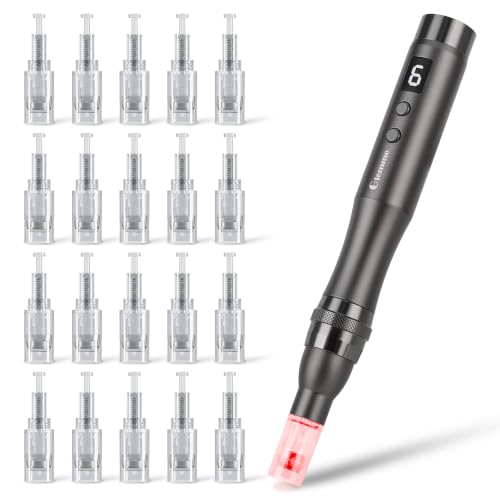


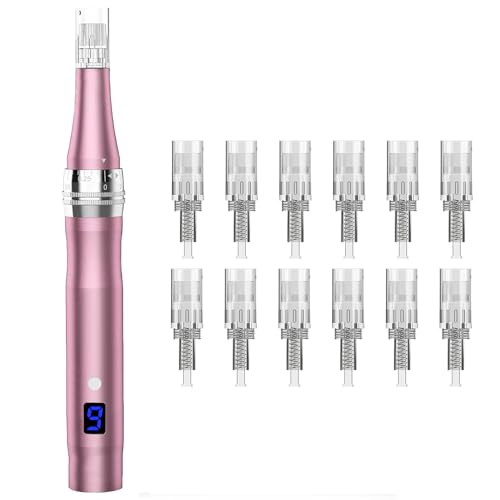
As an Amazon Associate we earn from qualifying purchases at no extra cost to you. Ratings are shown as listed on Amazon.
Quick picks by situation
| Situation | Best fit | Why | Main compromise |
|---|---|---|---|
| Lowest sensible entry cost | Basic rechargeable adjustable pen | Usually offers roughly 0.25–2.0 mm adjustment and 3–6 speeds | More variation in cartridge quality and battery consistency |
| Frequent home use | Dr. Pen M8 or M8S-type system | Broad cartridge availability, adjustable depth, USB-C or rechargeable operation on current versions | Ongoing cartridge expense and counterfeit risk |
| Maximum control | Derminator 2 | Wired power avoids battery fade and allows fine operating control | Less convenient, more expensive, and requires careful handling |
| Professional treatment | SkinPen through a licensed provider | Designed for clinical use with professional protocols | Not a do-it-yourself home device; treatment cost is substantially higher |
Models and bundles change over time, so verify the exact cartridge system, charging connector, included power supply, and replacement source before buying. A device name alone does not guarantee that every listing uses the same specifications.
What to compare before choosing
Needle-depth control
Depth adjustment is more important than a high maximum number. A useful home pen should adjust in small increments, ideally around 0.1 mm, rather than jumping between only two or three settings. A range of approximately 0.25–2.0 mm is common on consumer pens, but a large range does not make deeper settings appropriate for home use.
For cosmetic home care, many users should stay at the shallow end. The appropriate depth depends on the body area, skin condition, cartridge design, and individual risk factors. Deeper penetration increases bleeding, irritation, discoloration, infection risk, and the chance of scarring. Do not use a consumer pen to treat suspected acne scars, active acne, keloid-prone skin, unexplained lesions, or pigmentation disorders without professional advice.
Cartridge type and needle count
Cartridges are the consumable that most directly affects comfort, coverage, and safety. Common configurations include:
- 12-pin: a versatile choice for small facial areas and controlled movement.
- 16-pin or 18-pin: covers more area per pass but may feel less precise on the nose and around the mouth.
- 36-pin: broader coverage, though it can encourage excessive pressure or repeated passes.
- Nanocartridge: intended for very superficial product application rather than conventional microneedling; do not assume “nano” means interchangeable with needle cartridges.
- Round or flat cartridges: shape and needle arrangement vary by manufacturer, so use only cartridges specified for that pen.
Prefer individually sealed, sterile, single-use cartridges with an intact package and a visible expiry date. Never wash and reuse a cartridge. Cleaning cannot reliably restore sterility or guarantee that needles remain straight and undamaged.
Speed settings and motor behavior
Most rechargeable pens provide about 3–6 speed levels. More speed is not automatically better. Lower speeds make it easier to control a small treatment area and are usually preferable around bony contours. Higher speeds can make a pass quicker over larger areas, but they can also produce more heat, vibration, and accidental over-treatment.
Look for a motor that maintains movement when light contact is applied. A pen that stalls, chatters, or changes speed noticeably under pressure is harder to control. The goal is a smooth glide with minimal pressure, not forcing the device into the skin.
Battery life and charging
Typical cordless home pens advertise approximately 2–5 hours of runtime, although actual time depends on speed, cartridge resistance, and battery age. A pen used for a 15-minute session may therefore last several treatments between charges, but lithium-ion batteries gradually lose capacity.
USB-C charging is convenient, but check whether the device can operate while connected. Some products are cordless-only for safety or design reasons. Do not use a device if the battery housing is swollen, unusually hot, cracked, or wet.
Head-to-head: cordless adjustable pens versus wired precision devices
| Feature | Cordless adjustable pen | Wired precision device |
|---|---|---|
| Typical weight | About 80–150 g without charger | About 100–180 g for the handpiece, plus cable or controller |
| Depth range | Often 0.25–2.0 mm | Often approximately 0.2–2.5 mm, depending on model |
| Speed settings | Usually 3–6 | Often variable or finely adjustable |
| Runtime | Roughly 2–5 hours per charge when new | Continuous while powered |
| Cartridge cost | About $2–$8 per sealed cartridge in multipacks | About $3–$12 per cartridge, depending on the proprietary system |
| Best advantage | Portable and uncluttered | Consistent power and no charging interruptions |
| Ownership drawback | Battery eventually loses capacity | Less convenient and more equipment to store and disinfect |
Dr. Pen M8 and M8S-type devices represent the widely available cordless category. They are attractive because replacement cartridges are relatively easy to find and multiple needle configurations are offered. However, sellers may bundle different cartridges, and authenticity and sterility depend on the source. Derminator 2 represents the more control-oriented wired category. Its lack of an internal battery is useful for regular sessions, but its setup is less portable and its compatible consumables must be sourced carefully. SkinPen is a professional system rather than a recommendation for unsupervised home treatment.
Replacement cost: the number that changes the buying decision
Calculate ownership cost rather than comparing the pen price alone:
Cost per session = cartridge cost + disposable preparation costs + device cost divided by expected sessions.
For example, a $120 pen used for 24 sessions contributes $5 per session. Add a $4 sealed cartridge, about $1 for disposable applicators and protective supplies, and the practical total is approximately $10 per session. A cheaper $45 pen used only six times contributes $7.50 per session before cartridges, so the lower purchase price may not save money.
Also budget for replacement cartridges, because the motor is not usually the first part to wear out. Cartridge stock may become unavailable, the charging port may loosen, and the battery may decline after repeated charging cycles. Keep the device dry and do not store it in a humid bathroom.
Safe-use setup and sanitation
- Read the exact manual. Confirm compatible cartridges, charging instructions, depth adjustment, and prohibited areas.
- Inspect the skin. Postpone use over cuts, sunburn, rashes, active breakouts, cold sores, infection, or significant irritation.
- Wash hands and cleanse the area. Remove makeup, sunscreen, oil, and hair products. Use a clean disposable towel or freshly laundered towel.
- Prepare the pen. Wipe the device exterior according to the manufacturer’s instructions, keeping liquid away from the motor and charging port. Do not immerse it.
- Open one cartridge immediately before use. Check that the seal is intact and that the needles are not bent. Attach it without touching the needle surface.
- Start at the lowest practical setting. Use light pressure and short, organized passes. Do not repeatedly work one spot to chase redness or pinpoint bleeding.
- Discard the cartridge immediately. Place it in a suitable sharps container rather than loose household waste where local rules require otherwise.
- Clean the device exterior again. Use only the approved disinfectant method. Never spray liquid into the cartridge socket or motor.
Do not share a pen or cartridge. Avoid applying irritating acids, retinoids, fragranced products, or unverified “growth factor” products immediately afterward unless a qualified professional has given you a specific plan. Follow the device instructions for post-treatment care, protect the area from sun exposure, and stop if pain, swelling, warmth, pus, spreading redness, fever, or prolonged bleeding develops.
Who should get professional guidance first?
Ask a dermatologist or other appropriately licensed clinician before using a microneedling device if you have a history of keloids or poor wound healing, take medication that affects clotting, are immunocompromised, have active skin disease, are pregnant or breastfeeding and have treatment questions, or are considering deeper treatment for scars, wrinkles, or pigmentation. A professional can also determine whether the concern is suitable for microneedling at all.
Bottom line
Choose a cordless adjustable pen such as a Dr. Pen M8 or M8S-type model when portability, cartridge availability, and moderate cost matter most. Choose a wired device such as Derminator 2 when uninterrupted power and control outweigh convenience. For unsupervised beginners, prioritize sealed single-use cartridges, small depth increments, a stable low-speed setting, and transparent replacement costs over maximum speed or maximum depth. The best microneedling pens are the ones you can operate conservatively, sanitize correctly, and continue to support with compatible consumables.


Write Your Review
No reviews yet. Be the first to share your experience!