

Key takeaways
- Foam: Dense foam holds its shape better than very soft fill. A durable, non-flaking coated fabric is easier to wipe than thin upholstery.
- Wood: Look for rounded corners, smooth sanding, non-toxic finishes, and joints that use proper bolts rather than decorative fasteners.
- Metal: Powder-coated steel is generally more resistant to scratches and should have capped ends and protected welds.
- Stability: Wide feet, anti-slip pads, wall anchors where specified, and positive locking pins reduce movement.
- Entrapment protection: Avoid openings that can trap a child’s head, neck, fingers, or clothing. Remove cords and loose straps from the play area.
- Landing surface: Use an appropriate impact-absorbing mat, leaving no gaps where feet can catch. A thin decorative rug is not a safety surface.
Best Indoor Playsets for Small and Large Rooms
The best indoor playsets are compact foam climbers or modular activity sets for small rooms, while larger rooms can accommodate a wooden or metal frame with a slide, climbing wall, and swing without sacrificing a safe landing zone.
Quick picks by room and use
| Room or priority | Best playset type | Recommended footprint | Typical age range | Typical budget |
|---|---|---|---|---|
| Bedroom or apartment corner | Soft foam climber with ramp | 24–40 sq. ft. | 12 months–5 years | $80–$250 |
| Shared family room | Foldable Pikler-style triangle or climbing arch | 20–45 sq. ft. | 18 months–6 years | $120–$350 |
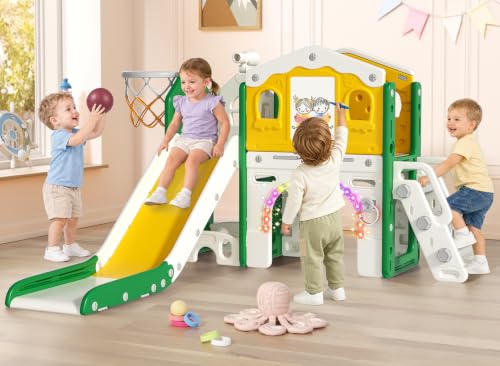
| Dedicated playroom | Wooden indoor gym with slide and climbing panel | 45–80 sq. ft. | 2–7 years | $250–$700 |
| Large basement or activity room | Multi-station frame with swing, slide, and monkey bars | 80–140 sq. ft. | 3–8 years | $500–$1,500+ |
These are planning ranges rather than guarantees. Always use the manufacturer’s stated dimensions, age rating, and weight limit before buying. A playset’s advertised footprint usually excludes the clearance needed in front of a slide or beneath a swing.
Our top picks


As an Amazon Associate we earn from qualifying purchases at no extra cost to you. Ratings are shown as listed on Amazon.
Best indoor playsets for small rooms
1. Modular foam climbers: best for apartments and young toddlers
A soft play set made from separate foam blocks is the easiest option when floor space is limited. A common arrangement uses a ramp, wedge, step, and rectangular block in an area about 4 by 6 feet. The pieces can then be stacked or moved against a wall when the room is needed for another activity.
Look for high-density foam, a wipeable coated cover, concealed zippers, and covers that can be removed for washing. Foam climbers are usually most useful from roughly 12 months through 4 or 5 years, but the correct age depends on the height of each piece and the child’s coordination. They are not a substitute for a crib, and they should not be used for unsupervised sleep.
Brands such as ECR4Kids sell SoftZone-style foam play equipment for classrooms and homes. Similar products vary considerably in foam firmness and cover quality, so check the assembled dimensions and the manufacturer’s cleaning instructions rather than judging by photographs.
2. Foldable wooden climbers: best for active toddlers in a narrow footprint
A Pikler-style triangle, climbing arch, or folding indoor gym gives children a more challenging climbing activity than a low foam set. Many occupy approximately 3 by 4 feet when positioned for climbing, although a connected ramp or slide can extend the length to 6 feet or more.
These sets work well in a small room because they offer vertical activity without requiring a permanent frame. Choose rounded edges, closely spaced rungs, a stable locking mechanism, and rubber or felt feet that will not slide across hard flooring. A foldable product is only useful if it can be folded safely; do not leave a hinge partly engaged or allow children to move the equipment while climbing.
Best indoor playsets for large rooms
3. Wooden indoor gyms: best balance of activities and durability
A wooden indoor gym with a low platform, climbing wall, ladder, and slide is a strong choice for a dedicated playroom. A typical unit measures about 6–8 feet long, 4–6 feet deep, and 5–7 feet high. It usually provides more varied play than a single-purpose climber while remaining quieter than a metal frame.
Wood construction can last for years, but only when the joints remain tight and the finish is protected from moisture. Inspect the frame monthly during heavy use. Wood can also develop splinters if the surface is poorly sanded or repeatedly struck against a wall, so examine exposed edges after assembly and whenever the set is moved.
4. Multi-station indoor frames: best for siblings and frequent use
Large metal or reinforced-wood systems may combine a swing, trapeze bar, climbing ladder, monkey bars, slide, and gym rings. They are appropriate only when the room can accommodate the equipment plus a generous fall and swing zone. A frame measuring 8 by 10 feet may need at least 12 by 14 feet of usable clear space after accounting for movement.
These playsets suit families with several children or children who use the equipment daily. Their disadvantages are substantial: assembly can take several hours, the frame may need anchoring, and hanging accessories impose forces that are much greater than a child’s static body weight. Follow the instructions for each accessory rather than assuming that a frame’s overall weight limit applies to every station.
How to match a playset to your room
- Measure the usable floor, not the whole room. Exclude sofas, radiators, low shelves, doors, aquarium stands, and walkways. Record the lowest ceiling height, including light fixtures.
- Add activity clearance. Allow at least 2 feet beyond the end of a low slide. For a swing or trapeze, follow the manufacturer’s clearance requirement; 6 feet or more in the direction of travel is common for larger equipment.
- Mark the proposed footprint with painter’s tape. Leave it in place for a day. This reveals whether drawers, doors, and walking routes still work.
- Check the floor. A level, solid surface is preferable. Thick play mats can reduce impact but may make some frames unstable unless the manufacturer approves their use.
- Measure the delivery route. A playset that fits the room may not fit through a staircase, doorway, or tight hallway once boxed.
Decision matrix: which type fits your situation?
| Your situation | Recommended choice | Why | Trade-off |
|---|---|---|---|
| Under 50 sq. ft. and frequent rearranging | Modular foam set | Light, quiet, and easy to store | Outgrown sooner; covers may wear |
| Under 50 sq. ft. and climbing is the priority | Foldable triangle or arch | Uses height efficiently | Requires closer supervision |
| 50–90 sq. ft. and one or two children | Wooden gym with slide | Good activity variety and moderate noise | Not quick to move after assembly |
| Over 90 sq. ft. and daily group use | Multi-station frame | Supports several types of play | Highest cost, clearance, and assembly demands |
Age, weight, and activity limits matter more than height
Age labels are a starting point, not a measure of readiness. A two-year-old who can climb confidently may still lack the judgment required for a high platform or swinging accessory. Check the minimum age for every attachment, including rings, ropes, ladders, and slides.
Weight limits should be read by station. A set might support 150 pounds overall but limit a swing to 50 pounds or a climbing wall to one child at a time. Do not add children’s weights together and assume the structure is safe. Adult use is also prohibited unless the instructions specifically permit it; an adult’s dynamic movement can stress joints and anchor points far beyond the listed child capacity.
Materials and safety features to prioritize
- Foam: Dense foam holds its shape better than very soft fill. A durable, non-flaking coated fabric is easier to wipe than thin upholstery.
- Wood: Look for rounded corners, smooth sanding, non-toxic finishes, and joints that use proper bolts rather than decorative fasteners.
- Metal: Powder-coated steel is generally more resistant to scratches and should have capped ends and protected welds.
- Stability: Wide feet, anti-slip pads, wall anchors where specified, and positive locking pins reduce movement.
- Entrapment protection: Avoid openings that can trap a child’s head, neck, fingers, or clothing. Remove cords and loose straps from the play area.
- Landing surface: Use an appropriate impact-absorbing mat, leaving no gaps where feet can catch. A thin decorative rug is not a safety surface.
Assembly and ownership realities
Assembly time commonly ranges from 30–60 minutes for a foam set, 1–3 hours for a small wooden climber, and 3–6 hours for a multi-station frame. A second adult is often useful for holding panels square while bolts are installed. Tighten fasteners only after the frame is aligned, then recheck them after the first few uses.
A worked space calculation illustrates why product dimensions can mislead. Suppose a slide-equipped climber is 7 feet long and requires 2 feet of landing clearance. A room with only 8 feet of uninterrupted length cannot safely accommodate it, even though the listed footprint appears to fit. The usable requirement is at least 9 feet, before adding side clearance and a route around the equipment.
The parts most likely to wear first are foam covers at seams, slide entry edges, swing ropes, rubber feet, and fasteners that loosen through vibration. Vacuum or wipe foam covers according to their care label, clean wood with a lightly damp cloth rather than soaking it, and inspect hanging hardware before every session. Keep replacement pads, covers, and bolts available when the manufacturer sells them; proprietary parts can be difficult to match later.
Final buying recommendation
Choose a modular foam set when portability and a small footprint matter most. Choose a foldable wooden climber when vertical movement is the priority. For a dedicated playroom, a wooden gym with a slide offers the best balance of variety, noise, and longevity. Select a multi-station frame only when you can provide its full clearance zone, anchor it as directed, and commit to regular inspections. The safest choice is the one that fits the room with space left over, not the largest playset that can technically be squeezed inside.

Write Your Review
No reviews yet. Be the first to share your experience!