

Key takeaways
- The best aquarium fish food for goldfish, from floating flakes to sinking pellets. Five picks for fancy and common goldfish, with sizes and feeding tips.
- Top Pick: Tetra Goldfish Flakes, 7.06 oz
- Runner-up: Hikari Sinking Goldfish Excel, 3.8 oz
- Also consider: Aqueon Goldfish Flakes, 7.12 oz
Goldfish are enthusiastic eaters, and they will take food from the surface, from mid-water, or from the bottom of the tank. That flexibility makes choosing a food sound simple, but the wrong form can cause real problems. A round-bodied fancy goldfish that gulps air while chasing floating flakes is more likely to struggle with buoyancy, while a slim comet may ignore a pellet that sinks past it. The best food matches the fish in front of you.
This guide compares five widely available goldfish foods in budget, mid-range, and premium tiers. Each pick states its form, whether it floats or sinks, the goldfish type it suits, the pellet size, and the exact pack size.
As an Amazon Associate, we earn from qualifying purchases.
Quick answer
For most keepers, floating flakes suit common and comet goldfish, while sinking pellets suit fancy goldfish that gulp air at the surface. If you keep one food on hand, choose a sinking pellet in a small size for fancies or a flake for commons. The five foods below cover both forms, several pack sizes, and budget, mid-range, and premium tiers.
The five picks at a glance
| Food | Form | Floats or sinks | Best for | Tier |
|---|---|---|---|---|
| Tetra Goldfish Flakes, 7.06 oz | Flakes | Floating | Everyday feeding | Budget |
| Hikari Sinking Goldfish Excel, 3.8 oz | Baby pellets | Sinking | Fancy goldfish | Premium |
| Aqueon Goldfish Flakes, 7.12 oz | Flakes | Floating | Common goldfish | Budget |
| Aqueon Goldfish Slow Sinking Granules, 5.8 oz | Granules | Slow sinking | Mixed tanks | Mid-range |
| API Goldfish Pellets, 7 oz | Pellets | Sinking | Adult fancies | Mid-range |
Tetra Goldfish Flakes, 7.06 oz

ASIN: B000R9WRIC
Tetra Goldfish Flakes are a nutritionally complete daily diet for all goldfish and small koi, sold here in a 7.06 oz jar. The flakes are enriched with vitamin C and carry the patented ProCare blend of immunostimulants, vitamins, biotin, and omega-3 fatty acids for immune support.
As a flake food, this pick is offered at the surface, which makes it easy to watch how much your fish eat. The flakes break into small pieces, so even modestly sized goldfish can take a mouthful without struggling. It is a budget-tier everyday flake for commons, comets, and mixed tanks.
The main limitation is the form itself. Because the flakes float, fancy goldfish feeding greedily at the surface can gulp air, a known trigger for buoyancy trouble. If your oranda or fantail floats awkwardly after meals, choose a sinking food instead. Tetra sells several jar sizes, each with its own listing; this is the single 7.06 oz jar.
Hikari Sinking Goldfish Excel, 3.8 oz

ASIN: B013Y1A4I4
Hikari Sinking Goldfish Excel is a premium sinking pellet for goldfish and baby koi, sold here as a 3.8 oz, or 110 g, pack of baby pellets. The formula contains higher levels of pure-cultured spirulina and carefully selected carotenoids to bring out the vibrant colours of goldfish. The ingredient list includes fish meal, wheat flour, spirulina, wheat germ meal, garlic, and astaxanthin.
The sinking form is the point of this pick. Fancy goldfish feed naturally below the surface, and a pellet that drops through the water lets them eat without gulping air at the top. The baby-pellet size suits smaller mouths and younger fish, so it works well for juveniles and smaller fancy varieties.
The trade-off is the pack size. At 3.8 oz, the jar is the smallest in this guide, and a tank with several adult goldfish will work through it quickly. Anything reaching the gravel uneaten should be siphoned out rather than left to decay.
Aqueon Goldfish Flakes, 7.12 oz

ASIN: B00176GUUU
Aqueon Goldfish Flakes are a floating flake food for common goldfish, fancy orandas, and koi, sold here in a 7.12 oz jar. The ingredient list includes whole fish meal, wheat flour, shrimp meal, spirulina, kelp, spinach, and astaxanthin, and the formula is described as using natural ingredients and colours with added vitamins, minerals, and trace nutrients.
This is a straightforward everyday flake in a generous jar, and it is the pick for keepers with common or comet goldfish who go through a lot of food. A large jar makes sense in a pond or a tank with several active fish, and the budget tier keeps a daily staple affordable.
The same floating-form caveat applies as with any flake. Fancy goldfish that gulp at the surface may take in air, so if buoyancy is already a concern, pair this with a sinking food or switch to one. Aqueon also sells these flakes in a smaller 2.29 oz jar, a different listing. The product described here is the 7.12 oz jar.
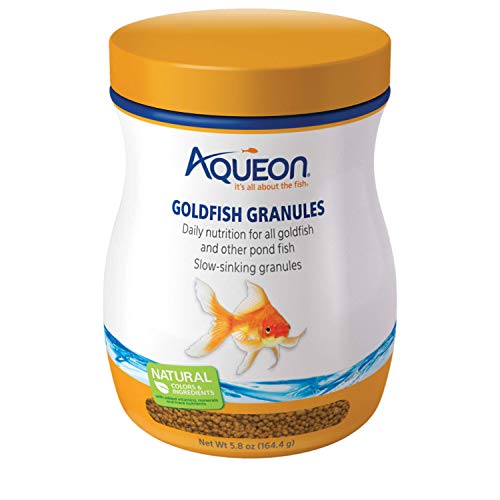
Aqueon Goldfish Slow Sinking Granules, 5.8 oz
ASIN: B00176GXOI
Aqueon Goldfish Slow Sinking Granules are a mid-range food for common goldfish, fancy orandas, and koi, sold here in a 5.8 oz container. The granules are about 1.5 mm across, and they sink slowly rather than dropping straight to the bottom. That slow descent lets mid-water fish reach the food before it settles.
This is the pick for keepers who want the benefits of a sinking food without committing to pellets. It suits fancy goldfish especially well, since they can feed below the surface and take in less air, and it also suits mixed tanks where fish feed at different depths. The listing states that the granules will not cloud the water when fed as directed.
The main limitation is portion control. Small granules are easy to overfeed, because a pinch looks like very little food, and uneaten granules that settle into the gravel will foul the water if they are not removed. Start with a small pinch, watch how quickly it disappears, and add more only if the fish clear it promptly.
API Goldfish Pellets, 7 oz

ASIN: B005XDCMYG
API Goldfish Pellets are a sinking pellet food sold here in a 7 oz container, the Large size in the API range, model 833C. The listing describes a complete and balanced diet for all goldfish types, including Shubunkins, Lionheads, and Fantails, built around optimal protein sinking pellets. The formula includes spirulina to enhance vibrant colours, garlic for appetite appeal, and brewers dried yeast for essential micronutrients.
The pellets sink to the bottom, where larger goldfish naturally look for food, which makes this a good choice for adult fancy goldfish. The feeding guidance on the listing is to feed twice a day, offering only as much as the fish will eat within two to three minutes. That short window matters, since goldfish keep eating long after they have had enough.
This is the pick for keepers of adult fancy goldfish, especially Shubunkins, Lionheads, and Fantails, who prefer pellets over flakes and want a mid-range daily staple. Despite the Large size label, which refers to the container size in the API range, the pellets themselves are small and quick sinking, so they suit a wide range of mouth sizes. Feed in small amounts and siphon out anything left after a few minutes.
How to choose
Start with the shape of your fish. Slim-bodied common goldfish, comets, and Shubunkins feed happily at the surface, so floating flakes suit them. Round-bodied fancy goldfish, including orandas, ranchus, fantails, and lionheads, are more prone to buoyancy problems, so a sinking pellet or slow-sinking granule is usually the safer daily food.
Next, match the food size to the mouth in front of you. Fry and juveniles need baby pellets or fine granules, while adults can handle standard pellets and larger flakes. An oversized pellet gets spat out and left to rot, and a flake that is too fine drifts away before shy fish reach it.
Read the ingredient list rather than the front of the pack. Look for named protein sources early, such as whole fish meal or shrimp meal, alongside plant matter such as spirulina, wheat germ, kelp, or spinach. Goldfish are omnivores, so a diet built only on grain fillers is a poor daily staple. Carotenoids such as spirulina and astaxanthin support the colour a fish already has, but they cannot change its genetics.
Finally, buy the pack size you will actually finish. Dry food loses freshness once opened, and a bulk jar open for a year is worse than a small jar replaced regularly. Store the container sealed, cool, and dry, away from the humidity above the tank.
Who should skip
Skip floating flakes if your fancy goldfish already shows buoyancy trouble after meals. A fish that floats nose-up, struggles to stay down, or rests on its side after eating is telling you that surface feeding is not working. Switch to a sinking pellet or a slow-sinking granule.
Skip large pellets if you keep fry or very young goldfish. Small mouths cannot manage a standard pellet, and uneaten pieces sink and decay. Choose a baby pellet or a fine granule until the fish are large enough to take a bigger bite.
Skip bulk jars if you keep a single goldfish in a small tank. A large container that takes a year to finish will be stale long before it is empty. Buy the smallest pack that covers a few months, and check the pack size before ordering, since the same food in a different bag size is a different listing.
FAQ
Should goldfish eat floating or sinking food?
Common goldfish, comets, and Shubunkins feed happily at the surface, so floating flakes suit them. Fancy goldfish, including orandas, ranchus, fantails, and lionheads, are more prone to gulping air at the surface, which can lead to buoyancy problems. For fancies, a sinking pellet or slow-sinking granule is usually better.
How much should I feed my goldfish each day?
Feed small amounts twice a day, offering only as much as the fish will finish within two to three minutes. Goldfish will keep eating well beyond what they need, so appetite is a poor guide to portion size. Remove anything left uneaten after a few minutes.
Do colour-enhancing foods really work?
Colour-enhancing ingredients such as spirulina, astaxanthin, and marigold extract support the colour a goldfish already has, and they can help a healthy fish show stronger reds and oranges. They cannot change the fish’s genetics or restore colour lost to illness or poor water.
How long does an opened container of goldfish food last?
An opened container should be used within a few months and kept sealed, cool, and dry. Dry food loses nutritional value once exposed to air and humidity, and a container above a warm, humid tank ages faster. Buy the pack size you will finish in that window.
Final verdict
For most keepers, the best starting point is a sinking food for fancy goldfish and a floating flake for commons. The Hikari Sinking Goldfish Excel is the strongest choice for fancies where colour and a sinking form matter most, while the Aqueon slow-sinking granules are a versatile mid-range alternative. The API pellets suit adult fancies such as Lionheads and Fantails.
If you keep common goldfish or comets, the Tetra flakes are a reliable everyday staple, and the Aqueon flakes are the better buy when you want a larger jar. Match the form to your fish, the pellet size to the mouth, and feed small amounts twice a day.
More from Amazon
Programs that pair well with the guide above. Offers and eligibility are set by Amazon and may change.
Set up recurring deliveries of everyday items on eligible products. Terms and savings are set by Amazon.
Explore Subscribe & SaveFree shipping on eligible items, Prime Video and more. Eligible new members can start with a free trial.
Start a Prime free trialAudiobooks and podcasts to listen to on the go. Eligible new members can start with a free trial.
Try Audible freeRead from a large library of eBooks and audiobooks on any device. Check Amazon for current plans.
Explore Kindle UnlimitedAs an Amazon Associate we earn from qualifying purchases.
Write Your Review
No reviews yet. Be the first to share your experience!