

Key takeaways
- Compare the best algae magnets by glass thickness, blade type and float design to keep aquarium glass clean without scratching or wet hands.
Disclosure: As an Amazon Associate, I earn from qualifying purchases.
An algae magnet is the tool most keepers reach for most often. Green dust algae forms on the viewing pane within days in almost every lit tank, and if left, it hardens into green spot algae a wipe no longer removes. A magnetic cleaner lets you wipe film in a minute or two from outside the tank, without wet hands or disturbing fish. Used little and often, it stops soft film becoming a stubborn crust.
Algae magnets are not interchangeable. Magnet strength is matched to glass thickness, deciding whether a cleaner glides firmly, slips off, or clamps so hard it scratches. Pad and blade material decides acrylic safety, and technique near the substrate decides whether it cleans or scratches. This guide explains those choices, then compares five magnets for nano tanks, standard glass, acrylic, and thicker panes.
How to Choose an Algae Magnet
Start with glass thickness, not tank volume. A magnet too weak will feel vague, skip film, and detach at corners. A magnet too strong for thin glass clamps hard, is tiring to slide, and presses trapped sand into the pane. Match the rating to your pane, and if between sizes, follow maker guidance rather than sizing up.
Next, separate scrubbing from scraping. A hook-and-loop pad is excellent for soft film, green dust, and diatom smears, and is right for weekly upkeep. It will not remove mature green spot or coralline algae. For those you need a blade: stainless steel for glass, plastic for acrylic and near silicone. Some cleaners combine pad and blade in one flipping body. If you only grow soft film, a pad-only magnet is simpler and safer; if you get hard spots, buy a blade model instead of pressing harder with a pad.
Acrylic needs special care. It is far softer than glass, and a glass-only pad or blade can leave fine scratches permanently. For acrylic, choose an explicitly acrylic-rated cleaner, use only plastic blades or acrylic-safe pads, and inspect the pad before every use. Even on glass, never drag grit: most scratches come from sand picked up near the bottom and dragged upward. Work top to bottom, stop above the substrate, and rinse the wet side before and after use.
Floating versus sinking also matters. A floating inner half rises when it detaches, so you can retrieve it without it tumbling through substrate picking up grit. A weighted half drops, but retrieval is wetter and needs a rinse. For most home tanks, floating is more forgiving. Size matters too: large magnets clean fast but cannot reach silicone or corners, while small magnets are precise in nano tanks. Replace worn pads and nicked blades; a worn pad smears and a nicked blade can gouge.
1. FLIPPER Standard Magnetic Aquarium Glass Cleaner

The FLIPPER Standard is the best-known flip-design cleaner: one side scrubs, the other scrapes, and you switch by rotating the outer handle so the inner half flips on the glass. Film and hard spots are handled in one pass, without reaching in. It is rated for 1/4 to 1/2 inch panes and uses rare-earth magnets to hold through that thickness.
Specs
- Rated glass thickness: 1/4 to 1/2 inch (about 6 to 12 mm)
- Cleaning surfaces: scrubber pad on one side, stainless steel blade on the other
- Magnet type: rare-earth magnets for firm hold on thicker panes
- Design: flip-in-place 2-in-1 body, operated from outside the tank
- Tank material: glass (keep blade away from silicone seams)
For tanks that grow both film and green spot algae, this is the most complete single tool here. The blade does work a pad cannot. The flip takes practice: move the outer half away, rotate it, and let the inner half roll over rather than forcing it.
Pros:
– Pad and blade in one tool, no swapping mid-clean
– Strong hold on glass up to 1/2 inch thick
– Blade removes green spot algae pads leave behind
– Works entirely from outside, hands stay dry
Cons:
– Too strong and large for thin nano glass
– Flip technique needs practice
– Steel blade must be kept away from silicone seams
Who it suits: Keepers of mid-size glass tanks with 1/4 to 1/2 inch panes who get hard spots as well as film and want one tool for both jobs.
2. Mag-Float Small Glass Aquarium Cleaner

The Mag-Float Small is the classic floating pad cleaner in its smallest glass size. The inner half floats, so if it detaches it rises instead of sinking into substrate. The design is simple: felt on the dry side, a scrubbing pad on the wet side, and magnets sized for thin glass.
Specs
- Rated use: small glass aquariums, commonly up to about 30 gallons
- Cleaning surface: scrubbing pad for soft film and dust algae
- Retrieval: floating inner half rises if detached
- Magnet type: encapsulated magnets matched to thin glass
- Tank material: glass version (separate acrylic versions exist — check listing)
This is a daily-upkeep tool. A quick pass every few days keeps the front pane clear and prevents film maturing. It will not scrape green spot algae; pair it with an occasional hand scraper for spots. Because it floats, it is a good first magnet for beginners learning corner speed.
Pros:
– Floats for easy, dry retrieval
– Simple, durable pad design with no blades to manage
– Well matched to thin glass on small tanks
– Encourages the little-and-often routine that works best
Cons:
– Pad only — no blade for hard spot algae
– Too small and weak for thicker panes
– Pad wears over time and performance fades gradually
Who it suits: Beginners and nano-to-small glass tank keepers who want an easy floating cleaner for regular film removal, and who will handle occasional hard spots with a separate hand tool.
3. Aqueon Algae Cleaning Magnet, Medium
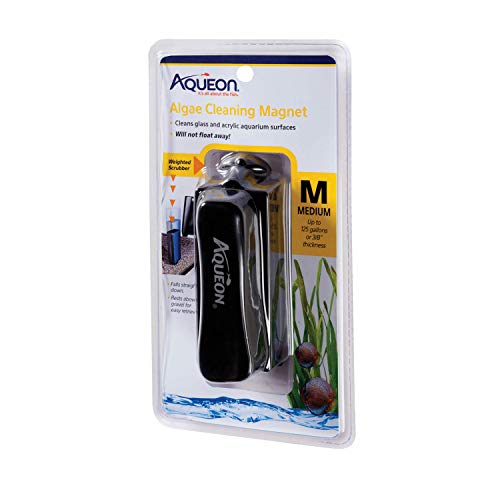
The Aqueon medium magnet is one of few cleaners explicitly sold for both glass and acrylic in one model, making it practical for acrylic or mixed tanks. It uses a pad rather than a blade, and its weighted inner half helps it stay in place and doubles as a hand-held scrubber.
Specs
- Rated use: medium aquariums, glass or acrylic
- Cleaning surface: pad scrubber, acrylic-safe when clean and grit-free
- Inner half: weighted design, sinks rather than floats
- Magnet type: standard-strength pair for small-to-medium panes
- Tank material: glass and acrylic (confirm size on listing)
The acrylic rating comes with a condition: safety depends on a clean pad. A pad carrying sand will scratch acrylic regardless of rating, so rinse and inspect before every use and stay above the substrate. The weighted half feels planted, but when it detaches it drops, so rinse it before it touches the pane again.
Pros:
– Rated for both glass and acrylic in one model
– Weighted inner half can be used as a hand scrubber
– Straightforward pad design, easy for beginners
– Widely available in several sizes
Cons:
– Sinking inner half is harder to retrieve and must be rinsed after a fall
– Pad only, so hard algae needs a separate plastic blade tool
– Standard strength is not enough for thick glass
Who it suits: Acrylic tank owners, and keepers with both glass and acrylic tanks, who want one pad cleaner safe across materials and are disciplined about rinsing the pad and staying clear of substrate.
4. fishkeeper Aquarium Magnetic Glass Cleaner, Medium

The fishkeeper medium cleaner combines a floating scrubber with two detachable scrapers. The scrubber handles daily film, and the snap-on scrapers tackle harder growth if you miss a week or two. The inner half floats, so detachment during slower blade work is easy to recover from.
Specs
- Rated use: medium glass aquariums (check thickness range on listing)
- Cleaning surfaces: scrubber pad plus 2 detachable scrapers
- Retrieval: floating inner half
- Scraper use: interchangeable attachments for harder algae
- Tank material: glass (use only suitable scraper material on acrylic)
Having scrapers included matters because hard algae is where many keepers give up on magnets. Use slow strokes, keep the blade flat, and stop if you feel grit. Scrapers also remove for pad-only work near plants and seams.
Pros:
– Scrubber plus two scrapers covers film and hard algae
– Floating design makes blade-work detachments painless
– Attachments remove for gentle pad-only cleaning
– Good step up from a basic pad magnet
Cons:
– Attachments are small parts that are easy to misplace
– Blade work is slower than pad wiping
– Must confirm glass thickness rating before buying
Who it suits: Keepers of medium glass tanks who outgrew a pad-only magnet because of green spot algae, and who want scraping ability and floating retrieval in one mid-size tool.
5. AQUANEAT Aquarium Magnetic Brush

The AQUANEAT magnetic brush is a compact, glass-only cleaner for small tanks and tight spaces. Its small footprint fits between plants and glass, works closer to corners than a large magnet, and is easy to steer in nano tanks where a full-size cleaner would be clumsy and over-strong.
Specs
- Rated use: small glass fish tanks
- Cleaning surface: brush-style scrubber pad for film algae
- Tank material: glass only — not for acrylic or plastic tanks
- Design: compact two-part magnet, outer handle and inner scrubber
- Best pane type: thin glass on nano and small aquariums
This is a precision tool, not a whole-tank workhorse. On a nano tank that is right: panes are small, scape is close to glass, and control matters more than coverage. On a large tank it would be slow. It is strictly glass-only; the listing is explicit it is not for acrylic or plastic.
Pros:
– Compact size reaches corners and tight planted areas
– Appropriately gentle strength for thin nano glass
– Simple pad design, easy to control
– Useful second magnet alongside a larger cleaner
Cons:
– Glass only — not safe for acrylic or plastic tanks
– Too small for efficient cleaning of large panes
– Pad only, no blade for hard algae
Who it suits: Nano and small glass tank owners, and planted-tank keepers who need a small magnet for corners and around aquascaping, rather than a large cleaner for open panes.
Comparison Table
| Product | Best for | Pane / material | Blade | Floats |
|---|---|---|---|---|
| FLIPPER Standard | Film plus hard spots | Glass 1/4 to 1/2 in | Yes, stainless | No (flip design) |
| Mag-Float Small | Daily film on small tanks | Small glass tanks | No | Yes |
| Aqueon Medium | Glass and acrylic tanks | Glass / acrylic, medium | No | No, weighted |
| fishkeeper Medium | Film plus scraping, medium tanks | Glass, medium | Yes, 2 detachable | Yes |
| AQUANEAT Brush | Nano tanks and corners | Small glass only | No | Check listing |
FAQ
How do I stop an algae magnet from scratching my tank?
Scratches almost always come from grit under the pad, not the pad itself. Rinse and inspect the wet side before and after use, work top to bottom, stop above the substrate, and never drag it through sand. If the inner half falls into substrate, rinse it before returning it to glass. On acrylic, use only acrylic-rated pads and plastic blades.
What size algae magnet do I need for my glass thickness?
Match the manufacturer rating to your pane thickness in inches or millimetres, not to tank volume. Too weak and it slips and skips; too strong and it clamps, tires your hand, and presses grit into the pane. If you are between sizes, follow maker guidance instead of automatically choosing the stronger one.
Can one algae magnet work on both glass and acrylic?
Only if it is explicitly rated for both, like the Aqueon in this guide, and only with a clean pad. Many magnets are glass-only, and their pads or steel blades will scratch acrylic. For acrylic, use acrylic-rated pads and plastic blades only, and be extra strict about keeping grit off the surface.
Why does my magnet leave algae behind in streaks?
Streaks usually mean algae has hardened beyond a pad, the pad is worn smooth, or the magnet is too weak and not pressing evenly. Hard spot or coralline algae needs a blade — steel on glass, plastic on acrylic. If a blade also streaks, check for nicks and replace worn parts.
Conclusion
The best algae magnet matches pane thickness and algae type. For mid-size glass tanks with film and hard spots, the FLIPPER Standard covers both jobs. For small tanks and daily upkeep, the Mag-Float Small is the floating classic. Acrylic owners should choose the Aqueon Medium. The fishkeeper Medium adds detachable scrapers and floating retrieval, while the AQUANEAT Brush is the option for nano tanks and corners. Use them little and often, keep pads clean, and stay above substrate.
More from Amazon
Programs that pair well with the guide above. Offers and eligibility are set by Amazon and may change.
Set up recurring deliveries of everyday items on eligible products. Terms and savings are set by Amazon.
Explore Subscribe & SaveFree shipping on eligible items, Prime Video and more. Eligible new members can start with a free trial.
Start a Prime free trialAudiobooks and podcasts to listen to on the go. Eligible new members can start with a free trial.
Try Audible freeRead from a large library of eBooks and audiobooks on any device. Check Amazon for current plans.
Explore Kindle UnlimitedAs an Amazon Associate we earn from qualifying purchases.


Write Your Review
No reviews yet. Be the first to share your experience!