

Key takeaways
- Compare the best tropical fish food for community tanks, from insect-based granules to micro pellets and flakes, with honest feeding and freshness tips.
Disclosure: As an Amazon Associate, I earn from qualifying purchases.
A community tank is a compromise at feeding time. Tetras nip at the surface, corydoras wait for whatever reaches the gravel, and the fastest fish would happily eat everyone’s share. The best tropical fish food is not the one with the boldest claim on the tub. It is the one whose size, sink rate and ingredient list match the mouths you actually keep, and that you can feed in small amounts without fouling the water.
This guide compares five widely available staple foods for tropical community tanks: an insect-based granule, a micro pellet for small mouths, the classic flake, a premium sinking pellet and a whole-seafood color flake. Each entry lists the format, the fish it suits and the trade-offs the label does not mention.
One warning before the list: more fish are harmed by too much food than by the wrong brand. Uneaten food decays into ammonia, and in a small tank that process is fast. Portion control matters as much as brand choice.
How to Choose Tropical Fish Food
Start with mouth size and feeding level. Flakes and floating foods serve top and mid-water feeders such as tetras, guppies and danios. Bottom feeders need food that actually sinks, in a size they can mouth. A granule perfect for a neon tetra is invisible to a larger barb, and a 3 mm pellet frustrates small mouths. Match particle size to the smallest fish you expect to eat it, and crush flakes for fry or nano species.
Read the first ingredients, not the front of the tub. Whole named proteins — whole salmon, Antarctic krill, black soldier fly larvae, whole menhaden fish — tell you more than vague terms like “fish meal” alone, and far more than a formula led by wheat or soy fillers. Fish use terrestrial starch poorly, so a food led by aquatic proteins and algae is usually the better buy. Almost every dry food uses some binder, so judge the overall list rather than one ingredient.
Check the protein level for your stock. Most tropical community fish do well on a staple in the mid-30s to mid-40s percent protein range, as printed in the guaranteed analysis. Growing fish and active species sit at the higher end; herbivore-leaning fish need less protein and more plant matter. Dedicated algae eaters need their own wafers — a tropical staple is not a pleco diet.
Treat freshness as a spec. Dry fish food loses vitamin potency once opened, and fats can go rancid. Buy a size your tank will finish in roughly one to two months, note the expiry date before you buy, and store the tub sealed, cool and dry — not on the warm, humid tank hood. A giant bargain tub that takes a year to finish is no bargain if the last half is stale.
Plan a rotation, not a single perfect food. Two or three staples in rotation, plus a weekly frozen or freeze-dried treat, cover nutritional gaps better than any one formula.
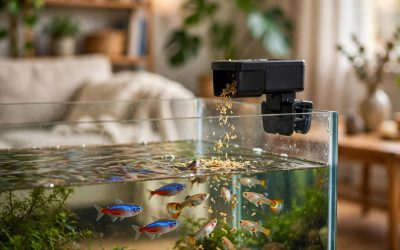
Feed less than the label suggests. Offer only what the fish clear in about two minutes, once or twice a day, and siphon what lands uneaten. If algae is booming and the filter clogs fast, overfeeding is the first suspect.
The 5 Best Tropical Fish Foods
1. Fluval Bug Bites Tropical Fish Food, Small Granules
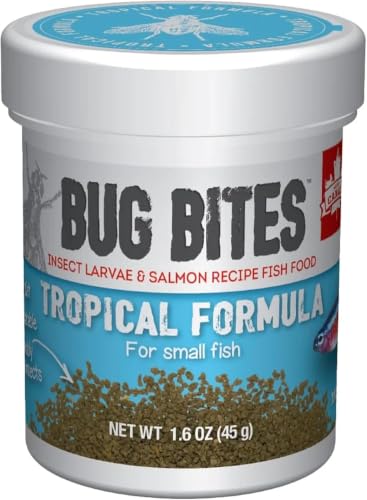
Fluval’s Bug Bites line is built around black soldier fly larvae, an insect protein closer to what many tropical fish eat in the wild than a grain-led formula. The tropical small granules are aimed at small to medium fish and sink slowly, giving mid-water feeders time to intercept them.
Specs
- Format: Slow-sinking small granules for small to medium fish
- Size listed: 1.6 oz (45 g) container, model A6577
- Primary protein: Black soldier fly larvae, listed by the maker at up to 40 percent of the recipe
- Also contains: Whole salmon and fish protein concentrate, with omega-3 and omega-6 fatty acids
- Feeding level: Surface to mid-water, with leftovers reachable by bottom feeders
Pros
- Insect-first ingredient list, unusual among mainstream brands
- Slow sink rate suits mixed community feeding levels
- Granules hold together better than flakes, so less dust in the water column
Cons
- Small tub size runs out quickly in a heavily stocked tank
- Granules may still be too large for the tiniest nano fish and fry
- Insect-based recipe is not a complete answer for algae-grazing species
Who it suits: Community tanks of tetras, rasboras, small barbs and guppies whose keeper wants an insect-protein staple instead of a flake.
2. Hikari Tropical Micro Pellets

Hikari’s Micro Pellets solve the smallest-mouth problem. The mix contains tiny semi-floating pellets in more than one size, so tetras, small barbs and other small-mouthed fish can take whole particles instead of shreds of flake. The semi-floating behavior keeps food in the upper and middle water column where these fish feed.
Specs
- Format: Semi-floating micro pellets in mixed sizes
- Size listed: 0.77 oz (22 g) pack
- Target fish: Tetras, barbs and other small-mouthed tropical fish, per the maker
- Recipe notes: Includes krill and spirulina among its protein and color-support ingredients
- Feeding level: Top to mid-water; not designed for bottom feeders
Pros
- Particle size genuinely fits small mouths without crushing
- Semi-floating spread gives shy fish time to feed
- Mixed pellet sizes let different species in one tank self-select
- Small pack stays fresh because it is used up quickly
Cons
- Cost per ounce is high compared with bulk flakes
- Bottom dwellers get little from it unless pellets eventually sink to them
- The smallest pack is easy to over-pour; a pinch goes a long way
Who it suits: Nano and small community tanks built around tetras, ember-sized fish and micro rasboras that struggle with standard flakes and granules.
3. Tetra TetraMin Tropical Flakes

TetraMin is the default flake many community tanks start on, and it remains a sensible baseline: a complete, balanced flake for top and mid-feeding tropical fish, sold everywhere in sizes from a trial tub to bulk. Tetra markets the current formula on easier digestion and clearer water, with antioxidants and prebiotics in its Active Life blend.
Specs
- Format: Flakes, float then slowly sink as they soften
- Size listed: 7.06 oz container, with smaller and bulk sizes in the same line
- Target fish: Top and mid-feeding tropical community fish
- Formula notes: Marketed as nutritionally balanced and complete, formulated not to leach color into the water
- Feeding level: Surface and mid-water; poor delivery method for bottom feeders
Pros
- Almost universally available, including outside specialist shops
- Easy to crush for smaller fish and fry
- A known quantity: most community fish accept it immediately
Cons
- Flakes foul water faster than granules if overfed, because they break apart
- Bottom feeders are an afterthought; pair with a sinking food
- Ingredient transparency is weaker than the premium brands on this list
Who it suits: Beginners and general community tanks that need one dependable, easy-to-find staple for surface and mid-water fish.
4. New Life Spectrum Naturox Regular Pellets

New Life Spectrum’s Naturox series skips artificial preservatives — Naturox is the natural preservation system the line is named for — and leads with whole Antarctic krill and giant squid. The Regular pellet, at 1 to 1.5 mm, is the all-purpose tropical formula in the range.
Specs
- Format: Sinking pellets, regular 1 to 1.5 mm size
- Size listed: 150 g container
- Guaranteed analysis as published: Protein min. 37 percent, fat min. 8 percent, fiber max. 7 percent, moisture max. 10 percent
- First ingredients as published: Whole Antarctic krill, giant squid, whole wheat flour, whole menhaden fish, plus several seaweeds, garlic and ginger
- Preservative approach: Naturox natural preservative; no added hormones, per the maker
- Feeding level: Mid-water to bottom as pellets sink
Pros
- Whole-seafood ingredient list with published analysis to back it
- Sinking format reaches fish that never feed at the surface
- Dense pellets make portion control easier than with flakes
Cons
- 1 to 1.5 mm pellets are too big for the smallest nano species
- Premium positioning means a higher cost per gram than flakes
- Pellets that reach the gravel uneaten still decay; siphon leftovers
Who it suits: Keepers who want one quality sinking staple for a mixed community, including mid-water fish and casual bottom feeders, and who read ingredient lists.
5. Omega One Super Color Flakes

Omega One built its name on using whole seafood rather than fish meal as the base, and the Super Color Flakes apply that approach to color support: whole salmon, herring, halibut and similar ingredients bring natural pigments and omega fatty acids along with the protein. It shares the flake format’s limits, but the ingredient list is a step above the average color flake.
Specs
- Format: Flakes for freshwater tropical fish
- Size listed: 5.3 oz container, with other sizes in the line
- Base ingredients as described by the maker: Whole salmon, herring, halibut and cod, with whole shrimp and kelp
- Focus: Natural color support from seafood pigments, plus omega-3 and omega-6 fatty acids
- Feeding level: Surface and mid-water feeders
Pros
- Whole-seafood base rather than a meal-led recipe
- Color support comes from the ingredients rather than added dyes
- Salmon-rich flakes are eagerly taken by most community fish
- Good second food in rotation alongside a pellet or granule
Cons
- Color claims still depend on genetics and overall health; no flake transforms a fish
- Flake format wastes more food than pellets if you overfeed
- Not a sinking food, so bottom feeders need separate provision
Who it suits: Community keepers whose staple already covers nutrition basics and who want a whole-seafood flake in the rotation for color support.
Comparison Table
| Product | Format | Feeding level | Primary protein | Best for |
|---|---|---|---|---|
| Fluval Bug Bites Tropical Small Granules | Slow-sinking granules | Surface to mid-water | Black soldier fly larvae | Insect-protein staple for small to medium fish |
| Hikari Tropical Micro Pellets | Semi-floating micro pellets | Top to mid-water | Krill-inclusive mixed recipe | Tetras and small-mouthed fish |
| Tetra TetraMin Tropical Flakes | Flakes | Surface to mid-water | Balanced mixed formula | Easy, widely available everyday staple |
| New Life Spectrum Naturox Regular | Sinking pellets 1 to 1.5 mm | Mid-water to bottom | Whole Antarctic krill and squid | One quality pellet for mixed communities |
| Omega One Super Color Flakes | Flakes | Surface to mid-water | Whole salmon and other seafood | Color support in a flake rotation |
Frequently Asked Questions
How much should I feed my tropical fish each day?
Less than you think. Offer only what the fish finish in about two minutes, once or twice daily. Overfeeding is the most common cause of cloudy water, ammonia spikes and algae outbreaks in community tanks. If food is still drifting after two minutes, the portion was too big, whatever the tub suggests.
Are flakes or pellets better for a community tank?
Neither wins outright. Flakes suit surface feeders and crush easily for small fish, but break apart and foul water faster. Pellets and granules hold together, sink to different levels and make portions easier to control, but must match mouth size. Many keepers run one of each in rotation, plus a sinking wafer for bottom feeders.
Does fish food expire, and how long does an open tub last?
Yes. Dry food carries an expiry date, and once opened it loses vitamin potency while the fats can oxidize. Plan to finish an opened container within one to two months, buy sizes matched to that pace, and store the tub sealed in a cool, dry cupboard. Food that smells rancid or has clumped from moisture should be replaced, not fed through.
Do color-enhancing foods really work?
Partly. Pigment ingredients such as krill, shrimp and salmon provide carotenoids that fish genuinely use in their coloration, so a seafood-based color food can support stronger reds and oranges over weeks. But genetics set the ceiling, and stress, lighting and water quality change how a fish looks day to day. Treat color foods as support, not transformation.
Conclusion
For most tropical community tanks, the strongest single staple here is the Fluval Bug Bites Tropical granules, thanks to the insect-first recipe and a sink rate that serves several feeding levels. Nano tanks built on small mouths are better served by Hikari Micro Pellets, while New Life Spectrum Naturox is the pick for a sinking pellet with a published analysis. TetraMin remains the easy baseline flake, and Omega One Super Color is the rotation partner for color support.
Whichever you choose, buy a size you will finish while it is fresh, check the expiry date, and feed in two-minute portions.
More from Amazon
Programs that pair well with the guide above. Offers and eligibility are set by Amazon and may change.
Set up recurring deliveries of everyday items on eligible products. Terms and savings are set by Amazon.
Explore Subscribe & SaveFree shipping on eligible items, Prime Video and more. Eligible new members can start with a free trial.
Start a Prime free trialAudiobooks and podcasts to listen to on the go. Eligible new members can start with a free trial.
Try Audible freeRead from a large library of eBooks and audiobooks on any device. Check Amazon for current plans.
Explore Kindle UnlimitedAs an Amazon Associate we earn from qualifying purchases.
Write Your Review
No reviews yet. Be the first to share your experience!