

Key takeaways
- Discover the best aquarium fish food for swordtails, from algae-rich gel and freeze-dried krill to flakes that support color, growth, and breeding health.
- Top Pick: Aquatic Foods Inc. Tropical Fish Flakes
- Runner-up: Specs
- Also consider: Specs
Swordtails are hardy, active livebearers with a healthy appetite, but they do best on a varied diet that mirrors what they eat in the wild. In their natural habitat, swordtails graze on algae and soft plant matter while snapping up small insects, crustaceans, and other tiny invertebrates. A single flake food can keep them alive, yet a rotation of vegetable-rich staples and protein-packed treats is what brings out their brightest colors, steadiest growth, and most reliable breeding condition.
The five foods below cover every part of that rotation: a bulk flake blend for everyday feeding, an algae-rich gel for the vegetable side of the diet, and three freeze-dried foods that add protein, variety, and color support. Each one suits the small mouths and surface-feeding habits of swordtails.
As an Amazon Associate, we earn from qualifying purchases.
Quick Answer
The best food for swordtails is a varied rotation built on a quality flake staple, an algae-rich gel such as Repashy Soilent Green, and freeze-dried treats such as krill, daphnia, and tubifex offered a few times per week. Feed small amounts two or three times a day, and only as much as the fish finish within a few minutes.
Table of Contents
- Quick Answer
- What Swordtails Actually Eat
- How to Choose Fish Food for Swordtails
- Aquatic Foods Inc. Tropical Fish Flakes
- Repashy SuperFoods Soilent Green
- San Francisco Bay Brand Freeze Dried Krill
- Hikari Bio-Pure Freeze Dried Daphnia
- San Francisco Bay Brand Freeze Dried Bacteria Free Tubifex
- How to Feed Swordtails
- Frequently Asked Questions
- Conclusion
What Swordtails Actually Eat
Swordtails are omnivores, built to handle both plant and animal foods. Vegetable matter makes up a large share of their natural diet, and keepers who skip it often notice duller colors and sluggish growth. Algae, spirulina, and soft plant material provide fiber and micronutrients that a pure protein diet cannot, while animal foods supply the amino acids needed for growth, fin development, and fry production.
Swordtails feed mostly at the surface and in the upper water column, so food that floats or sinks slowly works best. Flakes stay in reach long enough for every fish to eat, while freeze-dried foods can be crumbled to fit smaller mouths. Food that plunges straight to the substrate is often ignored, so feeding style matters as much as the recipe.
Variety also matters. In the wild, no single food dominates a swordtail’s diet, and the same applies in the aquarium. Rotating two or three foods across the week covers more nutritional bases than any one product alone.
How to Choose Fish Food for Swordtails
Start with the ingredient list. Look for whole fish meal, krill meal, or shrimp meal near the top, along with algae, spirulina, or seaweed for the vegetable side. A guaranteed analysis helps compare foods: a staple flake usually lists at least 35 to 40 percent crude protein, while single-ingredient freeze-dried foods such as krill and daphnia run higher.
Form is the next consideration. Flakes are the easiest daily staple because they are simple to portion and easy for swordtails to grab at the surface. Gels deliver a high proportion of algae and plant matter in a form that holds together in the water. Freeze-dried foods are best treated as supplements, offered a few times a week rather than at every meal.
Package size matters too. A large jar makes sense for a community tank with several swordtails, while a small jar suits a single pair or a lightly stocked aquarium, since opened fish food slowly loses freshness. Store dry foods sealed, cool, and dry, and discard any food that smells stale or has clumped with moisture.
Aquatic Foods Inc. Tropical Fish Flakes

This bulk flake blend is the everyday staple of the group, and its recipe reads like a checklist of what swordtails need. The ingredient list starts with anchovy fish meal and krill meal, then adds wheat flour, yeast powder, algae, sea fish oil, a vitamin complex, and probiotics, with astaxanthin for color support. The listing names live bearers directly among the fish it suits, alongside cichlids, angelfish, tetras, and guppies, so swordtails are squarely in its intended audience.
The flakes suit surface feeding, where swordtails spend most of their time, and the large jar format makes this a practical choice for a community tank. Because the blend already mixes fish meal, krill, and algae, it covers both the protein and vegetable sides of the diet in a single feeding, making it a strong foundation for a rotation.
Specs
| Specification | Details |
|---|---|
| Brand | Aquatic Foods Inc. |
| Form | Flakes |
| Package size | 1-lb 2oz large jar |
| Key ingredients | Anchovy fish meal, krill meal, wheat flour, yeast powder, algae, sea fish oil, vitamin complex, compound mineral, calcium propionate, choline chloride, betaine, astaxanthin, probiotics |
| Crude protein (min) | not stated |
| Crude fat (min) | not stated |
| Crude fiber (max) | not stated |
| Moisture (max) | not stated |
| Best for | Daily staple feeding for swordtails and other live bearers |
| Value group | Premium |

Repashy SuperFoods Soilent Green

Soilent Green is the vegetable anchor of this list, and it fills a gap that flake-only diets often leave open. It is a meal replacement gel made for fish, invertebrates, amphibians, and reptiles that eat algae and small living organisms. The powder mixes with water to form a gel that can be cut into pieces, and the ingredient list leads with spirulina algae and chlorella algae meal, followed by krill meal, pea protein isolate, squid meal, rice protein concentrate, and fish meal.
That algae-first recipe is exactly what swordtails need for the plant side of their diet, and the guaranteed analysis lists a minimum of 40 percent crude protein and 8 percent crude fat. The gel holds together in the water, so swordtails can graze on a piece over several minutes instead of chasing scattered flakes. Offer it a few times a week alongside a flake staple to keep the diet balanced.
Specs
| Specification | Details |
|---|---|
| Brand | Repashy SuperFoods |
| Form | Powder gel mix |
| Package size | 6 oz jar |
| Key ingredients | Spirulina algae, algae meal (chlorella), krill meal, pea protein isolate, squid meal, rice protein concentrate, fish meal, alfalfa leaf meal, dried brewers yeast, coconut meal, stabilized rice bran, flax seed meal, schizochytrium algae, dried seaweed meal, lecithin, dried kelp |
| Crude protein (min) | 40 percent |
| Crude fat (min) | 8 percent |
| Crude fiber (max) | 8 percent |
| Moisture (max) | 8 percent |
| Ash (max) | 12 percent |
| Best for | Algae and plant-matter feeding for swordtails and other grazers |
| Value group | Premium |
San Francisco Bay Brand Freeze Dried Krill
Freeze-dried krill is a protein-rich treat that swordtails take readily, and this jar from San Francisco Bay Brand is a single-ingredient food: krill, and nothing else. The guaranteed analysis lists a minimum of 58 percent crude protein and 17.1 percent crude fat, with a maximum of 3 percent crude fiber and 8.3 percent moisture. Krill is also naturally rich in astaxanthin and omega-3 fatty acids, and the manufacturer notes that EPA and DHA make up 20 percent of its total fatty acids.
Whole krill can be fed as-is to adult swordtails or crumbled between the fingers for smaller fish and juveniles. Because the protein and fat levels are high, krill works best as a supplement offered two or three times a week rather than as the only food. It is a good choice for conditioning swordtails before breeding and for adding variety to a flake-heavy diet. The same food is also sold in 2.54 oz and 5.08 oz jars for larger tanks.
Specs
| Specification | Details |
|---|---|
| Brand | San Francisco Bay Brand |
| Form | Freeze-dried whole krill |
| Package size | 1.27 oz (36g) jar |
| Key ingredients | Krill |
| Crude protein (min) | 58 percent |
| Crude fat (min) | 17.1 percent |
| Crude fiber (max) | 3 percent |
| Moisture (max) | 8.3 percent |
| Ash (max) | 16 percent |
| Phosphorus (min) | 0.5 percent |
| Best for | Protein and color support a few times per week |
| Value group | Mid-range |
Hikari Bio-Pure Freeze Dried Daphnia
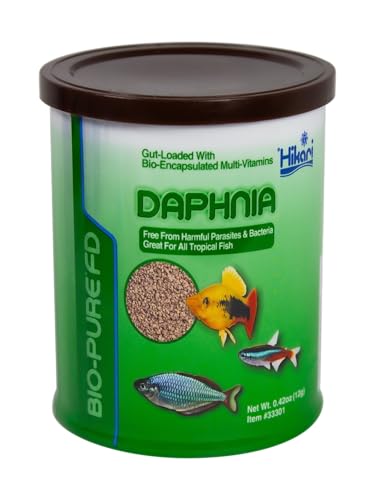
Daphnia is one of the most traditional livebearer foods, and Hikari’s freeze-dried version makes it easy to keep on the shelf. The guaranteed analysis lists a minimum of 66 percent crude protein, and the food is prepared with pharmaceutical-grade freeze-drying, with no artificial colors or preservatives. The 0.42 oz jar is a small format, which suits keepers with a single swordtail tank who want a treat food without committing to a large container.
Daphnia also has a useful role beyond nutrition: its small size and fiber make it a gentle food that supports digestion, and it suits fish that need a lighter meal. That said, freeze-dried daphnia is a treat, not a complete diet, so it belongs in a rotation rather than as the main food. Offer a small pinch once or twice a week, crumbled finely for fry and juveniles.
Specs
| Specification | Details |
|---|---|
| Brand | Hikari |
| Form | Freeze-dried daphnia |
| Package size | 0.42 oz |
| Key ingredients | Daphnia |
| Crude protein (min) | 66 percent |
| Crude fat (min) | not stated |
| Crude fiber (max) | not stated |
| Moisture (max) | not stated |
| Best for | Occasional treat and digestive support |
| Value group | Budget |
San Francisco Bay Brand Freeze Dried Bacteria Free Tubifex

Tubifex worms are a classic high-protein food for freshwater fish, and this freeze-dried version from San Francisco Bay Brand is pressed into cubes for easy handling. The worms are gamma irradiated and free of parasites and harmful bacteria, which addresses the main concern keepers have with tubifex. The manufacturer calls it an excellent growth enhancer for freshwater fish and recommends pressing a cube firmly against the front glass below the waterline at the desired feeding level.
That cube format is handy in a swordtail tank: the fish can pick at the cube while it stays in place, which spreads feeding out over a few minutes and gives every fish a chance to eat. The 4 oz jar holds a generous supply for a home aquarium. As with other rich animal foods, tubifex works best as a supplement a couple of times a week, balanced with flake and vegetable foods on the other days.
Specs
| Specification | Details |
|---|---|
| Brand | San Francisco Bay Brand |
| Form | Freeze-dried tubifex worm cubes |
| Package size | 4 oz |
| Key ingredients | Tubifex worms |
| Crude protein (min) | not stated |
| Crude fat (min) | not stated |
| Crude fiber (max) | not stated |
| Moisture (max) | not stated |
| Best for | Protein-rich treat and growth support |
| Value group | Budget |
How to Feed Swordtails
Feed adult swordtails small amounts two or three times a day, offering only what they finish within two to three minutes. Uneaten food decays quickly and fouls the water, so it is better to underfeed slightly than to leave flakes drifting around the tank. Remove any visible leftovers after feeding time ends.
Rotate the foods across the week rather than serving the same one at every meal. A practical pattern is a flake staple on most days, the algae gel two or three times a week, and one freeze-dried treat on the remaining days. Fry and juveniles need smaller pieces and more frequent meals, so crumble foods finely and feed them three or four small meals a day.
A short soak in tank water before feeding helps freeze-dried foods soften and sink slightly, making them easier for smaller swordtails to eat. Keep all dry foods sealed between feedings, and replace any jar that has been open for many months, since nutritional value fades with time and exposure to air.
Frequently Asked Questions
What is the best staple food for swordtails?
A quality flake blend with fish meal, krill meal, and algae is the best daily staple. It covers protein and vegetable matter in one feeding, floats where swordtails feed, and is easy to portion. Pair it with an algae-rich gel and freeze-dried treats a few times a week for a complete diet.
Do swordtails need vegetables or algae in their diet?
Yes. Swordtails are omnivores that graze on algae and plant matter in the wild, and vegetable content supports digestion, color, and overall health. Foods with spirulina, chlorella, or other algae in the ingredient list cover this need, and a gel food such as Repashy Soilent Green is a convenient way to deliver it.
How often should swordtails be fed?
Adult swordtails do well on two or three small meals a day, each sized so the fish finish it within two to three minutes. Fry and juveniles need smaller, more frequent meals, usually three or four times a day. Skipping one feeding day a week is harmless for healthy adults.
Can swordtails eat freeze-dried foods every day?
Freeze-dried foods such as krill, daphnia, and tubifex are best offered a few times a week rather than daily. They are rich in protein and work well as supplements, but a diet built only on freeze-dried treats misses the vegetable matter and balanced nutrition of a flake staple or algae gel. Soak them briefly in tank water before feeding to help them soften.
Conclusion
Swordtails thrive on variety, and the five foods here cover the full range of what they need. A flake blend handles everyday feeding, an algae-rich gel covers the vegetable side of the diet, and freeze-dried krill, daphnia, and tubifex add the protein and variety that support color, growth, and breeding condition. Feed small amounts, rotate through the week, and keep foods fresh for an active, colorful, healthy tank.
More from Amazon
Programs that pair well with the guide above. Offers and eligibility are set by Amazon and may change.
Set up recurring deliveries of everyday items on eligible products. Terms and savings are set by Amazon.
Explore Subscribe & SaveFree shipping on eligible items, Prime Video and more. Eligible new members can start with a free trial.
Start a Prime free trialAudiobooks and podcasts to listen to on the go. Eligible new members can start with a free trial.
Try Audible freeRead from a large library of eBooks and audiobooks on any device. Check Amazon for current plans.
Explore Kindle UnlimitedAs an Amazon Associate we earn from qualifying purchases.





Write Your Review
No reviews yet. Be the first to share your experience!