

Key takeaways
- Rack height: at least 4 inches below the lowest obstruction.
- Standing overhead press: roughly 12 to 18 inches above the lifter’s hand position, depending on bar path and ceiling tolerance.
- Pull-ups: additional headroom if you want to move through the top of the exercise.
The best power racks for most home gyms are 3×3-inch, 11-gauge steel racks with a 1,000-pound-or-higher stated capacity, 2-inch hole spacing through the bench zone, and enough height for your ceiling and overhead work.
Our top picks


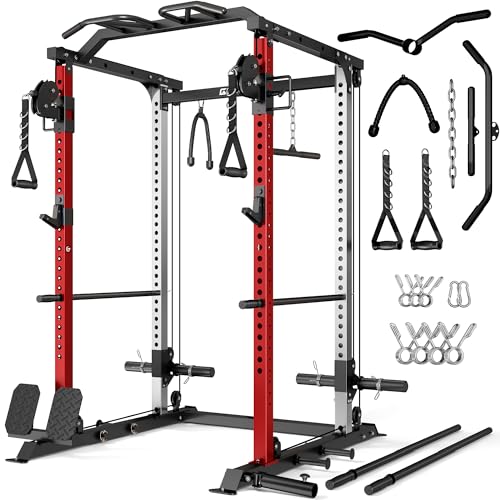
As an Amazon Associate we earn from qualifying purchases at no extra cost to you. Ratings are shown as listed on Amazon.
Best power racks by home-gym situation
| Home-gym situation | Best rack type | Recommended specifications | Why it fits |
|---|---|---|---|
| Limited budget or beginner setup | Half rack or compact full rack | 2×2-inch or 3×3-inch steel; 11- or 12-gauge; 700-1,000 lb capacity | Lower purchase cost and smaller footprint while still supporting normal barbell training |
| Regular lifter training alone | Full power rack with safety straps | 3×3-inch, 11-gauge steel; 1,000 lb or greater capacity; 1-inch or 5/8-inch hardware | Offers four-post stability and enclosed protection for squats and bench presses |
| Very limited floor space | Wall-mounted folding rack | 3×3-inch uprights; 21- or 41-inch folded depth; 700-1,000 lb capacity | Stores close to the wall, but requires suitable wall structure and careful installation |
| Advanced lifting and attachments | Modular 3×3-inch rack | 11-gauge steel; 1,000-1,500 lb stated capacity; 1-inch holes and 2-inch spacing | Supports adjustable monolifts, lever arms, cable systems, spotter arms, and storage additions |
| Low ceiling, basement, or garage | Short rack | 72- or 80-inch height; pull-up bar positioned below the ceiling; bolt-down provisions | Reduces clearance problems, although overhead pull-ups may be restricted |
Our top picks for the best power racks
Best overall: REP Fitness PR-4000
The REP Fitness PR-4000 is a strong all-purpose choice for a serious home gym because its 3×3-inch, 11-gauge uprights balance rigidity, accessory compatibility, and long-term upgrade potential. It is commonly available in several heights and depths, which matters more in a home than a small difference in advertised weight capacity.
Look for the version and configuration that provide 1-inch holes with 2-inch spacing through the bench area. That spacing lets you position J-cups and safety hardware more precisely than widely spaced holes. The PR-4000 platform also accommodates many modular attachments, but the final footprint can grow substantially when you add weight storage, a pulley system, or lever arms.
Choose it if you train several times per week, expect to add equipment, and have enough room for a four-post rack plus at least 36 inches of working clearance in front and behind the bar.
Best compact bolt-together rack: Rogue R-3 Power Rack
The Rogue R-3 is a compact, wall-mountable power rack designed around 3×3-inch, 11-gauge steel. Its short depth saves floor space compared with many freestanding racks, while the wall connection improves stability during racking and pull-ups. It is particularly suitable for a garage or dedicated lifting corner where the rack will remain in one position.
The trade-off is installation. A wall-mounted rack must attach to suitable structural framing or masonry; drywall anchors alone are not an acceptable substitute. You also need to account for the wall, rack, barbell, and lifter together when calculating usable depth. If the bar sleeves extend beyond the rack, plates and collars need additional clearance.
Best value-oriented option: Titan Fitness T-3 Series
The Titan Fitness T-3 Series is a practical choice when the priority is a functional rack at a lower general market price than premium modular systems. It is available in multiple heights and depths, including versions suited to lower ceilings. Its 2×3-inch steel format is less standardized for accessories than 3×3-inch systems, but it can be entirely adequate for conventional squats, bench presses, deadlifts, and pull-ups.
Pay close attention to the exact model rather than assuming every T-3 rack has the same dimensions or attachments. Confirm hole diameter, hole spacing, included safety hardware, and whether the rack is intended to be bolted down. A value rack becomes less attractive if the selected version cannot fit your bench or ceiling.
Best for very small rooms: a folding wall rack
A folding rack from a reputable manufacturer can be the best power rack when floor space is the deciding constraint. Folded depths commonly range from about 21 to 25 inches, while unfolded depths are often around 41 to 43 inches. This creates room for training equipment to be stored elsewhere after use.
Folding racks are not automatically easier to install. The hinges, mounting plates, and wall fasteners carry repeated dynamic loads, so installation quality is critical. Check that the uprights lock securely in both the training and folded positions. If you plan to use spotter arms outside the rack, verify the manufacturer’s approved configuration and do not exceed its stated limits.
How to evaluate a power rack before buying
1. Start with height and ceiling clearance
Measure from the finished floor to the lowest obstruction, not merely to the ceiling. Include beams, garage-door tracks, lights, ducts, and ceiling fans. A useful minimum is:
- Rack height: at least 4 inches below the lowest obstruction.
- Standing overhead press: roughly 12 to 18 inches above the lifter’s hand position, depending on bar path and ceiling tolerance.
- Pull-ups: additional headroom if you want to move through the top of the exercise.
For example, an 84-inch ceiling does not necessarily accommodate an 80-inch rack comfortably. A 4-inch difference may leave insufficient space for assembly, pull-up movement, or a bar placed overhead. In a basement, a 72-inch rack may be the safer choice even if it limits pull-up height.
2. Compare steel gauge and upright size
Steel gauge is a thickness reference: a lower gauge number means thicker steel. Eleven-gauge steel is about 0.120 inches thick, while 12-gauge is about 0.105 inches. Upright dimensions matter too. A 3×3-inch, 11-gauge upright generally resists twisting better than a 2×2-inch upright, but the frame design, welds, hardware, and anchoring also affect stability.
For most home users, 3×3-inch 11-gauge steel is more capacity than necessary but offers excellent attachment compatibility and reduced movement. A well-designed 2×3-inch or 2×2-inch rack can still be suitable for moderate training, particularly when bolted down.
3. Treat weight capacity as a reference, not a guarantee
Published capacities often describe static loads under specified conditions. A barbell dropped onto safety hardware creates more force than a barbell resting there. Capacity can also vary between J-cups, spotter arms, safety straps, pull-up bars, and storage pins.
For home training, a stated capacity of 700 to 1,000 pounds is usually ample. More important than chasing a 1,500-pound number is selecting a rack with secure safeties, solid connections, and an anchoring method appropriate to the floor and wall.
4. Check hole spacing and safety attachments
Two-inch hole spacing is common on many modern racks and provides useful adjustment. Some racks use smaller spacing through the bench zone, allowing the bar to sit closer to the ideal position over your chest. This is valuable when multiple people share the rack or when the bench height does not align perfectly with the J-cups.
A full rack should include either safety straps or safety pins. Straps are quieter and can reduce damage to the bar knurling; pins are simple and rigid but may make more noise. Spotter arms are convenient on a half rack, though they must be locked correctly and are less enclosed than internal safeties.
Footprint, anchoring, and the real space requirement
Do not shop using the rack’s listed width and depth alone. Add barbell length, plate loading space, bench clearance, and walking space. A practical planning rectangle for a four-post rack is often about 8 feet wide by 8 to 10 feet deep, even when the rack itself occupies only 4 by 4 feet.
As a worked example, suppose a rack is 49 inches wide and 48 inches deep. Add 18 inches on each side for loading plates and moving safely: 49 + 36 = 85 inches, or just over 7 feet wide. Add 24 inches behind the rack and 36 inches in front for the bench and lifter: 48 + 60 = 108 inches, or 9 feet deep. This is why a rack that fits on paper can feel cramped in a garage.
Bolting down is advisable for tall, narrow racks, heavy pull-ups, kipping movements, or a rack used with a pulley system. A wide, heavy four-post rack may remain stable without bolts during controlled lifting, but the manufacturer’s instructions should take priority.
Ownership realities: what wears first
- J-cup liners: Plastic or UHMW wear surfaces eventually become cut or compressed from repeated bar racking. Replace damaged liners before metal contacts the bar.
- Safety straps: Inspect for fraying, torn stitching, heat damage, and stretched adjustment holes. Keep straps dry and replace them when their condition is uncertain.
- Bolts and connections: Check them after initial assembly, after several heavy sessions, and periodically thereafter. Vibration can loosen hardware.
- Powder coating: Scratches around holes and contact points are normal. Remove chalk and sweat with a damp cloth, then dry the rack to reduce corrosion risk.
- Anchors and flooring: Concrete, wood framing, and rubber flooring require different fasteners. Do not improvise structural attachments.
The most common buying mistake is selecting the tallest or deepest rack that fits the product listing, rather than the rack that fits the complete workout area. Measure the ceiling, reserve clearance for the barbell, decide whether you need attachments, and then choose the smallest rack that provides appropriate safety and adjustability. For most dedicated home lifters, that leads to a 3×3-inch, 11-gauge full rack with adjustable safeties; for cramped rooms, a properly installed folding rack or short rack is the better answer.

Write Your Review
No reviews yet. Be the first to share your experience!