

Key takeaways
- Front adjustment bolt: A bracket expands against the inside of the bowl. It is simple and often tool-free, but it must be tightened evenly and checked periodically.
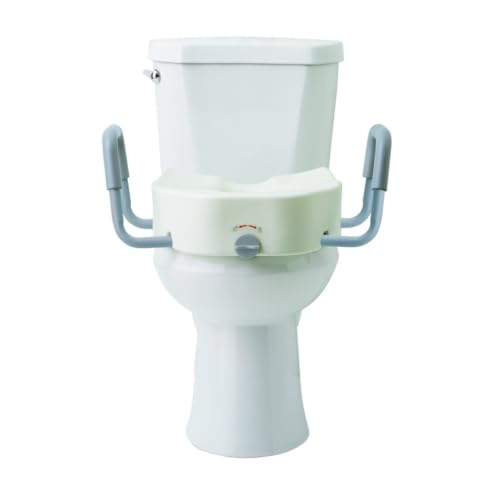
- Side clamps: Brackets grip the bowl from both sides. They can feel more secure and are useful on seats with armrests, although they add parts that collect residue.
- Replacement-bolt mounting: The seat attaches through the toilet’s existing mounting holes. This can provide strong alignment, but installation takes longer and may require tools.
Best Raised Toilet Seats for Safer Transfers
The best raised toilet seats are the ones that match your required height, fit your toilet bowl without rocking, lock securely, and provide enough width and support for every transfer—not simply the model with the greatest lift.
For most households, a 3-inch or 4-inch seat with a wide front-to-back opening and a mechanical locking system is the most balanced choice. Choose a 5- or 6-inch model when bending is especially difficult, and choose an armrest version when the user needs stable handholds during sitting or standing. If the toilet is elongated, verify the bowl shape before buying: many raised seats are designed primarily for standard, round bowls.
Our top picks



As an Amazon Associate we earn from qualifying purchases at no extra cost to you. Ratings are shown as listed on Amazon.
Quick comparison: which type fits your situation?
| Situation | Best seat type | Useful specification | Main compromise |
|---|---|---|---|
| Occasional short-term use | Basic elevated seat | 3-inch lift, 250-300 lb capacity, two locking points | Usually no armrests and less adjustment |
| Daily use by one person | Adjustable raised seat | 3- or 4-inch lift, 300-350 lb capacity, removable padded seat | More parts to clean and inspect |
| Transfers require hand support | Raised seat with armrests | 2 or 3 height settings, 300-400 lb capacity, locking side brackets | Needs extra clearance beside the toilet |
| Large user or frequent use | Heavy-duty wide seat | Up to 500-1,000 lb capacity, approximately 19-23 inch seat width | May not fit narrow bathrooms or every bowl |
| Elongated toilet | Elongated-specific seat or universal model with verified fit | Approximately 18.5-19.5 inch bowl length, front and rear contact points | Round-bowl models may sit forward or leave gaps |
How much height do you actually need?
Raised toilet seats commonly add 2, 3, 4, 5, or 6 inches to the existing toilet height. A standard toilet is often about 15 inches from the floor to the top of the bowl, excluding the seat. A 4-inch riser can therefore place the seating surface near 19 inches, although the exact result varies with the original toilet and the seat design.
More height is not automatically safer. A seat that is too high can make the user’s feet lose full contact with the floor, reducing stability during both sitting and standing. Measure from the floor to the back of the user’s knee while wearing normal footwear, then compare that figure with the finished seat height. The goal is usually a position that permits the feet to rest flat and the knees to remain comfortably bent, but individual mobility needs differ.
For someone who can sit and stand independently but needs less bending, 3 or 4 inches is often a sensible starting point. A 5- or 6-inch model may be appropriate when knee or hip flexion is very limited, but it deserves a careful fit check. A physical or occupational therapist can help determine the safest transfer height, particularly after surgery, injury, or a change in balance.
Seat width, opening, and bowl compatibility
Measure three things before ordering: the distance between the toilet’s mounting holes, the bowl length from the center of the mounting holes to the front edge, and the available width between nearby walls or fixtures. Also measure the user’s preferred sitting width. A narrow seat can feel restrictive, while a wide seat may interfere with a vanity, grab bar, or bathroom door.
Standard round toilets are typically about 16.5 inches long from the mounting-hole centerline to the front edge. Elongated bowls are commonly about 18.5 to 19.5 inches. These are useful reference points, not universal dimensions. A raised seat labeled “universal” may fit both shapes, but only if its rear supports, front lip, and locking hardware contact the bowl correctly.
Do not rely on the toilet’s original seat as a compatibility guide. Remove or raise it as directed by the riser’s instructions, then check that the new seat rests evenly on the porcelain. The riser should not overhang so far forward that it shifts under load, and it should not press against the tank or leave the rear unsupported.
Locking systems: the feature that matters most
Raised seats generally use one of three attachment methods:
- Front adjustment bolt: A bracket expands against the inside of the bowl. It is simple and often tool-free, but it must be tightened evenly and checked periodically.
- Side clamps: Brackets grip the bowl from both sides. They can feel more secure and are useful on seats with armrests, although they add parts that collect residue.
- Replacement-bolt mounting: The seat attaches through the toilet’s existing mounting holes. This can provide strong alignment, but installation takes longer and may require tools.
Prefer a system with two or more contact points, a visible tightening mechanism, and a design that prevents the seat from rotating. A seat that merely rests on the bowl is better suited to limited, supervised use than to repeated independent transfers. Recheck the fasteners after the first few uses and whenever the seat begins to move. Never compensate for a poor fit by adding household wedges, towels, or improvised shims.
Armrests: helpful support or unnecessary obstruction?
Armrests can make transfers easier by giving the user a consistent place to push from. Look for padded or rounded grips, a gap that allows the user to approach from the front, and armrests that do not flex independently of the seat frame. Fixed arms are usually simpler; flip-up arms make side transfers and cleaning easier.
Measure the space from each side of the toilet to the nearest wall, cabinet, or shower screen. A seat that is 20 inches wide may need several additional inches of usable clearance for the user’s elbows and caregiver access. If the bathroom is narrow, a seat without arms combined with correctly positioned wall-mounted grab bars may be more practical, but grab-bar placement should be assessed professionally rather than guessed.
Weight limits and stability
Standard raised seats often list capacities around 250 to 350 pounds. Wider or heavy-duty models may be rated from approximately 400 to 1,000 pounds. Treat the stated capacity as a minimum requirement, not a target. Include clothing, movement, and any downward force applied during transfers, and choose a product with a meaningful margin above the user’s body weight.
Capacity alone does not guarantee stability. A seat can meet its rating yet feel unsafe if the bowl shape is wrong, the hardware is loose, or the bathroom floor encourages twisting. A heavy-duty seat with a reinforced frame may be a better choice for frequent use, while a lightweight molded seat may be adequate for occasional use by a lighter person.
Cleanability and long-term ownership
Nonporous molded plastic is usually easier to maintain than fabric-covered padding. Favor smooth surfaces, rounded corners, removable lids, and hardware that can be reached without dismantling the entire riser. Open-sided designs may rinse more easily, but they can allow more splash onto the toilet and surrounding floor.
Clean the seat according to its instructions using a mild household cleaner compatible with plastic and metal hardware. Avoid abrasive powders, harsh solvents, and soaking mechanisms that contain springs or adjustment threads. Dry the underside and mounting points, since trapped moisture can cause odors, corrosion, or loosening.
The parts most likely to wear first are rubber bumpers, threaded knobs, clamp pads, and armrest fasteners. Inspect them weekly during heavy use and at least monthly during occasional use. Replace a component if it is cracked, flattened, stripped, or no longer holds tension. A seat that rocks after correct tightening should be removed from service rather than repeatedly adjusted.
A simple fit and cost calculation
Suppose a toilet measures 15 inches high and the user’s preferred transfer height is approximately 19 inches. The calculation is:
19 inches desired height − 15 inches existing height = 4 inches of additional height.
Allow for the thickness of the original toilet seat if it remains installed, and confirm the manufacturer’s finished height rather than relying only on the advertised lift. For ownership cost, a $60 seat used twice daily for one year costs about:
$60 ÷ 730 uses = approximately 8 cents per use.
That figure is only a comparison aid. A less expensive seat that loosens, does not fit the bowl, or requires early replacement may cost more over time than a sturdier model with replaceable pads and hardware.
Setup checklist before the first transfer
- Confirm whether the toilet is round or elongated and compare the actual measurements with the product diagram.
- Remove the original seat only if the instructions require it; some risers install over the bowl while others replace the seat.
- Center the riser from left to right and ensure every support pad contacts the porcelain.
- Tighten the locking mechanism evenly without overtightening plastic parts.
- Press down firmly on the front, rear, and both sides to check for rocking.
- Test armrests for movement and confirm that nearby fixtures do not block the transfer path.
- Have the intended user sit and stand with assistance available during the first test.
Bottom line
Choose a 3- or 4-inch raised seat with a secure multi-point lock for general daily use, a wide heavy-duty model when capacity and space demand it, and an armrest version when stable hand support is needed. Verify round-versus-elongated compatibility, finished height, width, and cleaning access before considering price. If transfers are unstable, painful, or changing after a medical event, ask a qualified healthcare professional to assess the bathroom setup and recommend suitable support equipment.

Write Your Review
No reviews yet. Be the first to share your experience!