

Key takeaways
- Inspect the intake screen or prefilter weekly during leaf and algae season.
- Clean the impeller chamber every one to three months, depending on debris load.
- Remove mineral deposits with diluted white vinegar, then rinse thoroughly before reassembly.
- Check unions, hose clamps, and flexible pipe for air leaks or kinks.
- Keep external pumps shaded and ventilated; do not bury them without access.
- Never run a pump dry, even briefly, unless the manufacturer specifically permits it.
- Use a residual-current or ground-fault protection device and follow local electrical rules.
The best koi pond pumps are energy-efficient external or solids-handling submersible pumps sized to turn over the pond’s actual water volume about once every 1–2 hours after accounting for lift, pipe friction, filters, and waterfall height.
Our top picks
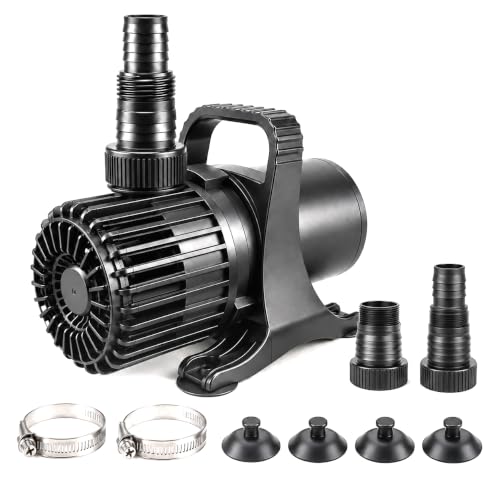


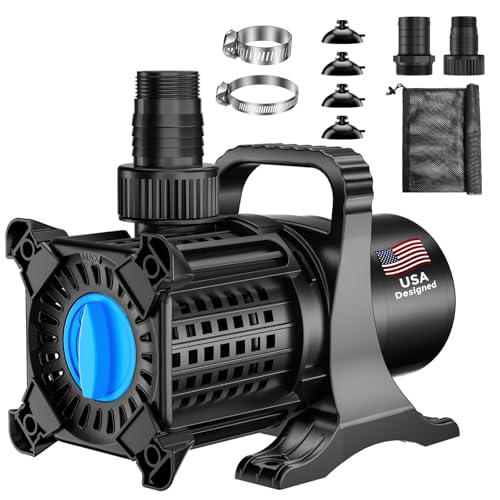
As an Amazon Associate we earn from qualifying purchases at no extra cost to you. Ratings are shown as listed on Amazon.
Quick Picks by Pond Situation
| Situation | Best pump type | Practical target | Why it fits |
|---|---|---|---|
| Small koi pond, under 1,500 gallons | Solids-handling submersible | 1,500–3,000 gph at working head | Simple installation and no separate pump vault |
| Medium pond, 1,500–5,000 gallons | Variable-speed external or hybrid pump | 3,000–6,000 gph at working head | Lower operating cost and adjustable flow |
| Large pond, above 5,000 gallons | External solids-handling pump | Turnover in 1–2 hours | Better efficiency, serviceability, and continuous-duty performance |
| Prominent waterfall or stream | High-head pump | Measure flow at the waterfall height | Maintains useful flow after elevation and pipe losses |
| Very low operating budget | Efficient asynchronous or variable-speed pump | Compare watts per delivered 1,000 gph | The purchase price matters less than 24-hour electricity use |
How to Size a Koi Pond Pump Correctly
Do not choose a pump from its maximum gallons-per-hour figure alone. That number is usually measured at zero lift, with no pipe, elbows, filter, or waterfall. A pump advertised at 5,000 gph may deliver considerably less at a 5-foot waterfall.
Step 1: Calculate the pond volume
For a roughly rectangular pond, multiply length, average width, and average depth in feet, then multiply by 7.48 to convert cubic feet to US gallons. For an irregular pond, divide it into simple sections or use a measured fill volume.
Example: a pond averaging 12 feet long, 8 feet wide, and 3 feet deep contains approximately 2,154 gallons:
12 × 8 × 3 × 7.48 = 2,154 gallons
Step 2: Set the turnover goal
A koi pond with a biological filter commonly needs approximately one complete circulation every 1–2 hours. A 2,154-gallon pond therefore needs roughly 1,100–2,200 gph delivered to the filter or waterfall. Heavily stocked ponds may need more circulation, but increasing pump flow does not replace adequate filtration, aeration, or routine water-quality management.
Step 3: Add total dynamic head
Measure the vertical distance from the pump water level to the highest point where water exits. Then account for horizontal pipe, narrow tubing, elbows, valves, check valves, prefilters, and filter media. As a planning estimate, a compact installation with 2–3 feet of lift may lose 10–25% of its rated flow; a long or restrictive installation can lose much more.
For the example pond, suppose the waterfall is 4 feet above the pump and the pipework adds an estimated 1 foot of friction. A target of 2,200 gph at 5 feet of total head is sensible. Choose a pump whose performance curve—not its box headline—shows at least that flow at 5 feet.
Head-to-Head: Pump Types for Koi Ponds
Solids-handling submersible pumps
These sit in the pond or a pump chamber and are usually the easiest option for a small installation. Models designed for ponds may pass particles around 1/4 to 1/2 inch, reducing the risk of frequent blockage from leaves and fish waste. They are convenient, but the motor adds heat to the water, access can be awkward, and a failed unit may require reaching into the pond.
External solids-handling pumps
External pumps are installed outside the pond and are often more efficient and easier to service. They suit larger ponds, bottom-drain systems, and installations where the pump must remain accessible. They need a correctly sized flooded suction line or suitable prefilter, dependable unions, and protection from flooding and freezing.
Variable-speed pumps
Variable-speed models cost more initially but let you reduce flow when the filter or waterfall does not need maximum output. They are useful when seasonal adjustment, quiet operation, or electricity savings matter. A variable-speed controller is only beneficial if the pump remains efficient at the chosen setting; compare delivered flow and watts at several speeds.
| Pump category | Typical nominal flow | Typical power range | Particle handling | Best use |
|---|---|---|---|---|
| Compact submersible | 1,500–3,000 gph | 40–120 W | Often 1/4 inch | Small ponds and short waterfalls |
| Large submersible | 3,000–8,000 gph | 100–350 W | Often 1/4–1/2 inch | Medium ponds and simple retrofits |
| External asynchronous | 4,000–12,000 gph | 150–700 W | Depends on model; prefilter usually required | Continuous circulation and larger systems |
| Variable-speed external | 3,000–15,000 gph | 30–600 W adjustable | Depends on model and intake protection | Energy-conscious owners and adjustable waterfalls |
These are comparison ranges, not universal specifications. Always check the manufacturer’s flow curve, maximum head, inlet and outlet diameter, and solids-passage rating for the exact model.
What Matters More Than Maximum Flow
Energy use
A pump running continuously uses 8,760 hours per year. A 200-watt pump consumes about 1,752 kWh annually. At an electricity rate of $0.20 per kWh, that is approximately $350 per year. A 100-watt pump moving the same useful volume would cost about $175 per year at that rate.
Compare energy efficiency at your actual working head. A smaller pump that cannot overcome the waterfall may consume less electricity but fail to circulate the pond properly. Conversely, an oversized pump throttled heavily with a valve can waste energy and create unnecessary turbulence.
Solids handling
For koi ponds, a clear strainer is not the same as a solids-handling intake. Look for a published particle-passage specification and use a coarse prefilter or intake screen that can be cleaned without dismantling the pump. Fine mesh may protect the impeller but clog quickly with algae and leaves.
Durability and materials
Continuous-duty pumps should have corrosion-resistant fasteners, a sealed motor, ceramic or hardened shafts where specified, and replaceable wear components. External pumps should be mounted on a stable, dry base with unions on both sides. Avoid placing a pump where a leaking fitting can flood its electrical connection.
The impeller, wear ring, shaft, seals, and intake screen generally show wear before the motor housing does. Grit, calcium deposits, string algae, and running dry accelerate that wear. A pump that becomes noisy, loses flow, or draws more power than usual may need cleaning or a replacement impeller rather than immediate replacement of the entire unit.
Maintenance That Prevents Lost Flow
- Inspect the intake screen or prefilter weekly during leaf and algae season.
- Clean the impeller chamber every one to three months, depending on debris load.
- Remove mineral deposits with diluted white vinegar, then rinse thoroughly before reassembly.
- Check unions, hose clamps, and flexible pipe for air leaks or kinks.
- Keep external pumps shaded and ventilated; do not bury them without access.
- Never run a pump dry, even briefly, unless the manufacturer specifically permits it.
- Use a residual-current or ground-fault protection device and follow local electrical rules.
Clean the mechanical prefilter before blaming the pump for low flow. A blocked intake can make a healthy pump appear undersized and can cause cavitation, noise, overheating, or premature seal damage.
How to Choose Without Overspending
For a small pond with a short return, choose a solids-handling submersible whose working-head output meets the turnover calculation. For a medium or large pond, an external pump usually makes more sense when the installation can accommodate a proper prefilter and service area. Choose variable speed when the waterfall flow changes seasonally or electricity prices make long-term operating cost important.
Budget approximately $100–$250 for a basic pond pump, $250–$700 for a more efficient or variable-speed model, and more for high-capacity commercial-style equipment. Include the cost of pipe, unions, valves, intake protection, and replacement wear parts; a cheap pump can become expensive if its fittings are restrictive or its impeller is unavailable.
Final Buying Checklist
- Know the pond’s actual gallons, not just its approximate dimensions.
- Measure the vertical lift and estimate pipe friction.
- Read the flow curve at the required head.
- Compare watts at delivered flow, not at zero head.
- Choose solids handling suitable for koi waste and leaves.
- Confirm inlet, outlet, replacement impeller, and seal availability.
- Install isolation valves and unions so maintenance does not require draining the pond.
- Leave access for cleaning the intake and removing the pump.
The best koi pond pump is the one that delivers the required flow at the real waterfall height, handles debris without constant blockage, and can be cleaned and repaired without disrupting the entire pond system.

Write Your Review
No reviews yet. Be the first to share your experience!