

Key takeaways
- Best for: roughly 5–75 gallon freshwater tanks, depending on the model and stocking level.
- Strengths: simple installation, good surface agitation, easy cartridge-free media customization, and generally low operating cost.
- Limitations: media baskets are smaller than those in canisters, water can evaporate through the open top, and the spillway may be noisy if the water level drops.
- Typical media capacity: about 0.25–2 liters across small to large units.
The best aquarium filters are the ones that provide gentle, reliable circulation, enough biological media for your livestock, and easy maintenance: choose a hang-on-back filter for most budget-conscious community tanks, a canister for larger or heavily stocked aquariums, a sponge filter for fry and shrimp, and an internal filter when space or installation simplicity matters most.
Our top picks


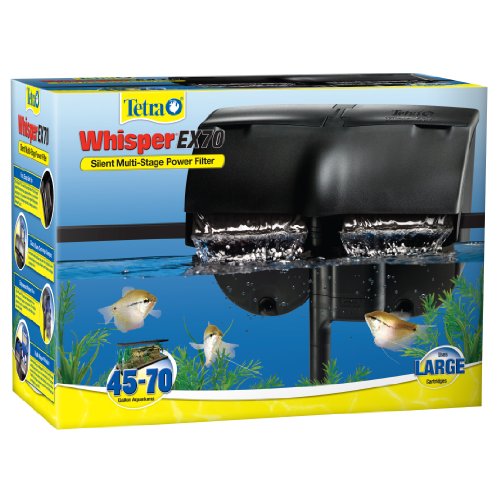
As an Amazon Associate we earn from qualifying purchases at no extra cost to you. Ratings are shown as listed on Amazon.
Quick picks by aquarium situation
| Situation | Best filter type | Why it fits | Typical target flow |
|---|---|---|---|
| 10–30 gallon community aquarium | Hang-on-back | Good mechanical filtration, accessible media, modest cost | 80–240 gallons per hour |
| 40–100+ gallon planted or community aquarium | Canister | Large media capacity and quieter, distributed circulation | 200–600 gallons per hour |
| Breeding, shrimp, fry, or quarantine tank | Air-driven sponge | Safe intake, gentle flow, inexpensive biological surface | Air pump output rather than a rated water-flow figure |
| Small aquarium without a rear rim | Internal filter | Submersible, compact, and easy to install | 60–200 gallons per hour |
| Heavy fish load or infrequent maintenance | Large canister or oversized HOB | More media volume and longer intervals before clogging | About 6–10 tank turnovers per hour |
These figures are starting points, not guarantees. Manufacturer flow ratings are usually measured with clean media and little or no lift. Real flow falls when filter media becomes dirty, tubing is long, or water must be pushed upward. A filter rated for 300 gallons per hour may deliver substantially less in a filled aquarium.
How the four main filter types compare
Hang-on-back filters: the practical all-rounder
A hang-on-back, or HOB, filter hangs on the outside of the aquarium and returns water through a spillway. Models such as the AquaClear series and Seachem Tidal series are popular examples of this format. HOB filters are usually the easiest choice for a first community aquarium because the media is visible and reachable without opening a cabinet.
- Best for: roughly 5–75 gallon freshwater tanks, depending on the model and stocking level.
- Strengths: simple installation, good surface agitation, easy cartridge-free media customization, and generally low operating cost.
- Limitations: media baskets are smaller than those in canisters, water can evaporate through the open top, and the spillway may be noisy if the water level drops.
- Typical media capacity: about 0.25–2 liters across small to large units.
Look for a model with a reusable foam block and a separate space for biological media. A filter that forces you to replace an all-in-one cartridge every month can cost more and remove useful bacterial colonies during servicing. Keep the intake tube covered with a coarse prefilter if you keep shrimp, fry, or fish that produce fine debris.
Canister filters: the high-capacity choice
Canister filters sit below or beside the aquarium and push water through several trays of media before returning it through a spray bar or outlet. Fluval 07-series canisters, Eheim Classic models, and Oase Biomaster models represent common designs, although exact features vary by model.
- Best for: medium to very large aquariums, planted displays, turtle tanks, and aquariums with high biological demand.
- Strengths: substantial media capacity, flexible flow direction, quiet operation when properly primed, and less equipment visible inside the aquarium.
- Limitations: more expensive, slower to clean, more vulnerable to leaks if seals are neglected, and less forgiving of incorrect media arrangement.
- Typical media capacity: about 3–15 liters, depending on size and basket design.
Canisters are not automatically better. Their advantage is capacity, not magic water purification. A neglected canister can accumulate decomposing waste and reduce flow. Use a coarse mechanical layer first, followed by finer polishing media only when needed, then biological media. Avoid filling every tray with disposable chemical media unless you have a specific reason.
Sponge filters: safest for delicate livestock
A sponge filter uses an air pump to draw water through open-cell foam. It is one of the best aquarium filters for shrimp, fry, bettas with low-flow requirements, quarantine tanks, and breeding setups. The foam provides both mechanical filtration and a large bacterial surface.
- Best for: approximately 2–40 gallon tanks, or as supplemental filtration in larger aquariums.
- Strengths: gentle intake, low purchase cost, excellent biological filtration, and no impeller to trap small livestock.
- Limitations: weaker fine-particle polishing, visible equipment, bubbling noise, and dependence on an air pump.
- Typical foam volume: about 0.1–2 liters for common single and dual-sponge designs.
Use a check valve in the airline so water cannot siphon backward into the air pump during a power outage. Clean the sponge by squeezing it in removed aquarium water, not untreated tap water, which can damage its established bacterial population and may leave disinfectant residues.
Internal filters: compact and straightforward
Internal filters operate fully inside the aquarium. They are useful where a rear-mounted filter will not fit, including some rimless tanks, temporary setups, and small aquariums. Many combine a small pump with foam and optional biological or chemical media.
- Best for: nano to medium tanks, quarantine systems, and aquariums needing simple submersible equipment.
- Strengths: easy installation, no external hoses, low risk of an external leak, and adjustable outlet direction on many models.
- Limitations: occupies display space, often has limited media volume, and can create strong localized flow.
- Typical media capacity: about 0.1–1 liter.
Choose an internal filter with a guarded intake and adjustable output. In a small aquarium, even a modest pump can produce uncomfortable turbulence, especially for long-finned fish or slow swimmers.
Size the filter by real flow, not the box alone
A useful starting formula is:
Required rated flow = tank volume × desired turnovers per hour.
For example, a 29-gallon community aquarium stocked at a moderate level may suit six turnovers per hour:
29 gallons × 6 = 174 gallons per hour.
Because flow decreases as media clogs, choose a filter rated around 200–250 gallons per hour rather than one rated exactly at 174. For messy fish or heavy stocking, 8–10 turnovers per hour may be appropriate, but diffuse the return with a spray bar, sponge, or wide outlet if the fish struggle against the current.
Turnover is only part of the decision. A small filter with a high pump rating may move water quickly but contain too little biological media. For a heavily stocked tank, prioritize media volume and intake area over an impressive maximum-flow number.
Decision matrix: which filter matches your priorities?
| Priority | Recommended choice | Trade-off |
|---|---|---|
| Lowest upfront cost | Sponge filter | Requires an air pump and does less fine polishing |
| Beginner-friendly routine maintenance | HOB filter | Less media space than a canister |
| Maximum media capacity | Canister filter | More parts, hoses, and cleaning time |
| Shrimp or newly hatched fry | Sponge filter or intake prefilter | May need a separate polishing solution for very clear water |
| Very limited space behind the tank | Internal filter | Uses visible aquarium space |
| Weekly cleaning is difficult | Oversized HOB or canister | Oversizing does not eliminate maintenance |
Maintenance realities that affect long-term performance
Mechanical foam usually clogs first, so rinse or replace it when flow visibly falls. Biological media should be disturbed less often and rinsed gently in siphoned aquarium water. Chemical media such as activated carbon is optional and has a limited useful life; it is not a substitute for removing waste or changing water.
The parts most likely to wear are impeller shafts, rubber bushings, O-rings, suction cups, airline tubing, and flexible canister hoses. Keep replacement parts available for older filters, particularly the impeller and the main sealing gasket. A dry or gritty impeller can become noisy before it stops, while a flattened O-ring can cause a slow leak.
Common mistakes include choosing a filter based only on tank gallons, packing media so tightly that water bypasses it, replacing all biological media at once, and allowing an intake sponge to become completely blocked. Clean the intake and impeller chamber during routine servicing, but preserve established biological media whenever possible.
Bottom line
Choose a HOB filter for the simplest all-purpose solution, a canister when media capacity and quiet circulation matter most, a sponge filter for delicate livestock and breeding, and an internal filter when compact installation outweighs display space. Whichever type you select, buy some capacity in reserve, protect small animals with an intake sponge, and judge success by stable flow, clean mechanical media, and healthy aquarium behavior rather than by the pump’s advertised number alone.

Write Your Review
No reviews yet. Be the first to share your experience!