

Key takeaways
- Bluetooth: The minimum practical feature for phone streaming. Confirm whether the receiver supports hands-free calling if that matters to you.
- USB: Useful for charging and playing files, but check the supported file formats and whether the port is protected from spray.
- AM/FM: Reception varies significantly offshore. A proper marine antenna is more reliable than a short improvised wire.
- Auxiliary input: A useful backup when Bluetooth pairing fails or when connecting an older navigation device.
- Zone control: Valuable on pontoons and cruisers, allowing the cockpit, bow, and cabin to use different volume levels.
- App or wired remote support: Helpful when the receiver is installed far from the helm, but a wired remote avoids dependence on a phone.
- NMEA 2000 or network integration: Relevant for some larger-boat installations, especially when controlling audio from a multifunction display.
The best boat stereos for clear sound on the water are marine-rated systems matched to your boat’s available space, amplifier power, and exposure level—not simply the units with the highest wattage.
Our top picks


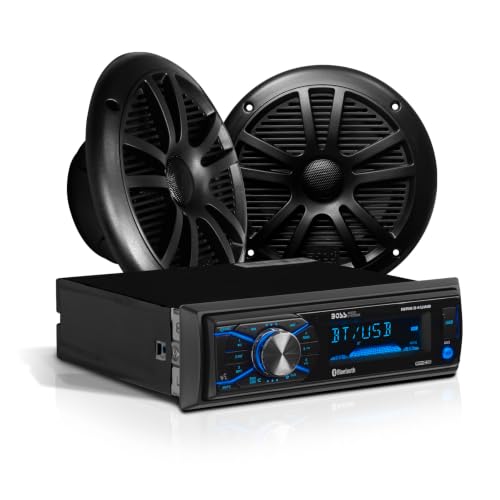
As an Amazon Associate we earn from qualifying purchases at no extra cost to you. Ratings are shown as listed on Amazon.
Quick picks by boat and setup
| Best for | Recommended type | Useful target specifications | Typical equipment budget |
|---|---|---|---|
| Small fishing boat or runabout | Compact marine receiver with two 6.5-inch speakers | 50–100 W RMS total, IPX6 or IPX7 front, Bluetooth, 4–8 hours of listening per battery charge | $180–$450 |
| 20–25-foot bowrider | Marine receiver, four 6.5-inch speakers, optional four-channel amplifier | 200–400 W RMS system power, 4-ohm speakers, conformal-coated electronics | $500–$1,200 |
| Larger cruiser or pontoon | Marine receiver, six or more speakers, dedicated amplifier and subwoofer | 500–1,000 W RMS total, zone control, multiple amplifier outputs, IPX6 or better controls | $1,200–$3,000+ |
| Open boat with severe spray | Fully marine-rated receiver and sealed speakers | IPX6/IPX7 receiver face, UV-resistant grilles, tinned wiring, sealed connectors | $350–$1,500 |
For a compact, reputable system, look at marine receiver and speaker ranges from brands such as Fusion, JL Audio, Kicker, Kenwood, Pioneer, Rockford Fosgate, and Wet Sounds. The exact model matters less than verifying its marine rating, continuous power specification, installation depth, and available connections.
What matters most when choosing a boat stereo
Water resistance is not the same as waterproofing
Look for an Ingress Protection rating, usually written as IP followed by two numbers. The first number describes protection from solids and dust; the second describes water exposure. An IPX6 rating indicates protection from powerful water jets, while IPX7 indicates temporary immersion under the stated test conditions. A stereo with an IPX7 face is better protected against accidental splashes and brief submersion than an un-rated car stereo, but it is not permission to leave the entire unit underwater.
Marine receivers also use features that an IP rating may not fully describe: conformal-coated circuit boards, UV-resistant plastics, gasketed buttons, drainage paths, and corrosion-resistant fasteners. Speakers should have polypropylene or similarly moisture-resistant cones, synthetic-rubber surrounds, sealed magnets, and grilles designed for ultraviolet exposure.
Do not confuse a water-resistant control panel with a waterproof amplifier or wiring harness. Place amplifiers in a dry, ventilated compartment, use marine-grade tinned copper cable, and protect every connection from saltwater.
RMS power beats peak power
Peak or “maximum” watts describe a short-duration limit and are poor for comparing systems. RMS power is the useful continuous figure. A receiver may advertise 200 watts across four channels, yet deliver only about 15–25 watts RMS per channel from its built-in amplifier. That can be adequate at moderate volume, but open boats are noisy: engine sound, wind, and hull slap quickly consume that margin.
For two 6.5-inch speakers, 15–30 watts RMS per channel is suitable for casual listening. Four speakers benefit from a four-channel amplifier delivering roughly 50–75 watts RMS per channel. Larger systems usually need separate amplification for the speakers and subwoofer.
Match the amplifier to the speaker’s RMS rating rather than its peak rating. An amplifier producing 60 watts RMS into a speaker rated for 50–100 watts RMS is a sensible pairing. Too little clean power can also be harmful if you turn a small amplifier into clipping distortion.
Connectivity determines daily convenience
- Bluetooth: The minimum practical feature for phone streaming. Confirm whether the receiver supports hands-free calling if that matters to you.
- USB: Useful for charging and playing files, but check the supported file formats and whether the port is protected from spray.
- AM/FM: Reception varies significantly offshore. A proper marine antenna is more reliable than a short improvised wire.
- Auxiliary input: A useful backup when Bluetooth pairing fails or when connecting an older navigation device.
- Zone control: Valuable on pontoons and cruisers, allowing the cockpit, bow, and cabin to use different volume levels.
- App or wired remote support: Helpful when the receiver is installed far from the helm, but a wired remote avoids dependence on a phone.
- NMEA 2000 or network integration: Relevant for some larger-boat installations, especially when controlling audio from a multifunction display.
Head-to-head: receiver-only, portable, or complete marine system?
Fixed marine receiver and speakers
This is the best choice for frequent boating and permanent installation. It provides cleaner wiring, better volume control, and less risk of a speaker being dropped overboard. A fixed system also makes it easier to add an amplifier later. The trade-off is installation work, cutout sizing, and a higher initial cost.
Portable Bluetooth speaker
A portable speaker works well for an occasional user, rental boat, or boat owner who does not want to cut the dash. Choose a model with at least IPX6 protection, a stated battery capacity, and physical controls that can be operated with wet hands. The main limitations are lower output, less stereo separation, and battery degradation over time.
Complete installed marine system
A receiver, amplifier, speakers, and subwoofer provide the best result on a large boat, but only if the electrical system can support them. A 600-watt RMS audio system can draw approximately 50 amps at 12 volts under demanding conditions before accounting for amplifier efficiency. That may require heavier wiring, a larger battery bank, and a charging system capable of replacing the energy used.
Decision matrix for common buying situations
| Your situation | Best direction | Why | What to avoid |
|---|---|---|---|
| Limited budget, occasional use | Portable IPX6/IPX7 speaker or basic marine receiver | Lowest installation cost and adequate casual volume | Adding an amplifier before upgrading the battery or speakers |
| Small dash and shallow mounting space | Compact receiver with a depth under 3 inches and two 6.5-inch speakers | Reduces cutting and avoids interference behind the console | Large receivers with rear-mounted connectors that cannot clear the dash |
| Frequent saltwater use | Fully marine-rated components, tinned wiring, sealed connectors | Reduces corrosion-related failures | Repurposed car audio equipment |
| Large pontoon with several listening areas | Four or more speakers, zone control, and a multi-channel amplifier | Spreads sound instead of forcing one pair to play excessively loud | One powerful speaker pair at the helm |
| Desire for strong bass | Dedicated marine subwoofer with a correctly matched amplifier | Lets the main speakers play more clearly at moderate volume | Expecting 6.5-inch coaxial speakers to produce deep bass outdoors |
Worked power calculation: is your battery large enough?
Suppose a four-channel amplifier produces 50 watts RMS per channel. At a typical listening level, it may average about 25 watts per channel, or 100 watts total. Allowing for roughly 85% amplifier efficiency, the battery supplies about 118 watts. At 12 volts, that equals approximately 9.8 amps.
For three hours of listening:
9.8 amps × 3 hours = 29.4 amp-hours.
A 60-amp-hour battery should not normally be discharged completely, so its practical usable capacity may be closer to 30 amp-hours depending on battery chemistry and the boat’s starting requirements. This example leaves little reserve for navigation electronics, pumps, lights, or engine starting. If you listen while anchored, use a separate house battery or monitor voltage rather than relying on guesswork.
Installation details that affect sound quality
Speaker location often matters more than buying the next larger receiver. Keep left and right speakers reasonably separated and aimed toward the listening area. Avoid mounting both speakers inside the same sealed compartment unless the enclosure is designed for it. A speaker needs the correct acoustic space behind its cone; an accidental air leak can reduce bass and introduce rattles.
Use the manufacturer’s cutout diameter and mounting depth exactly. A common 6.5-inch marine speaker may require a cutout around 5 inches in diameter and 2.5–3.5 inches of depth, but dimensions vary. Check for wiring, hinges, fuel lines, and structural supports before cutting.
Use tinned copper marine cable, adhesive-lined heat-shrink terminals, and a fuse close to the battery. Keep signal cables away from high-current charging and bilge-pump wiring where possible. Set amplifier gain with the receiver near its clean maximum volume, then increase gain only until distortion begins and back it down slightly.
Durability and ownership realities
On marine audio equipment, the first problems are often not blown speakers. Salt deposits corrode connectors, UV light makes grilles brittle, and trapped moisture damages switches or amplifier terminals. Rinse exposed speakers and controls with fresh water after saltwater use, then let them dry before covering the boat. Do not use a pressure washer at close range.
Inspect speaker surrounds, grille fasteners, fuse holders, and cable glands at least once a season. Replace cracked seals and loose terminals promptly. Keep the receiver’s protective cover closed when it is not in use, and disconnect or isolate portable batteries during long-term storage.
Common mistakes include mounting a receiver where water drains toward its rear connectors, using household speaker wire, relying on peak watts, and installing a subwoofer without checking battery capacity. A moderately powered, properly installed marine system will usually sound clearer and last longer than an oversized system assembled from incompatible parts.
Bottom line
Choose the best boat stereo by starting with exposure and installation space, then match RMS power to the number of speakers and the boat’s noise level. For a small boat, a marine receiver with Bluetooth and two efficient 6.5-inch speakers is enough. For a larger or frequently used boat, prioritize zone control, an amplifier, sealed wiring, and a battery plan. Water resistance protects the equipment, but careful installation and routine freshwater cleaning are what preserve clear sound season after season.

Write Your Review
No reviews yet. Be the first to share your experience!