

Key takeaways
- Use a dedicated pump or a correctly sized manifold branch so the chiller receives stable flow.
- Match the hose diameter to the barb rather than forcing a smaller tube over it.
- Expect metric and imperial fittings to differ; a 16 mm hose is not always interchangeable with 5/8-inch tubing.
- Install a strainer or pre-filter before the chiller to keep sand, algae, and fragments out of the heat exchanger.
- Keep the chiller upright, dry, and accessible for cleaning.
- Leave generous clearance around the intake and exhaust fan, following the manual’s ventilation distance.
The best aquarium chillers are sized by actual heat load—not just tank volume—so choose a titanium thermoelectric chiller for small systems, a compressor chiller such as the Hailea HC or JBJ Arctica range for medium and large aquariums, and a higher-capacity unit such as an Aqua Medic Titan or TECO TK model when reliability, lower temperature control, and continuous use matter most.
Our top picks


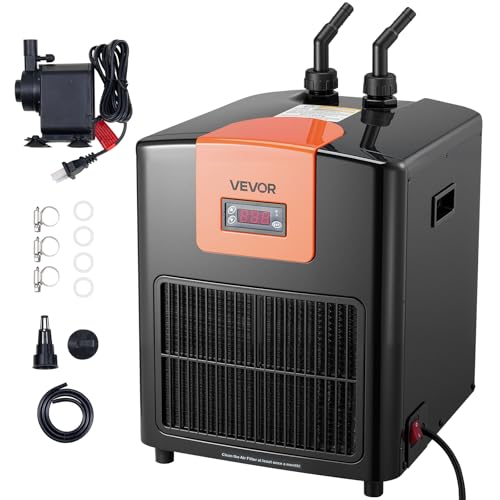
As an Amazon Associate we earn from qualifying purchases at no extra cost to you. Ratings are shown as listed on Amazon.
Quick picks by aquarium situation
| Situation | Best fit | Typical target capacity | Why it makes sense |
|---|---|---|---|
| Small aquarium or desktop reef | Thermoelectric chiller | 10–30 US gal (38–114 L) | Compact, quieter, and simpler, but usually removes only a modest amount of heat |
| 40–100 US gal reef or freshwater system | 1/15–1/10 HP compressor chiller | 150–380 L | Better cooling reserve when lights, pumps, and room temperature raise the load |
| 100–180 US gal aquarium | 1/5 HP compressor chiller | 380–680 L | More suitable for warm rooms and densely equipped reef systems |
| Large display, fish room, or frequent hot-weather use | 1/3 HP or larger compressor unit | 680 L and above | Greater cooling reserve and less continuous operation when correctly installed |
These are planning ranges rather than guarantees. A chiller rated for 100 gallons under ideal laboratory conditions may be marginal on a 100-gallon reef aquarium in a warm room. Manufacturers also use different test temperatures, so ratings are not perfectly comparable.
Best aquarium chillers compared
| Chiller type or example range | Useful capacity range | Typical flow requirement | Temperature control | Noise and energy expectations | Fittings |
|---|---|---|---|---|---|
| Thermoelectric aquarium chiller | 10–30 gal (38–114 L) | Approximately 100–300 L/h | Often about 20–28°C (68–82°F) | Usually quieter; commonly 40–100 W | Often 12–16 mm hose barbs |
| Hailea HC-150A / similar small compressor unit | Up to about 150 L under favorable conditions | Roughly 250–750 L/h, depending on model | Often adjustable around 4–30°C (39–86°F) | Compressor hum; approximately 1/10–1/4 HP class power draw | Commonly 16 mm hose connections, but verify the exact revision |
| Hailea HC-300A / HC-500A class | Approximately 300–500 L | About 600–1,200 L/h | Usually adjustable across a broad aquarium range | Noticeably louder than thermoelectric units; often 200–500 W while running | Usually 16–20 mm hose barbs |
| JBJ Arctica Titanium, 1/10–1/3 HP class | Approximately 300–1,000 L, depending on HP | Often about 600–2,500 L/h, model dependent | Digital setpoint with a narrow operating range | Efficient relative to cooling output, but compressor and fan noise remain | Model-dependent hose or rigid-pipe connections |
| Aqua Medic Titan or TECO TK compressor range | Small to very large aquariums, depending on model | Commonly 500–2,500 L/h | Digital control; some models support heating as well | Designed for continuous aquarium use; electrical demand rises with capacity | Check the manual: fittings may require adapters for metric or imperial hose |
The table gives realistic selection categories, not a substitute for the specification sheet. Exact flow limits, power consumption, dimensions, and connections can change between regional versions. A chiller should never be connected to a pump outside its permitted flow range.
How much cooling capacity do you need?
Start with the system’s total water volume, including the sump, then account for heat sources. A useful conservative method is to select the next capacity tier above the manufacturer’s nominal aquarium rating when the tank has strong lighting, several high-wattage pumps, a closed cabinet, or a room that regularly exceeds 27°C (81°F).
For example, consider a 75-gallon aquarium with a 20-gallon sump. The system contains about 95 gallons, or 360 L, before allowing for rock and sand displacement. A small 1/15 HP chiller marketed for 40–80 gallons is therefore undersized. A 1/10 HP unit may work in a cool room, but a 1/5 HP model provides better reserve if the room reaches 30°C (86°F) or the aquarium uses powerful reef lighting.
Do not select a massively oversized unit without considering control behavior. An oversized compressor can cool the water rapidly, but frequent short cycles may increase wear. A properly sized model should run long enough to remove heat, then remain off for a reasonable interval rather than switching on every few minutes.
Head-to-head: thermoelectric versus compressor chillers
Thermoelectric units
Thermoelectric chillers use a solid-state cooling element rather than a refrigerant compressor. They are attractive for nano aquariums because they are compact, relatively quiet, and have fewer moving parts. Their limitation is cooling power: they generally work best when the desired temperature is only a few degrees below room temperature and when the aquarium has a low heat load.
Choose one for a small freshwater aquarium, shrimp system, or lightly equipped nano reef. Avoid relying on it for a warm room, large aquarium, or system with intense lighting unless the specifications show sufficient heat-removal capacity.
Compressor chillers
Compressor models, including the Hailea HC, JBJ Arctica Titanium, Aqua Medic Titan, and TECO TK families, offer substantially more cooling capacity. Titanium heat exchangers are particularly useful for marine aquariums because titanium resists corrosion in saltwater when the rest of the plumbing is properly maintained.
The trade-offs are size, fan and compressor noise, greater electrical consumption, and the need for adequate ventilation. A compressor chiller placed inside a sealed cabinet may heat the cabinet faster than it can discharge heat, causing longer run times and poorer performance.
Flow rate, hose fittings, and installation details
Flow is not simply “the more, the better.” Too little flow can allow the heat exchanger to become excessively cold, reduce performance, or trigger a protection fault. Too much flow can reduce contact time and exceed the pump or chiller’s limit. Use the manufacturer’s stated operating range, measured after head loss from elbows, valves, and hose length.
- Use a dedicated pump or a correctly sized manifold branch so the chiller receives stable flow.
- Match the hose diameter to the barb rather than forcing a smaller tube over it.
- Expect metric and imperial fittings to differ; a 16 mm hose is not always interchangeable with 5/8-inch tubing.
- Install a strainer or pre-filter before the chiller to keep sand, algae, and fragments out of the heat exchanger.
- Keep the chiller upright, dry, and accessible for cleaning.
- Leave generous clearance around the intake and exhaust fan, following the manual’s ventilation distance.
For a 360 L system requiring approximately 1,000 L/h through the chiller, a pump rated at 1,000 L/h may be inadequate once it lifts water 1.2 m and pushes it through tubing. Select a pump with a higher zero-head rating, then confirm its real flow at the installed head height.
Energy use and noise: what ownership is really like
Electrical cost depends on runtime, not only the wattage printed on the label. A 300 W chiller running for six hours per day uses:
0.3 kW × 6 hours × 30 days = 54 kWh per month.
At an electricity rate of $0.20 per kWh, that is about $10.80 per month, excluding the pump. In a hot room, the unit may run considerably longer. Improving room ventilation, reducing unnecessary lighting heat, and using a timer for lights can lower operating cost more effectively than choosing a slightly smaller chiller.
Noise is usually dominated by the compressor starting, the cooling fan, and vibration transmitted through a cabinet. Rubber feet, firm level support, and flexible hose can reduce vibration. Do not enclose a compressor chiller tightly just to hide the sound; restricted airflow increases runtime and may shorten component life.
Maintenance and common mistakes
The first parts that commonly need attention are the air filter, fan, hose connections, and temperature probe—not necessarily the refrigerant circuit. Dust on the condenser reduces airflow, while marine salt deposits can corrode nearby metal and restrict fittings.
- Turn off the chiller and pump before servicing.
- Rinse or replace the pre-filter and inspect hoses for soft spots, splits, and salt creep.
- Vacuum dust from the air intake and condenser area without bending the fins.
- Clean the water path according to the manufacturer’s instructions; do not use an unapproved chemical in a marine system.
- Check the probe against a separate, reliable thermometer before changing the setpoint.
Set a reasonable differential, such as 0.5–1°C, instead of demanding constant precision to a tenth of a degree. Place the probe where it measures representative tank water, not directly in the chiller return stream. Also remember that a chiller does not replace an aquarium heater: a thermostat-controlled heater is still needed when room temperature can fall below the target.
Bottom line
For the best aquarium chillers, match the rated capacity to total system volume, then move up one size for hot rooms, powerful equipment, or marine systems with little thermal margin. Choose thermoelectric cooling for small, lightly heated aquariums; choose a compressor model for most serious reef and larger freshwater applications. Before buying, confirm the required flow, fitting diameter, ventilation space, operating noise, and realistic monthly energy use—not just the advertised gallon rating.



Write Your Review
No reviews yet. Be the first to share your experience!