

Key takeaways
- Best overall for beginners: A 20-gallon long or 29-gallon rectangular glass aquarium. It provides stable water volume without requiring an unusually large stand.
- Best for a small room: A 10-gallon glass tank, provided you choose a modest stocking level and accept that water changes must be consistent.
- Best for planted aquariums: A 20-gallon long tank with a full-length adjustable LED light, inert or plant-friendly substrate, and a filter rated for at least 30 gallons.
- Best for children or high-traffic rooms: A low, rimmed glass aquarium on a properly fitted cabinet, rather than a tall narrow model that is easier to bump.
- Best for moving or custom installations: Acrylic, especially when lower weight and impact resistance matter more than scratch resistance.
- Best for advanced aquascaping: A rimless low-iron glass aquarium, but only with a level stand, careful handling, and a plan for managing evaporation.
Best Aquariums for Fish, Plants, and Easy Care
The best aquariums for most beginners are 20–29 gallon glass tanks with a rectangular footprint, a tight-fitting lid, an adjustable LED light, and a separate cabinet rated for the filled weight; smaller tanks cost less but are less forgiving, while acrylic tanks are lighter and safer but scratch more easily.
Quick picks by situation
- Best overall for beginners: A 20-gallon long or 29-gallon rectangular glass aquarium. It provides stable water volume without requiring an unusually large stand.
- Best for a small room: A 10-gallon glass tank, provided you choose a modest stocking level and accept that water changes must be consistent.
- Best for planted aquariums: A 20-gallon long tank with a full-length adjustable LED light, inert or plant-friendly substrate, and a filter rated for at least 30 gallons.
- Best for children or high-traffic rooms: A low, rimmed glass aquarium on a properly fitted cabinet, rather than a tall narrow model that is easier to bump.
- Best for moving or custom installations: Acrylic, especially when lower weight and impact resistance matter more than scratch resistance.
- Best for advanced aquascaping: A rimless low-iron glass aquarium, but only with a level stand, careful handling, and a plan for managing evaporation.
Size matters more than the label
Aquarium volume affects temperature stability, dilution of waste, swimming space, and how quickly a small mistake changes water chemistry. A 5-gallon tank can be attractive and inexpensive, but it has little margin for overfeeding, evaporation, or an undersized filter. It is usually better suited to a single appropriate centerpiece animal or a carefully selected invertebrate setup than to a community of fish.
Our top picks


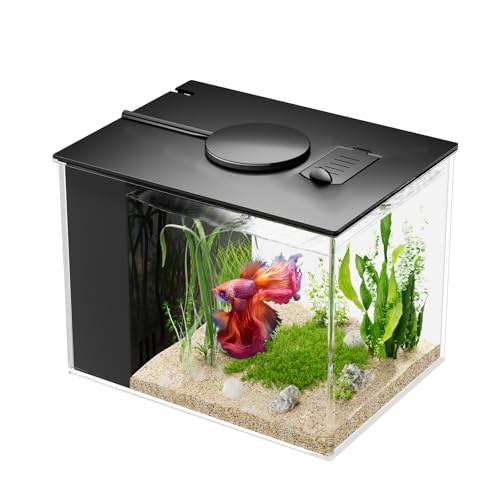

As an Amazon Associate we earn from qualifying purchases at no extra cost to you. Ratings are shown as listed on Amazon.
The 10-gallon size is a practical minimum for many beginner fishkeepers. It fits on a compact stand and is inexpensive to equip, but its short length limits the swimming room available to active fish. A 20-gallon long tank offers substantially more horizontal space while remaining relatively easy to maintain. A 29-gallon tank gives more water volume and height, although its taller design can make planting and cleaning the bottom less convenient.
| Nominal size | Approximate outside dimensions | Water capacity | Filled weight estimate | Best use |
|---|---|---|---|---|
| 5 gallons | 16 × 8 × 10 in | About 4–5 gal | 55–70 lb | Invertebrates or very limited stocking |
| 10 gallons | 20 × 10 × 12 in | About 8–9 gal | 100–120 lb | Budget beginner setup |
| 20 gallons long | 30 × 12 × 12 in | About 16–18 gal | 190–230 lb | Best balance of stability and footprint |
| 29 gallons | 30 × 12 × 18 in | About 24–26 gal | 280–330 lb | More volume and taller planted layouts |
| 40 gallons breeder | 36 × 18 × 16 in | About 34–36 gal | 380–450 lb | Large footprint, aquascaping, community fish |
These filled-weight estimates include water, roughly 1–2 inches of substrate, and basic décor. Water alone weighs approximately 8.34 pounds per US gallon. A 20-gallon aquarium therefore contains around 167 pounds of water before gravel, rocks, equipment, and the tank itself are added. Treat the table as a planning guide, not as a structural certification.
Glass versus acrylic: a practical head-to-head
Glass
Glass is the best default for most home aquariums. It resists scratching during normal cleaning, remains clear for years, and usually costs less in standard sizes. Its main disadvantages are weight and brittleness. A glass tank must be carried from below, never by its rim or plastic trim, and placed on a level surface that supports the base as specified by the manufacturer.
Standard float glass is suitable for most freshwater aquariums. Low-iron glass can look clearer, particularly at thicker panels, but it generally costs more. Rimless glass provides an unobstructed view and is popular for planted layouts; however, it demands extra care with water level, splashing, and a perfectly level stand.
Acrylic
Acrylic weighs considerably less than glass and is less likely to shatter from an impact. It is useful for large tanks, unusual shapes, and rooms where moving a heavy aquarium is difficult. Acrylic also provides good insulation, which may slightly reduce heat loss.
The trade-off is surface damage. A rough sponge, trapped grain of sand, or unsuitable algae scraper can leave visible scratches. Acrylic may also bow slightly on large panels and can develop cloudy areas if cleaned with incompatible chemicals. Use tools specifically labeled for acrylic and never drag debris across the surface.
| Factor | Glass | Acrylic |
|---|---|---|
| Typical cost | Lower for standard sizes | Usually higher |
| Weight | Heavy | Roughly 40–50% lighter than comparable glass |
| Scratch resistance | Good | Low unless cleaned carefully |
| Impact resistance | Can crack or shatter | Better resistance to impact |
| Shape options | Best in standard rectangular designs | More custom shapes available |
What equipment should be included?
A starter kit is convenient, but “included” does not always mean “adequate.” Look for a hood or lid, filter, heater where appropriate, thermometer, and light. Check the actual filter flow, heater wattage, and light controls rather than choosing by the package’s tank-size label.
- Filter: Choose a model with mechanical and biological media and a flow rate that can turn over the aquarium’s nominal volume several times per hour. Adjustable flow is valuable for bettas, shrimp, and other animals that dislike strong current.
- Heater: A common planning range is approximately 3–5 watts per gallon, but room temperature, tank size, and insulation change the requirement. A 50-watt heater often suits a 10-gallon aquarium, while a 100-watt model is commonly used around 20 gallons. Follow the manufacturer’s range and use a separate thermometer.
- Light: A basic LED is fine for low-light plants such as Anubias and Java fern. Demanding carpeting plants need stronger, controllable lighting and usually benefit from carbon dioxide supplementation.
- Lid: A lid reduces evaporation, prevents fish from jumping, and limits dust. Leave only the openings needed for cables and feeding.
- Maintenance tools: Budget for a siphon, algae scraper, dedicated bucket, water conditioner, and test kits. These are more important to long-term success than decorative extras.
Cabinet and placement requirements
Use a purpose-built aquarium stand or a cabinet explicitly rated for the filled aquarium. Do not assume an ordinary bookcase or flat-pack table can handle several hundred pounds continuously. The stand should match the tank’s length and depth, sit on a solid floor, and provide full support where the aquarium’s design requires it.
Place the aquarium away from direct sunlight, radiators, heating vents, and doors that are frequently opened. Sunlight can encourage algae and cause temperature swings. Leave enough clearance behind the tank for filter hoses and electrical cables, and create a drip loop so water cannot run along a cable into an outlet.
A beginner setup that avoids common mistakes
- Confirm the location first. Measure the stand, tank, lid, and maintenance clearance before buying equipment.
- Rinse substrate and décor. Use plain water only. Soap and household cleaners can leave harmful residues.
- Install equipment before filling. Position the filter intake, heater, thermometer, and light so they can be reached without dismantling the layout.
- Fill with conditioned water. A plate or plastic bag can diffuse the flow and prevent the substrate from shifting.
- Cycle the aquarium before adding a full stock. Beneficial bacteria need time to establish. Add livestock gradually and verify that ammonia and nitrite remain at zero with an aquarium test kit.
- Start with a conservative light schedule. Around 6–8 hours daily is a reasonable starting point for many planted freshwater tanks. Increase gradually only if plants need more light and algae remains controlled.
Ownership costs and durability
The aquarium itself is only part of the budget. A basic 10-gallon setup may fall in the general market range of $100–$250 before livestock, while a 20–29 gallon setup with a stand, reliable equipment, substrate, décor, and water-treatment supplies commonly reaches roughly $250–$600. Larger, rimless, low-iron, or custom aquariums can cost substantially more.
The items most likely to need replacement are filter cartridges or media, heater units, air pumps, light power supplies, and silicone suction cups. Avoid replacing all biological filter media at once; rinsing reusable media in removed aquarium water preserves more beneficial bacteria. Replace disposable media only when it is deteriorated or clogged, and use permanent biological media whenever the filter design allows.
A weekly 25% water change is an easy planning example: a 20-gallon tank with approximately 18 gallons of actual water volume requires about 4.5 gallons changed. That is manageable with a small bucket, while the same percentage on a 75-gallon aquarium requires nearly 19 gallons and a more efficient hose or pump system. Maintenance time, not just purchase price, should influence your size choice.
Final buying decision
Choose a 10-gallon aquarium when space and budget are the primary constraints. Choose a 20-gallon long when you want the safest all-purpose beginner option for fish and plants. Choose a 29-gallon or 40-gallon breeder when the stand and floor can support the weight and you want greater stability or more swimming room. Choose acrylic for low weight and impact resistance, and glass for lower cost, scratch resistance, and easier long-term ownership.
Whichever format you select, prioritize a suitable stand, dependable filtration, a secure lid, and enough room for routine maintenance. Those decisions have a greater effect on ease of care than a premium trim package or decorative shape.

Write Your Review
No reviews yet. Be the first to share your experience!