

Key takeaways
- What wears first: amplifier electronics, power-supply components, rubber surrounds, and cabinet fasteners are more likely long-term failure points than the cone itself. Heat, moisture, and sustained clipping accelerate wear.
- Keep it dry: despite this site’s aquarium focus, a home-audio subwoofer should not sit beside an open aquarium where condensation or splashing can reach its electronics. Leave ventilation space around the amplifier panel.
- Do not overdrive a small model: a rattling, clicking, or compressed sound indicates that the subwoofer is near its limits. Lower the level or move to a larger model rather than adding extreme bass boost.
- Use the crossover correctly: with an AV receiver, select the LFE or bypass setting on the subwoofer and let the receiver manage bass. With stereo equipment, begin around 70–80 Hz and adjust by ear.
- Allow for cabinet space: a large ported 12-inch subwoofer can occupy more than 2 cubic feet and weigh over 50 pounds. Check doorways, shelving, and floor loading before buying.
- Expect room variation: moving a subwoofer by only a foot can produce a major change at the listening seat. Recalibration after placement is part of ownership, not an optional extra.
The best subwoofers balance driver size, amplifier power, enclosure design, room volume, and connection options: choose a compact sealed model for music and small rooms, a ported 10- or 12-inch model for cinema-level depth, and dual subwoofers when even bass across several seats matters most.
Our top picks

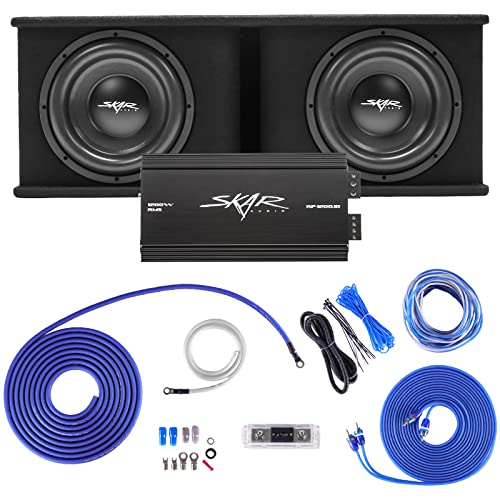
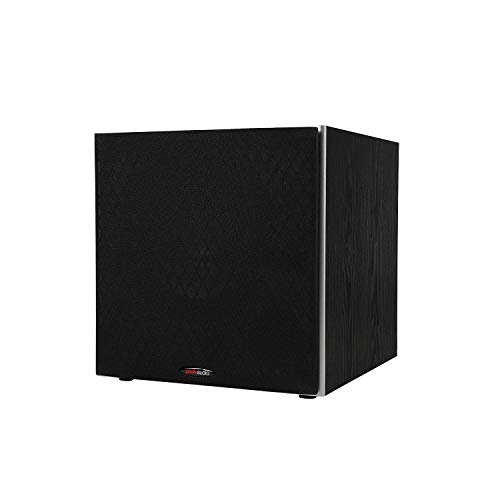

As an Amazon Associate we earn from qualifying purchases at no extra cost to you. Ratings are shown as listed on Amazon.
Best subwoofers by listening situation
| Situation | Best type | Useful target | Examples to consider |
|---|---|---|---|
| Small room or apartment | Sealed 8–10 inch | 300–600 watts RMS; low visual impact | SVS SB-1000 Pro, KEF KC62 |
| Mixed music and movies | Sealed or ported 10 inch | 20–25 Hz extension; app or DSP control | RSL Speedwoofer 10S MKII, SVS SB-1000 Pro |
| Medium or large theater room | Ported 12 inch | 400–800 watts RMS; output below 20–25 Hz | SVS PB-1000 Pro, Monoprice Monolith 12 |
| Several seating positions | Two matched subwoofers | Placement flexibility and room smoothing | Two identical 10- or 12-inch models |
| Minimalist stereo system | Compact sealed wireless model | Line-level, speaker-level, or wireless input | KEF KC62 or another compact DSP-controlled subwoofer |
How driver size changes bass
The driver is the subwoofer’s moving cone. Larger cones generally move more air with less excursion, producing greater output at low frequencies. An 8-inch unit can add weight to music and soundtracks, but it has less headroom than a 10- or 12-inch model. A 12-inch driver is usually the safer choice for a large room, loud listening, or bass-heavy films.
Size alone does not determine performance. A well-designed 10-inch subwoofer with a rigid cabinet, powerful motor, and effective digital signal processing can outperform a poorly engineered 12-inch model. Cone area, maximum excursion, cabinet volume, amplifier capability, and distortion all work together.
For a small room under roughly 150 square feet, an 8- or 10-inch subwoofer is often sufficient. Rooms around 150–300 square feet commonly benefit from a strong 10- or 12-inch model. Above 300 square feet, especially with open doorways or high ceilings, consider a larger ported model or two subwoofers. These are starting points rather than strict rules because listening distance and volume matter too.
Wattage: useful headroom, not a quality score
Subwoofer specifications often advertise peak watts, but RMS or continuous power is more useful for comparing products. A 500-watt amplifier does not automatically play deeper or cleaner than a 300-watt amplifier. The driver’s efficiency, enclosure, limiter, and power supply determine how much of that power becomes useful acoustic output.
More wattage provides headroom: the ability to reproduce sudden explosions, kick drums, and low synthesizer notes without audible strain. In a small room at moderate volume, 300–500 watts RMS may be ample. A large theater room may justify 500–1,000 watts RMS or more, particularly with a ported 12-inch cabinet.
Do not select a subwoofer solely by the lowest frequency printed on its box. A claimed 18 Hz response may be measured at a generous tolerance or at low output. Look for frequency response tolerance, maximum output measurements, and independent testing when available.
Sealed versus ported enclosures
Sealed subwoofers
A sealed cabinet has no port and is usually smaller. Its response often rolls off gradually, which can sound controlled and natural with music. Sealed models also tend to be easier to place near a wall or furniture, although room gain can make their deep bass surprisingly strong.
The trade-off is efficiency. A sealed subwoofer may need more amplifier power and driver excursion to produce the same low-frequency output as a ported model. It is a strong choice for music-focused systems, compact rooms, and listeners who value a smaller enclosure.
Ported subwoofers
A ported cabinet uses an opening tuned to reinforce a specific low-frequency range. This produces more output per watt around the tuning frequency and is useful for film effects, games, and large rooms. The cost is a larger cabinet and more careful placement. Below the port tuning frequency, output falls rapidly, so using extreme equalization to force deeper bass can stress the driver.
A ported 12-inch model such as the SVS PB-1000 Pro is typically more suitable for a dedicated theater than a compact sealed subwoofer. A ported design is not automatically boomy; excessive bass is more often caused by placement, room modes, or an incorrect crossover level.
Connection options and placement
The most flexible subwoofers provide a line-level LFE input, stereo RCA inputs, adjustable phase, a low-pass filter, and volume control. LFE is the usual connection from an AV receiver. Stereo RCA inputs are useful with a two-channel preamplifier or integrated amplifier. Speaker-level inputs can help when an amplifier lacks a subwoofer output.
Wireless connectivity reduces cable runs but does not eliminate placement requirements. Confirm whether the wireless system is included, whether it introduces latency, and whether it supports the receiver’s full LFE bandwidth. Bluetooth is convenient for casual playback but is not a substitute for a proper subwoofer connection in a home theater.
Start by placing the subwoofer near the front wall, then use the subwoofer-crawl method: put the subwoofer at the main listening seat, play a bass sweep or familiar bass-heavy track, and walk around the room perimeter. The locations where bass sounds smoothest are candidates for the subwoofer’s final position. Keep the cabinet away from corners if bass becomes excessively thick, though corner placement can increase output when the room sounds too weak.
For two subwoofers, opposite walls or opposing front and rear positions often provide more even coverage than placing both beside the front speakers. Room correction software can improve integration, but it cannot fully fix a severely unsuitable location.
A practical buying calculation
Suppose a room is 12 by 18 feet with an 8-foot ceiling. Its volume is 1,728 cubic feet. That is a medium-sized room where a compact 8-inch subwoofer may sound adequate at low levels but can run out of headroom during action movies. A 10-inch model with roughly 300–600 watts RMS is a reasonable starting point; a ported 12-inch model becomes more attractive if the room opens into a hallway or adjacent space.
Now consider listening distance. Bass output decreases as distance increases, and room boundaries change the result. If the seat is 10 feet from the subwoofer rather than 6 feet away, selecting a model with additional output capacity is safer than trying to compensate later with excessive volume or equalization.
Ownership realities and common mistakes
- What wears first: amplifier electronics, power-supply components, rubber surrounds, and cabinet fasteners are more likely long-term failure points than the cone itself. Heat, moisture, and sustained clipping accelerate wear.
- Keep it dry: despite this site’s aquarium focus, a home-audio subwoofer should not sit beside an open aquarium where condensation or splashing can reach its electronics. Leave ventilation space around the amplifier panel.
- Do not overdrive a small model: a rattling, clicking, or compressed sound indicates that the subwoofer is near its limits. Lower the level or move to a larger model rather than adding extreme bass boost.
- Use the crossover correctly: with an AV receiver, select the LFE or bypass setting on the subwoofer and let the receiver manage bass. With stereo equipment, begin around 70–80 Hz and adjust by ear.
- Allow for cabinet space: a large ported 12-inch subwoofer can occupy more than 2 cubic feet and weigh over 50 pounds. Check doorways, shelving, and floor loading before buying.
- Expect room variation: moving a subwoofer by only a foot can produce a major change at the listening seat. Recalibration after placement is part of ownership, not an optional extra.
Which model should you choose?
Choose the SVS SB-1000 Pro when you want a compact sealed enclosure, app-based adjustment, and a versatile blend of music and movies. Choose the RSL Speedwoofer 10S MKII when value and strong all-round performance are more important than the smallest cabinet. Choose the SVS PB-1000 Pro for deeper, higher-output movie bass in a medium-sized room. The KEF KC62 suits buyers prioritizing a very compact, refined design and extensive DSP, although its small cabinet commands a premium. For a larger room and high-output cinema use, a powerful ported 12-inch model such as the Monoprice Monolith 12 is the more appropriate direction.
Typical market pricing ranges from about $300–$600 for capable entry-level 8- or 10-inch subwoofers, $600–$1,200 for advanced 10- or 12-inch models, and roughly $1,000–$2,000 or more for compact premium designs or high-output theater models. The best subwoofer is not the one with the biggest driver or highest wattage; it is the model that has enough headroom for your room, fits your placement options, and integrates cleanly with the speakers you already own.

Write Your Review
No reviews yet. Be the first to share your experience!