

Key takeaways
- The best steam tables for catering are the ones that match your pan count, service volume, power supply, transport routine, and cleaning capacity—not simply the unit with the most burners. Quick Picks by Catering Situation Catering situation Best steam-table format…
The best steam tables for catering are the ones that match your pan count, service volume, power supply, transport routine, and cleaning capacity—not simply the unit with the most burners.
Quick Picks by Catering Situation
| Catering situation | Best steam-table format | Recommended capacity | Why it fits |
|---|---|---|---|
| Small events, tastings, and occasional use | Compact electric countertop table | 2 full-size pans or 4 half-size pans | Low purchase cost, simple setup, and easy storage |
| Regular buffet service for 50–150 guests | Four- or five-pan electric table | 4–5 full-size pans | Good balance of capacity, holding control, and labor efficiency |
| Outdoor or venue locations with unreliable electricity | Gas-fired table or chafer-style fuel system | 2–4 full-size pans | Does not depend on a high-amperage electrical circuit |
| Large production kitchens and frequent events | Heavy-duty stainless electric table | 6–8 full-size pans | More usable space, stronger construction, and faster service flow |
| Mobile caterers with limited vehicle space | Folding or narrow countertop model | 2–3 full-size pans | Lower weight and smaller footprint during transport |
How to Choose the Best Steam Tables for Catering
1. Start with pan capacity, not the advertised table length
Steam tables are commonly designed around standard food pans. A full-size pan is approximately 20.75 by 12.75 inches, while half-size pans are approximately 12.75 by 10.4 inches. Actual dimensions vary slightly by manufacturer, so check the pan wells before buying replacement pans.
Our top picks

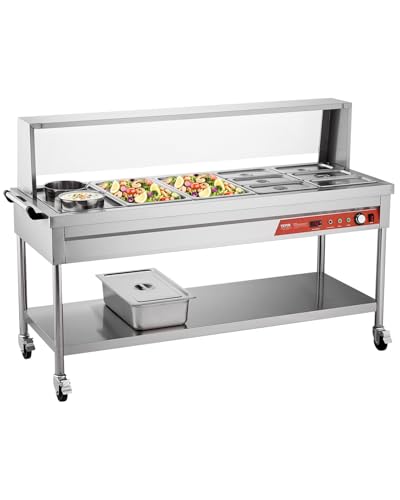
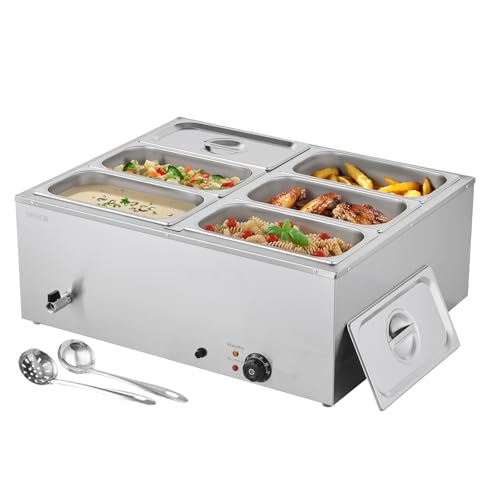

As an Amazon Associate we earn from qualifying purchases at no extra cost to you. Ratings are shown as listed on Amazon.
Pan depth also changes capacity substantially. A 2.5-inch pan is useful for shallow sides or toppings; a 4-inch pan suits many buffet foods; and a 6-inch pan holds considerably more but may heat more slowly. A practical rule is to allow one full-size pan position for each major hot menu item, then add a spare position for flexibility or replenishment.
For example, a buffet offering rice, vegetables, chicken, and sauce needs four pan positions. If the menu regularly includes two proteins, a four-pan table will force frequent swaps. A five- or six-pan model may cost more initially but reduce staff movement and service interruptions.
2. Match the heating method to the venue
Electric water-bath tables are usually the easiest choice for indoor catering. A heating element warms water in the well, and the water transfers heat gently to the pans. This reduces hot spots and is well suited to holding cooked food during service. They require a nearby outlet, enough circuit capacity, and careful cord management.
Dry electric tables heat pans without a water reservoir. They can be quicker to set up and avoid draining dirty water, but food may heat unevenly if pans are not designed for dry operation. Follow the manufacturer’s instructions; a water-bath table should not be run dry unless specifically approved.
Gas tables are valuable for outdoor work or venues where electrical circuits are limited. They require a compatible propane supply, ventilation, flame supervision, and more attention during transport. Gas heat can be powerful, but it may create hotter areas near burners, making thermostat control and stirring more important.
Fuel-heated chafing systems use disposable or refillable fuel cans beneath the pans. They are portable and require no electrical connection, but they generally provide less precise temperature control and create recurring fuel costs. They are best for short events or locations where a powered table is impractical.
3. Check power requirements before purchase
A table’s wattage determines both heating performance and whether the venue can safely operate it. A compact unit may draw around 1,200–1,800 watts, while larger electric tables can draw 2,000–3,500 watts or more. At 120 volts, a 1,800-watt unit draws approximately 15 amps:
1,800 watts ÷ 120 volts = 15 amps
That can use most of a standard 15-amp circuit by itself. A larger table may need a 20-amp circuit or a different electrical connection. Do not assume two tables can share one outlet, and avoid ordinary extension cords unless the manufacturer permits them and the cord is rated for the full load.
For mobile operations, record the venue’s outlet type, circuit rating, and distance from the service line before accepting a job. A lower-wattage table may be the better choice if it prevents circuit trips during service.
Steam Table Size and Capacity Comparison
| Table type | Typical pan positions | Approximate footprint | Typical electrical load | Best use |
|---|---|---|---|---|
| Compact countertop | 2 full-size or 4 half-size | 27–32 inches wide | 1,200–1,800 watts | Small parties and limited counter space |
| Medium four-pan | 4 full-size | 55–65 inches wide | 1,800–2,500 watts | Routine buffet and corporate catering |
| Large five- or six-pan | 5–6 full-size | 70–90 inches wide | 2,400–3,500 watts | High-volume service with several hot dishes |
| Portable gas table | 2–4 full-size | 30–65 inches wide | No electrical load | Outdoor events and venues with limited power |
These are useful planning ranges rather than universal specifications. Verify the exact dimensions, voltage, amperage, pan compatibility, and shipping weight for the model under consideration.
Material, Mobility, and Work-Space Details
304 stainless steel is a strong choice for commercial food-service equipment because it resists corrosion and is relatively easy to sanitize. Thinner stainless construction can reduce weight, but it may dent more easily and transmit heat to surrounding surfaces. Look for reinforced legs, welded corners, rounded edges, adjustable feet, and a well that is easy to drain.
A medium steam table commonly weighs roughly 45–100 pounds before pans and food are added. Casters help in a kitchen, but they do not make a fully loaded table easy to move. Four full-size pans containing dense food can add more than 100 pounds. If the table must travel through doorways, up ramps, or into a van, measure the folded or disassembled dimensions and calculate the loaded weight.
For transport, removable legs, nesting components, locking casters, and a fitted cover are more useful than decorative shelves. A lower shelf is convenient for pans and serving equipment, but it also adds weight and can make the unit harder to clean underneath.
Ownership Costs and Common Failure Points
The purchase price is only part of the cost. Budget for pans, lids, drain valves, casters, fuel, electrical accessories approved for the equipment, and replacement thermostats or heating elements. Market pricing varies widely, but compact commercial units are generally in the low hundreds of dollars, while large heavy-duty tables can cost well into four figures. Gas and custom-built configurations may add further expense.
The parts that commonly wear first are drain-valve seals, thermostat controls, heating elements, caster wheels, power cords, and loose fasteners. Water-bath units also develop scale if filled with hard water and emptied inconsistently. Scale insulates the heating surface and can extend warm-up time.
A simple cost-per-use calculation helps compare a cheaper table with a more durable one. Suppose a $450 unit lasts 150 events: its equipment cost is $3 per event. A $1,200 commercial unit lasting 500 events costs $2.40 per event, before energy, transport, and repairs. The more expensive model may therefore be economical for a caterer operating every week, while the compact unit may be more sensible for occasional use.
Setup and Cleanup Routine
- Inspect before loading: Check the cord, plug, drain valve, casters, legs, and thermostat. Look for bent pan supports or sharp edges.
- Position safely: Set the table on a stable, level surface with clearance around controls and ventilation openings. Keep cords away from walkways.
- Fill correctly: For a water-bath model, add the specified amount of water before turning on the heat. Too little water can expose the well; too much can splash into food pans.
- Preheat: Allow enough time for the water and well to reach operating temperature. Loading cold food into a barely warm table can create an extended holding period.
- Use compatible pans: Ensure each pan sits fully in the well. Cover pans when possible to reduce drying and heat loss.
- Drain and cool: Turn off and unplug electric equipment before draining. Allow hot water and metal surfaces to cool enough for safe handling.
- Wash and dry: Remove food residue, clean the wells and drain path, rinse thoroughly, and dry stainless surfaces. Do not flood electrical controls.
- Descale periodically: Use a manufacturer-approved descaling method when mineral buildup appears. Avoid abrasive pads and chlorine products that can damage stainless steel.
One frequent mistake is using a steam table to reheat large quantities from refrigerator temperature. Most are designed primarily for hot holding, not rapid reheating. Bring food to the required serving temperature using appropriate cooking or reheating equipment, then transfer it to the holding table.
Final Buying Recommendation
Choose a compact two-pan electric table if storage and occasional use matter most. Choose a four- or five-pan water-bath electric table for the best all-around indoor catering balance. Choose gas or fuel heating when electrical access is the limiting factor, and choose a heavy-duty six-pan model only when your menus and event volume justify its footprint, power demand, and transport weight.
Before ordering, confirm five details in writing: usable pan dimensions, maximum pan depth, voltage and amperage, unloaded weight, and the availability of replacement parts. Those specifications will tell you more about whether a steam table fits your catering operation than its headline pan count alone.

Write Your Review
No reviews yet. Be the first to share your experience!