

Key takeaways
- Choose the largest tank that fits your space, floor strength and budget, then check that it suits the adult size and swimming habits of the fish you want.
Choose the largest tank that fits your space, floor strength and budget, then check that it suits the adult size and swimming habits of the fish you want. For most beginners that means 20 to 40 gallons, because larger volumes dilute mistakes and stay more stable than tiny bowls.
This 2026 guide walks through the practical steps: measuring the spot, understanding weight, matching fish to length and footprint, and deciding where to compromise. It is written for first-time keepers, people upgrading from a starter kit, and anyone planning a tank for a specific species such as bettas, goldfish, shrimp or a community of tetras.
Start With Space and Weight
Measure the width, depth and height of the spot, then add room for a stand, a filter, cables and arm access to the back. Leave a few inches behind the tank for hoses and plugs, and clear space above for a lid and light. Check that the location is away from direct sun, radiators and exterior doors, because temperature swings stress fish.
Water is heavy, at roughly eight pounds per gallon before you count glass, substrate and stand. A 40-gallon tank can weigh several hundred pounds once filled. Place it against a load-bearing wall, on a level floor, and on a stand built for aquariums. If you are unsure about the floor in an upper-story room or older building, ask a building professional before installing a large tank.
Matching Tank Size to Your Fish
Start with adult size, not store size
Fish are sold young, but you must plan for the adult. A tiny goldfish from a feeder bin grows into a large animal that needs far more room than a small tank can provide. Research the full adult length of every species before you commit, and plan for the biggest fish on your list.
Consider footprint, not just gallons
A long tank gives more swimming room and surface area than a tall one of the same volume. Active schooling fish like danios and many tetras need horizontal space. Bottom dwellers care about floor area, so a wider footprint helps catfish, loaches and shrimp colonies.
Plan for group size
Many small fish do best in groups of six or more. Count the whole group when you size the tank. A pair of larger, territorial fish may need more room than a school of tiny ones, so also consider temperament and how much territory each animal will claim.
Think about equipment and decor
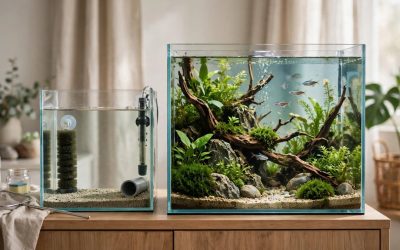
Filters, heaters, plants, rock and wood all displace water and take up space. A decor-heavy scape leaves less swimming room, so choose a tank that still feels roomy after you add hardscape.
Size Ranges at a Glance
| Tank size range | Typical suitability | Main trade-off |
|---|---|---|
| Under 10 gallons | Single betta, shrimp, a few nano fish | Water quality changes quickly |
| 10 to 20 gallons | Small community, planted nano tank | Limited stocking options |
| 20 to 40 gallons | Beginner community, many tetras and livebearers | Needs a proper stand and more floor space |
| 40 to 75 gallons | Larger community, small cichlids | Heavy; plan for placement and weight |
| 75 gallons and up | Big fish, advanced setups | Higher running costs and a serious floor load |
Why Bigger Is Often Easier
A larger water volume changes slowly. A missed feeding, a dead plant leaf or a short power cut has less impact in 40 gallons than in 5. Temperature, pH and waste levels all stay steadier, which makes the hobby more forgiving. That said, bigger tanks cost more to heat, light and fill, and water changes take longer.
Small tanks can work well if you choose compatible species and stay consistent with maintenance. A well-kept 10-gallon planted tank is a better home than a neglected 50-gallon with the wrong fish. Size is only one part of success.
If you are torn, consider a middle path: buy a mid-size tank now, keep the stocking modest for the first few months, and let the tank mature before adding more fish. This gives you the stability benefits of volume without rushing. It also leaves you free to upgrade later if your interests change, for example from a community tank to a planted scape or a species-focused display.
Common Fish Groups and the Room They Want
Bettas are often sold in tiny cups, but they do better in a heated, filtered tank with space to explore, commonly five gallons and up. Shrimp colonies do well in small tanks, yet their numbers grow quickly, so a 10-gallon gives more headroom than a 5. Schooling fish such as tetras and rasboras need a long tank and a group, which usually points to 20 gallons or more.
Goldfish are a classic trap. Fancy and common varieties both grow larger than most people expect and produce a lot of waste, so they call for roomy tanks and strong filtration. Cichlids and other territorial fish need extra floor area and hiding places to avoid fights. When in doubt, read about the adult needs of your chosen species and size up rather than down.
Budget and Running Costs
Think in tiers rather than exact figures. A budget plan covers a basic glass tank, a simple filter and heater, and a hood light. A mid-range plan adds a quality stand, a better filter and a programmable light. A premium plan adds extras like a sump or custom cabinet. Every step up in tank size increases the cost of the stand, substrate, water conditioner and electricity.
Ongoing costs scale with size too. Larger tanks use more conditioner at each water change, need stronger heaters and take more time to clean. If your schedule is tight, a medium tank you can keep up with is more sensible than an ambitious one that slips into neglect.
A Simple Decision Walkthrough
Begin by choosing the fish you most want to keep, since they set the minimum. Next, match that minimum to the space you measured and the weight your floor can carry. Then decide how much time you can give to maintenance. If the result sits between two sizes, pick the larger one when space allows, because it leaves room for a few extra fish, a better scape and a margin for mistakes.
Finally, talk to a local fish store or an experienced keeper before you buy, and compare their advice with what you have read. If you are weighing a tank against a specific cabinet or shelf, measure twice and check the manufacturer weight limit for the furniture.
Before You Buy Checklist
- Measure the exact space, including clearance for lid, light and hoses
- Confirm the floor and stand can handle the full filled weight
- List every fish you want and note adult size and group needs
- Choose a footprint that suits swimming habits, not just gallons
- Plan filter, heater and light for the tank size before you buy a tank
- Think about water-change logistics, including how you will move water
- Leave room to grow if you expect to add fish later
Common Mistakes
- Buying a tank for the fish at store size instead of adult size
- Choosing a tall, narrow tank that offers little swimming length
- Forgetting the weight of water, substrate and stand
- Squeezing a tank into a spot with no room for maintenance
- Assuming a larger tank means you can skip water changes
- Putting a tank near a window and fighting algae
Related guides
- Canister Filter For 55 Gallon Freshwater Tank
- Programmable App Controlled Aquarium Lights
- Beneficial Bacteria Starters For Aquariums
Frequently Asked Questions
Is a bigger tank always better?
Usually, because water quality stays steadier, but only if you can afford the space, equipment and upkeep. A tank you can maintain well is better than a huge one you struggle with.
What is the best size for a beginner?
Many experienced keepers point to 20 to 40 gallons. It is large enough to be forgiving yet small enough to manage, and it offers plenty of stocking choices.
How many fish can I keep per gallon?
There is no safe universal rule. Stocking depends on adult size, behavior, filtration and feeding. Research each species and add fish gradually while watching water readings.
Does tank shape matter?
Yes. Surface area drives oxygen exchange, and footprint drives swimming room. Long, shallow tanks generally suit more species than tall, narrow ones of the same volume.
More from Amazon
Programs that pair well with the guide above. Offers and eligibility are set by Amazon and may change.
Set up recurring deliveries of everyday items on eligible products. Terms and savings are set by Amazon.
Explore Subscribe & SaveFree shipping on eligible items, Prime Video and more. Eligible new members can start with a free trial.
Start a Prime free trialAudiobooks and podcasts to listen to on the go. Eligible new members can start with a free trial.
Try Audible freeRead from a large library of eBooks and audiobooks on any device. Check Amazon for current plans.
Explore Kindle UnlimitedAs an Amazon Associate we earn from qualifying purchases.
Write Your Review
No reviews yet. Be the first to share your experience!