
Our Short List of 3

- Best for: A hobbyist with a 40 to 70 gallon tank in a bedroom or home office who wants quiet running above all else.
- For aquariums up to 70 US gallons
- Maximum flow rate of 1,150 liters per hour
- eTEC construction with ultra-quiet operation, up to 25 percent quieter than previous generations
- EZ-Lift media baskets

- Best for: A planted or community tank of 50 to 100 gallons where the filter must stay quiet in a living room.
- For aquariums up to 100 US gallons
- Pump output of 383 gallons per hour (1,450 liters per hour)
- eTEC construction with ultra-quiet operation, up to 25 percent quieter than previous generations
- EZ-Lift media baskets

- Best for: A large or heavily stocked tank up to 250 gallons where a smaller canister would be undersized.
- For aquariums up to 250 US gallons
- Pump output of 700 gallons per hour (2,650 liters per hour)
- Filter circulation of 450 gallons per hour (1,700 liters per hour)
- Smart Pump technology that monitors pump performance and evacuates trapped air every 12 hours
All 4 Picks at a Glance
| Product | Specs | Action |
|---|---|---|
| Fluval 307 Performance Canister Filter |
| Check price on Amazon |
| Fluval 407 Performance Canister Filter |
| Check price on Amazon |
| Fluval FX4 High Performance Canister Filter |
| Check price on Amazon |
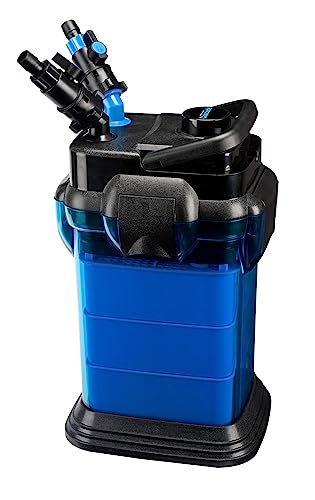 Penn-Plax Cascade 1000 Canister Filter |
| Check price on Amazon |
Our Top Picks
A canister filter lives in the cabinet under the tank, so its hum travels through wood, floor and walls instead of staying behind glass. The real decision is not which filter moves the most water, but which one keeps a bedroom, living room or home office peaceful while still turning the tank over several times an hour. A filter that rattles after a month, gurgles on trapped air or vibrates against the cabinet floor fails at the one job this guide cares about most.
This guide is for aquarium hobbyists who keep a tank where people sleep, work or relax and want filtration that fades into the background. Every filter below was chosen from the name and stated specifications on its Amazon listing, with a stated quiet-running design as the first requirement and tank size and flow rate as the second. No filter here is a hang-on-back, internal or sump unit.
Quick Picks
As an Amazon Associate we earn from qualifying purchases.
| Product | Best for | Key spec from title |
|---|---|---|
| Fluval 307 Performance Canister Filter | A bedroom tank up to 70 gallons | Up to 70 gallons, eTEC ultra-quiet operation |
| Fluval 407 Performance Canister Filter | A planted community tank up to 100 gallons | Up to 100 gallons, 383 GPH pump output |
| Fluval FX4 High Performance Canister Filter | A large or heavily stocked tank up to 250 gallons | Up to 250 gallons, 700 GPH pump output |
| Penn-Plax Cascade 1000 Canister Filter | A first canister on a straightforward setup | Up to 100 gallons, 265 GPH, push-button self-primer |
How to Choose
Match the rating to your tank, not to your ambition
A canister rated far above your tank size pushes more water than slow swimmers and fine substrate can handle, while one rated below it runs flat out all day. Start with the gallon rating on the listing, then check the flow figure beside it: a 55-gallon community tank suits a filter rated for 55 to 70 gallons with roughly 200 to 300 gallons per hour, while a heavily stocked cichlid tank of the same size deserves the next size up. Remember that rated flow is measured with clean media and no head height, so real flow in your cabinet will be lower. Buying one size above the minimum gives headroom without turning the tank into a washing machine.
Read the quiet claim the way the listing means it
Manufacturers describe quiet running in different ways, and the wording matters. A listing that names a specific noise-reducing design, such as a re-engineered pump, a unidirectional impeller with fewer moving joints or rubber feet that damp vibration, gives you something concrete to judge. A listing that only calls itself quiet without saying how is a weaker promise. Also check where the noise comes from in practice: trapped air in the impeller chamber causes gurgling, a canister sitting unevenly on a cabinet floor causes buzzing, and a loose intake causes rattling. The quietest filter on paper still needs a level surface, full priming and hoses that do not vibrate against the cabinet.
Check priming, valves and cabinet fit before you buy
A canister is only easy to live with if starting and servicing it are simple. Self-priming designs, such as a push-button primer or a Smart Pump that starts itself once the canister holds water, remove the messiest part of setup, while manual-prime models ask you to fill the canister by hand before switching on. Quick-disconnect valves matter just as much: they let you lift the canister out for cleaning without draining hoses or spilling tank water across the floor. Measure the cabinet before ordering, because a tall unit with hoses curving out of the top needs more clearance than its body height suggests. Leave room to open the lid and pull the baskets straight up.
Look at media space and spare parts
Quiet running means little if the filter cannot hold enough media for your stocking level, so compare basket layout as well as flow. Stacked baskets that lift out individually let you rinse mechanical media without disturbing biological media, and a pre-filter basket catches coarse debris before it reaches the finer stages. Check what media arrives in the box, since some listings include foam, carbon and biological media while others expect you to buy it separately. Finally, confirm that impellers, O-rings and hoses are easy to find for the brand you choose, because a quiet filter that cannot be repaired after a worn impeller starts buzzing is a short-lived purchase.
The 4 Best Options
Fluval 307 Performance Canister Filter
- Best for: A hobbyist with a 40 to 70 gallon tank in a bedroom or home office who wants quiet running above all else.
- For aquariums up to 70 US gallons
- Maximum flow rate of 1,150 liters per hour
- eTEC construction with ultra-quiet operation, up to 25 percent quieter than previous generations
- EZ-Lift media baskets
A hobbyist with a 40 to 70 gallon tank in a bedroom or home office who wants quiet running above all else.
One recent Amazon listing overview showed a 220 volt rating, so confirm the voltage and seller details match a US 120 volt supply before ordering.
The Fluval 307 suits the hobbyist whose tank shares a wall with a bedroom. Its eTEC pump is built around a re-engineered design that the listing describes as running up to 25 percent quieter than previous generations, and it draws about as much energy as a single LED bulb. Rated for aquariums up to 70 gallons, it covers the mid-size community tanks most hobbyists actually keep, and its EZ-Lift baskets come out with one finger for rinsing. The AquaStop valve lets you stop water flow and disconnect hoses for maintenance without a spill.
Watch out for: One recent Amazon listing overview showed a 220 volt rating, so confirm the voltage and seller details match a US 120 volt supply before ordering.
Fluval 407 Performance Canister Filter
- Best for: A planted or community tank of 50 to 100 gallons where the filter must stay quiet in a living room.
- For aquariums up to 100 US gallons
- Pump output of 383 gallons per hour (1,450 liters per hour)
- eTEC construction with ultra-quiet operation, up to 25 percent quieter than previous generations
- EZ-Lift media baskets
A planted or community tank of 50 to 100 gallons where the filter must stay quiet in a living room.
The strong flow can push fine substrate and delicate plants around unless you fit a spray bar or aim the output at the glass.
The Fluval 407 takes the same quiet eTEC pump design as the 307 and scales it up for larger community and planted tanks. Its listing states ultra-quiet operation with a pump running up to 25 percent quieter than previous generations, and the 383 gallon per hour pump output gives a 100-gallon tank solid turnover even after media and head height take their share. The EZ-Lift baskets make the larger media load manageable, and the AquaStop valve keeps routine cleaning tidy. Planted tank keepers will appreciate the strong flow paired with a spray bar option for spreading it gently.
Watch out for: The strong flow can push fine substrate and delicate plants around unless you fit a spray bar or aim the output at the glass.
Fluval FX4 High Performance Canister Filter
- Best for: A large or heavily stocked tank up to 250 gallons where a smaller canister would be undersized.
- For aquariums up to 250 US gallons
- Pump output of 700 gallons per hour (2,650 liters per hour)
- Filter circulation of 450 gallons per hour (1,700 liters per hour)
- Smart Pump technology that monitors pump performance and evacuates trapped air every 12 hours
A large or heavily stocked tank up to 250 gallons where a smaller canister would be undersized.
The Smart Pump pauses briefly every 12 hours to purge air, and that purge is audible, so expect a short burst of noise twice a day rather than total silence.
The Fluval FX4 is the heavy lifter of this group, built for tanks up to 250 gallons where smaller canisters would run at their limit. Its Smart Pump monitors the impeller and evacuates trapped air on a 12-hour cycle, which removes one of the main causes of gurgling in big canisters, and rubberized feet damp the vibration a powerful motor would otherwise pass into the cabinet. The basket-in-basket trays hold a large volume of media, and the built-in water-change system lets you drain and refill without carrying buckets. It is a large unit, so it belongs under a tank with a cabinet that can take its footprint and hose routing.
Watch out for: The Smart Pump pauses briefly every 12 hours to purge air, and that purge is audible, so expect a short burst of noise twice a day rather than total silence.
Penn-Plax Cascade 1000 Canister Filter
- Best for: A hobbyist setting up a first canister on a community tank up to 100 gallons who wants simple priming.
- For aquariums up to 100 gallons
- Flow rate of 265 gallons per hour
- Quietly delivers crystal clear water, as stated on the listing
- 3 poly fiber floss pads, 1 coarse bio-sponge and 1 bag of activated carbon included
A hobbyist setting up a first canister on a community tank up to 100 gallons who wants simple priming.
It has fewer flow-control and convenience features than the Fluval models, so check that the fixed flow suits your fish before buying.
The Penn-Plax Cascade 1000 is the straightforward pick for a hobbyist buying a first canister. Its Amazon listing says it quietly delivers clear water, and the design keeps things simple: a push-button self-primer starts the siphon without manual filling, and independent 360-degree rotating valve caps let you aim the hoses where the cabinet allows. Three media baskets hold the included floss pads, bio-sponge and activated carbon, so it arrives ready to run. At 265 gallons per hour for tanks up to 100 gallons, it suits community tanks that need steady turnover rather than maximum flow.
Watch out for: It has fewer flow-control and convenience features than the Fluval models, so check that the fixed flow suits your fish before buying.
Which One Fits Your Situation
Your tank sits in a bedroom or home office
Choose the Fluval 307. Its eTEC pump is the listing’s central quiet claim, and the 70-gallon rating covers most bedroom tanks without oversizing the flow. The EZ-Lift baskets and AquaStop valve also mean late-night maintenance stays quick and dry, which matters when the tank is steps from where you sleep.
You run a planted community tank of 50 to 100 gallons
Choose the Fluval 407. It shares the 307’s quiet pump design but adds the flow and media volume a planted tank with moderate stocking needs. Pair it with a spray bar to spread the output across the surface, and the plants get gentle circulation instead of a single hard jet.
You keep a large or heavily stocked tank
Choose the Fluval FX4. A 250-gallon rating, 700 gallon per hour pump output and large media trays give it the capacity a big tank demands, while the Smart Pump’s air evacuation and rubberized feet address the noise that usually comes with a motor this size. Just make sure the cabinet has room for its footprint.
You want your first canister without a complicated setup
Choose the Penn-Plax Cascade 1000. The push-button primer and rotating valves remove the two fiddliest parts of installing a canister, and the included media means it runs straight out of the box. It is the least feature-heavy pick here, but for a community tank up to 100 gallons that simplicity is the point.
Common Mistakes
- Buying a filter rated exactly for your tank size and then stocking heavily, which leaves no headroom once media clogs and flow drops.
- Judging quietness from the brand name alone instead of checking whether the listing names a specific noise-reducing design, such as a re-engineered pump or vibration-damping feet.
- Skipping the priming step or starting the filter with air still in the chamber, which causes the gurgling most owners blame on the motor.
- Setting the canister on an uneven cabinet floor with hoses touching the cabinet walls, so vibration turns into an audible buzz.
- Cleaning every media tray at once in tap water, which strips out the beneficial bacteria the filter exists to support.
Frequently Asked Questions
How quiet should a canister filter be in a bedroom?
A well-chosen canister should fade into background room noise once primed and seated level in a closed cabinet. Listings that name a noise-reducing pump design or vibration-damping feet are the best guide, since makers rarely publish a standard noise figure. If you can hear a rattle or gurgle, check for trapped air, a loose intake or an uneven surface before blaming the filter.
Can a canister filter be too strong for my fish?
Yes. High flow stresses slow swimmers such as bettas and angelfish and blows fine substrate around the tank. Choose a filter rated for your tank size rather than the largest available, and use a spray bar or aim the output at the glass to spread the current. Adjustable flow or a smaller model is the safer choice for gentle species.
How often should I clean a quiet canister filter?
Most hobbyists open the canister every one to three months, depending on stocking and how quickly flow drops. Rinse mechanical media in old tank water, never tap water, and clean only part of the biological media at a time. A sudden drop in flow usually means the pre-filter or foam pads are clogged, not that the motor is failing.
Do I need a second filter for a large tank?
Not always, but redundancy helps on large or heavily stocked tanks. Two filters mean one can be cleaned while the other keeps running, and a failure is less disruptive. On a tank above 100 gallons, pairing a main canister with a smaller second filter is a common setup among hobbyists who want a backup.
More from Amazon
Programs that pair well with the guide above. Offers and eligibility are set by Amazon and may change.
Set up recurring deliveries of everyday items on eligible products. Terms and savings are set by Amazon.
Explore Subscribe & SaveFree shipping on eligible items, Prime Video and more. Eligible new members can start with a free trial.
Start a Prime free trialAudiobooks and podcasts to listen to on the go. Eligible new members can start with a free trial.
Try Audible freeRead from a large library of eBooks and audiobooks on any device. Check Amazon for current plans.
Explore Kindle UnlimitedAs an Amazon Associate we earn from qualifying purchases.


Write Your Review
No reviews yet. Be the first to share your experience!