
Key takeaways
- Compare the best terrestrial plants for aquarium rims and ripariums: pothos, lucky bamboo, peace lily and spider plant picks, plus setup and care tips.
As an Amazon Associate we earn from qualifying purchases


Some of the healthiest growth in a planted tank happens above the waterline. Terrestrial plants grown emergent style, with their roots in the aquarium water and their leaves in the open air, pull dissolved waste from the water column while adding a lush, natural frame around the rim. Because their leaves breathe open air instead of competing for dissolved carbon dioxide, these plants often grow faster than fully submerged species, and their dangling root systems give fry and shrimp extra cover.
The catch is that not every houseplant tolerates wet roots, and not every seller listing is a good fit for a tank rim. This guide to the best terrestrial plants for aquarium use covers four live plants sold on Amazon US that adapt well to emergent growing: golden pothos, lucky bamboo, peace lily and spider plant. Each one is sold as a live plant listing, so what arrives is a real, rooted plant you can rinse, position and grow on. Below you will find how to choose between them, what each plant does well, where each one falls short, and the setup mistakes that cause most failures.
Quick Picks
Our Short List of 3
- Strength: Roots quickly from stem sections, so one 4-inch pot can stock a whole rim.
- Strength: Tolerates the modest light most rooms provide and still grows steadily.
- Strength: Dense hanging roots give fry and shrimp sheltered surface area.
- Trade-off: The fastest grower here, so it needs trimming to stop it shading the water surface.
- Strength: Sold already water-rooted, so there is no soil to wash off and no adaptation from dry roots.
- Strength: Slim, vertical stems suit narrow rims and small tanks where trailing plants overwhelm.
- Strength: Slow growth means months can pass between trims.
- Trade-off: Only the roots and lower stem may sit in water; if the leafy top goes under, that stem will rot.
- Strength: Naturally suited to wet roots, being a waterside plant in its native habitat.
- Strength: Arrives large, giving a riparium or open-top tank an instant focal plant.
- Strength: Broad leaves shade the water edge, which many fish prefer over bright open surface.
- Trade-off: Its size overwhelms small tanks; it needs a medium or large footprint.
All 4 Picks at a Glance
| Product | Specs | Action |
|---|---|---|
| Golden Pothos (Epipremnum aureum) — Wekiva Foliage |
| Check price on Amazon |
| Lucky Bamboo (Dracaena sanderiana) — Arcadia Garden Products LV24 |
| Check price on Amazon |
| Peace Lily (Spathiphyllum) — Costa Farms |
| Check price on Amazon |
 Spider Plant (Chlorophytum comosum) — Perfect Plants |
| Check price on Amazon |
All four picks are true terrestrial plants, not submerged aquatics. That is the whole point of this category: the roots work in the water, the foliage works in the air. If you want plants that live entirely underwater, this is the wrong list. If you want greenery rising out of the tank, these four are the most forgiving places to begin.
Choosing the Best Terrestrial Plants for Aquarium Rims
Roots in the Water, Leaves in the Air
The single rule that decides success is the waterline. For every plant in this guide, roots and the lowest part of the stem can sit in the water, but the leaves and crown must stay dry and above the surface. A leaf trapped underwater cannot exchange gases the way it does in air, so it yellows, softens and rots, and rotting foliage fouls the water you were hoping the plant would clean. Before buying, picture exactly where the plant will sit: in a hang-on-back filter, in a rim planter, wedged among hardscape at the back, or in a shallow riparium ledge. The plant’s mature shape has to match that spot.
Light Above the Waterline
Emergent leaves use room light or the spill from your aquarium light, and they need more of it than most people expect. A tank in a dim corner will keep a pothos alive but growing slowly, while the same plant under a bright window ledge or a raised light fixture pushes out new leaves steadily. Check the light guidance on each listing: the pothos and spider plant here are listed for partial shade, which suits a bright room without direct sun. Direct midday sun through glass can scorch leaves held close to it, so a little distance from south-facing windows is safer.
Growth Rate and Tank Size
Fast growers are a blessing in a large, heavily stocked tank and a burden in a nano tank. Pothos is the fastest plant on this list and will need regular trimming so its vines do not shade the whole surface. Peace lily is the biggest plant here, listed at 14 to 24 inches tall, and it earns that footprint only in a medium or large setup. Lucky bamboo grows slowly and stays narrow, which makes it the natural pick for small tanks and tight rims. Match the plant’s pace to the space you can actually give it.
How the Plant Arrives
Every pick below ships as a live plant in a pot, not as a bare cutting or a packet of seed. That matters for aquarium use because a rooted plant adapts faster once its roots reach the water. Plan to remove the plant from its pot, rinse all soil from the roots under tap water, and trim any damaged roots before the roots go into the tank. Soil and the fertilizer it carries do not belong in aquarium water. Some keepers also rest new plants in a separate container of dechlorinated water for a few days, which lets any surface treatments from the grower rinse away before the plant meets sensitive livestock.
Livestock and Household Safety
Grown with roots in the water and leaves in the air, these plants are widely kept alongside fish and shrimp, and their roots are generally left alone by livestock. Two cautions still apply. First, pothos, peace lily and lucky bamboo are all plants that should not be eaten by cats or dogs, so position trailing leaves where a curious pet cannot chew them. Second, any plant can arrive carrying snail eggs or hitchhikers on its roots and leaves, so inspect and rinse each plant before it goes near the tank, just as you would with any new addition.
The Picks in Detail
Golden Pothos (Epipremnum aureum) — Wekiva Foliage
- Strength: Roots quickly from stem sections, so one 4-inch pot can stock a whole rim.
- Strength: Tolerates the modest light most rooms provide and still grows steadily.
- Strength: Dense hanging roots give fry and shrimp sheltered surface area.
- Trade-off: The fastest grower here, so it needs trimming to stop it shading the water surface.
Golden pothos is the default recommendation for emergent aquarium growing, and for good reason. It roots readily in plain water, tolerates a wide range of light, and its roots draw on the nitrogen compounds your filter produces. This Wekiva Foliage listing is a live plant in a 4-inch pot, listed for partial shade with moderate watering needs, which makes it easy to divide: one pot usually yields several stems, and each stem with a node can be rooted along the back rim or inside a hang-on-back filter chamber. The green-and-gold variegated leaves trail over the edge of the tank and keep growing as long as the roots stay wet and the leaves stay dry.
Skip it if: your tank has a tight-fitting lid with no opening for stems, because pothos needs its leaves in open air.
Lucky Bamboo (Dracaena sanderiana) — Arcadia Garden Products LV24
- Strength: Sold already water-rooted, so there is no soil to wash off and no adaptation from dry roots.
- Strength: Slim, vertical stems suit narrow rims and small tanks where trailing plants overwhelm.
- Strength: Slow growth means months can pass between trims.
- Trade-off: Only the roots and lower stem may sit in water; if the leafy top goes under, that stem will rot.
Lucky bamboo is not a true bamboo but a Dracaena, and it is one of the few houseplants routinely sold already growing in water. This Arcadia Garden Products LV24 arrangement comes with 5 stems rooted in water and pebbles in an aged wood planter, with no soil involved, and the plant stands roughly 13 to 19 inches tall including the container. For aquarium use, the bare stems transfer neatly into a rim planter, a filter compartment or a cluster of hardscape at the waterline, where their upright form adds height without spreading sideways. Growth is slow, which keeps maintenance low.
Skip it if: you want quick nutrient uptake from a fast-growing root mass, because this plant’s slow pace works against that goal.
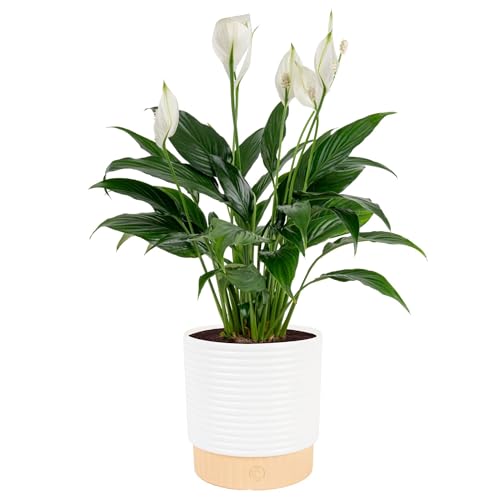
Peace Lily (Spathiphyllum) — Costa Farms
- Strength: Naturally suited to wet roots, being a waterside plant in its native habitat.
- Strength: Arrives large, giving a riparium or open-top tank an instant focal plant.
- Strength: Broad leaves shade the water edge, which many fish prefer over bright open surface.
- Trade-off: Its size overwhelms small tanks; it needs a medium or large footprint.
Peace lily is a marginal plant by nature, growing in damp ground at the edges of water in the wild, which is exactly the position an emergent aquarium plant occupies. The Costa Farms listing ships a live plant in a decorative pot at 14 to 24 inches tall (item model CO.SPATH6.13.BAM), so what arrives is already a substantial plant rather than a starter. Set the washed root ball into a riparium planter or a shallow ledge with the crown above the waterline, and the broad leaves arch out over the tank while the roots work below. It is the only pick here that also flowers, producing white spathes above the foliage when light is adequate.
Skip it if: your setup is a small desktop tank, because this plant will outgrow the rim quickly.
Spider Plant (Chlorophytum comosum) — Perfect Plants
- Strength: Self-propagating plantlets root at the waterline with no effort from the keeper.
- Strength: The variegated foliage adds contrast against plain green tank planting.
- Strength: A forgiving plant that tolerates irregular care and moderate light.
- Trade-off: The crown rots if it sits in the water, so it must be held above the surface, not floated.
Spider plant earns its place on this list through its plantlets. A mature plant sends out arching stems tipped with small copies of itself, and those plantlets root eagerly when they touch water. This Perfect Plants listing is a live plant in a 6-inch grower’s pot with green and white variegated leaves. Perched in a rim planter with the crown kept dry, the mother plant stays compact while the plantlets cascade toward the surface and root at the waterline, creating a curtain of small plants above the tank. It is also the pick to consider when plant-eating pets are a concern, as spider plant is the one plant in this guide generally regarded as a safer choice around cats and dogs.
Skip it if: you cannot mount a planter at the rim, because this plant needs its base held clear of the water.
Which One Fits Your Situation
A Standard Community Tank With a Hang-on-Back Filter
Choose the golden pothos. Stems root inside many hang-on-back filter chambers or along the back rim through the gaps in the cover, the roots take up waste between water changes, and one pot supplies enough stems to fill the available slots. Trim the vines whenever they start to cover more than about a third of the surface so submerged plants and surface-feeding fish still get light and access.
A Riparium or Paludarium Build
Choose the peace lily as the centrepiece and support it with lucky bamboo. The lily’s size and flowering habit give the land-water boundary a finished look, while the bamboo stems add vertical lines at the back without spreading. Both tolerate permanently wet roots, which is the defining condition of a riparium planting ledge.
A Small Tank in a Low-Light Room
Choose lucky bamboo. It grows slowly, asks little of the available light compared with flowering plants, and its narrow stems fit the limited rim space a small tank offers. Set the stems so only the roots and the lowest section of stalk are submerged, and expect steady, undramatic growth rather than rapid coverage.
A Shrimp Tank Where Caution Comes First
Choose the spider plant, and prepare it carefully. Rinse the roots thoroughly, rest the plant in clean dechlorinated water for several days, and inspect for hitchhikers before it goes near the colony. The plantlets rooting at the surface give shrimplets grazing cover, and the mother plant’s modest pace will not strip nutrients faster than a fed colony produces them.
Common Mistakes
- Submerging the whole plant. Leaves and crowns rot underwater; only roots and the lowest stem belong below the waterline.
- Skipping the rinse. Potting soil, fertilizer residue and grower treatments should be washed off before roots enter the tank.
- Planting straight into the display tank. A few days in a separate container lets you spot hitchhikers and damaged roots first.
- Putting a fast grower in a tiny tank. Pothos in a nano setup quickly shades the surface and crowds the rim.
- Sealing the lid over emergent leaves. Trapped heat and condensation damage foliage pressed against a closed cover.
- Expecting plants to replace maintenance. Emergent roots absorb some waste, but they do not remove the need for filtration and water changes.
- Letting pets chew the leaves. Pothos, peace lily and lucky bamboo should be positioned where cats and dogs cannot eat them.
FAQ
Can terrestrial plants really grow with their roots in aquarium water?
Yes, provided the species tolerates wet roots and the foliage stays in the air. All four plants in this guide meet that condition: pothos and spider plant root from stems and plantlets in water, lucky bamboo is sold already growing in water, and peace lily grows at the water’s edge in the wild. The failure mode is almost always the same — leaves or crowns pushed below the surface, where they rot.
Do emergent plants replace a filter or water changes?
No. Root systems absorb dissolved nitrogen compounds and give beneficial bacteria extra surface, which supports water quality, but they do not trap solid waste, oxygenate the water or remove everything a filter and a water change handle. Treat them as a helpful addition to a normal maintenance routine, not a substitute for one.
How do I hold a plant at the rim of the tank?
Common approaches include suction-cup or hang-on rim planters, a basket inside a hang-on-back filter, wedging stems between hardscape at the back, or a dedicated riparium ledge. What matters is that the roots hang in the water while the base of the plant is held firmly above the waterline, and that the arrangement stays put when you work in the tank.
Will these plants harm fish or shrimp?
With the leaves out of reach above the water, these plants are widely kept with fish and shrimp without problems, and the submerged roots are usually ignored or used as cover. The bigger risk is what arrives on a new plant — soil, fertilizer or hitchhikers — which is why rinsing and a short rest in clean water before planting is worth the small effort.
How fast will a pothos cutting root in tank water?
A stem section with at least one node typically shows new roots within a couple of weeks in a lit, filtered tank, and leaf growth follows once the roots establish. Warmer water and brighter light above the rim speed things along. If a section has no node, it will not root no matter how long it sits, so check each piece before you place it.
What should I do if leaves yellow after moving a plant to the tank?
First, check the waterline: a leaf that slipped underwater or a crown sitting too low is the most common cause, and lifting the plant usually stops the decline. Next, consider light, since a plant moved from a bright shop to a dim room often sheds a leaf or two while it adjusts. Remove any soft, rotting material promptly so it does not foul the water, and give the roots time to adapt before judging the plant a failure.
More from Amazon
Programs that pair well with the guide above. Offers and eligibility are set by Amazon and may change.
Set up recurring deliveries of everyday items on eligible products. Terms and savings are set by Amazon.
Explore Subscribe & SaveFree shipping on eligible items, Prime Video and more. Eligible new members can start with a free trial.
Start a Prime free trialAudiobooks and podcasts to listen to on the go. Eligible new members can start with a free trial.
Try Audible freeRead from a large library of eBooks and audiobooks on any device. Check Amazon for current plans.
Explore Kindle UnlimitedAs an Amazon Associate we earn from qualifying purchases.


Write Your Review
No reviews yet. Be the first to share your experience!