
Our Short List of 3

- Best for: nano reefs and small planted tanks that need a simple two-pump layout.
- Flow rate: 425 GPH (1,608 L/h maximum)
- Item model number: P29201
- Body length: 2.4 inches
- Built-in cable protector

- Best for: mid-size fresh or saltwater tanks where two pumps should share one pattern.
- Maximum flow: 2114 GPH
- Power: 10 W, DC 24 V
- LED controller with 6 wave modes
- 20 wave strength levels and 99 flow interval options
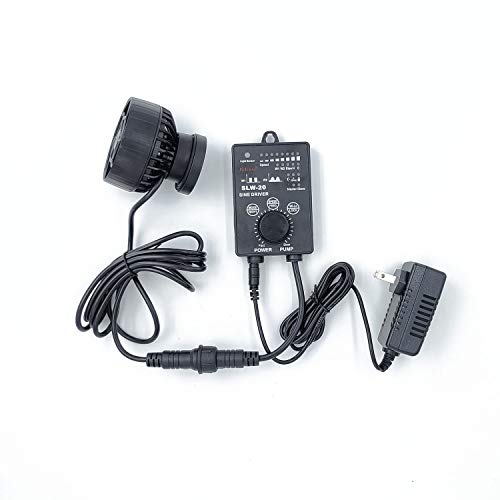
- Best for: reefs of roughly 75 gallons and up running two pumps on opposite ends.
- Flow rate: 2641 GPH (10,000 L/h)
- Power: 20 W
- Sine wave flow technology
- Controller included
All 4 Picks at a Glance
| Product | Specs | Action |
|---|---|---|
| Hydor Koralia Nano 425 |
| Check price on Amazon |
| hygger 2114 GPH Inverter Wavemaker |
| Check price on Amazon |
| Jebao SLW-20 |
| Check price on Amazon |
 Tunze Turbelle Nanostream 6025 |
| Check price on Amazon |
Key takeaways
- Two circulation pumps beat one when they are placed well. Compare four pumps that pair well, plus layouts for opposite ends, gyre flow and high-low setups.
Running two circulation pumps raises a question a single pump never does: where does the second one go, and how should the two streams meet? The real decision is coverage, not raw power. One pump always leaves a calm corner where waste settles, while a well-placed pair can carry debris toward the filter intake, ripple the whole surface and keep every zone moving. Choosing the pair means deciding how their outputs combine, then picking pumps whose size, mounts and controls suit that layout.
This guide is for nano reef keepers with one dead corner, planted tank owners chasing even movement, and reef hobbyists with rockwork that blocks a single stream. Each pump below was chosen from its Amazon listing details: published flow output, mount style and controller features that matter when two units share one tank. Two are compact fixed-output models, and two are DC wavemakers with controllers that can sync or alternate a pair.
Quick Picks
As an Amazon Associate we earn from qualifying purchases.
| Product | Best for | Key spec from title |
|---|---|---|
| Hydor Koralia Nano 425 | Nano and small tanks | 425 GPH in a 2.4-inch body |
| hygger 2114 GPH Inverter Wavemaker | Paired mid-size setups | 2114 GPH with LED controller |
| Jebao SLW-20 | Larger reef tanks | 2641 GPH sine wave flow |
| Tunze Turbelle Nanostream 6025 | Simple fixed-flow pairs | 2,800 L/h from a 70 mm body |
How to Choose
Combined Output Matters More Than One Big Pump
Add the two pumps together and judge the pair against your livestock, not against a headline figure. Two moderate pumps on opposite walls move the full water column more evenly than one oversized unit blasting from a single point. Coral and fish also tolerate two gentler streams better than one harsh jet. As a rough guide, aim for combined movement that turns the tank volume over many times per hour in a reef, and far less in a planted tank where leaves should sway, not bend flat. If a pair feels too strong, two controllable pumps let you turn both down rather than removing one.
Decide How the Two Streams Should Meet
Placement geometry does the real work. Mounting pumps on opposite end walls, aimed at each other, creates a meeting zone in the middle where currents collide and tumble downward, lifting waste off the substrate. Angling both along the same long wall builds a circular gyre that travels the full tank length and returns along the opposite side. A high-low split, one pump near the surface and one near the bottom on the far wall, suits tall tanks and dense rockwork. Pick the pattern first, because it decides which wall, height and aim each pump needs before you buy.
Control, Sync and Timing Options
A pair behaves very differently depending on control. Fixed-output pumps run constantly, so placement and aim carry the whole plan. DC wavemakers add wave modes, feed pauses and night settings, and some link two units wirelessly so they pulse together or take turns. Alternating a pair on timers can sweep dead zones that a steady pattern misses, since the calm corner moves each time the active pump changes. If you want that flexibility, choose pumps with a controller in the box and confirm from the listing whether a second unit can follow the same controller or link to it.
Mounts, Glass Thickness and Cable Runs
Two pumps mean two mounts and two cables, so check the hardware details on each listing. Magnetic holders reposition in seconds, which matters while you experiment with placement, while suction cups suit thin glass and smooth surfaces. Confirm the magnet strength against your glass thickness, since a mount that slips will slowly rotate and redirect the stream. Plan cable routes before filling the tank: cords should reach a drip loop outside the water without crossing the rim at awkward angles. Compact bodies hide behind rockwork more easily, and a built-in cable protector guards the cord where it leaves the pump.
The 4 Best Options
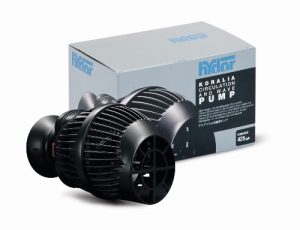
Hydor Koralia Nano 425
- Best for: nano reefs and small planted tanks that need a simple two-pump layout.
- Flow rate: 425 GPH (1,608 L/h maximum)
- Item model number: P29201
- Body length: 2.4 inches
- Built-in cable protector
nano reefs and small planted tanks that need a simple two-pump layout.
output is fixed, so a very small tank may need careful aiming rather than full facing placement.
In a nano tank, two of these small pumps solve the classic problem of one corner collecting mulm while the opposite corner gets battered. The 2.4-inch body tucks onto each end wall of a small aquarium without dominating the view, and the gentle 425 GPH stream suits a facing pair: the currents meet mid-tank, soften each other and drop debris where a small filter can collect it. With no controller to program, placement is the whole setup, so angle each pump slightly upward for surface ripple and toward the front glass for a visible return sweep.
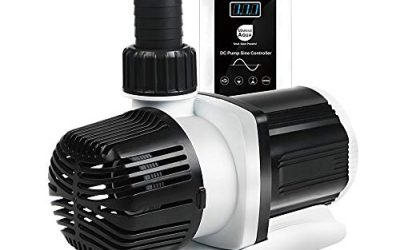
hygger 2114 GPH Inverter Wavemaker
- Best for: mid-size fresh or saltwater tanks where two pumps should share one pattern.
- Maximum flow: 2114 GPH
- Power: 10 W, DC 24 V
- LED controller with 6 wave modes
- 20 wave strength levels and 99 flow interval options
mid-size fresh or saltwater tanks where two pumps should share one pattern.
at full strength a pair is far too much for the smallest tanks in its range, so plan to run both low.
This DC wavemaker fits the mid-size tank where a pair needs to act as one system. Its listing describes six wave modes and wireless multi-pump control, so two units can pulse in sync along one wall for a gyre pattern or alternate from opposite ends. The LED controller adjusts wave strength across many levels, which helps because two pumps at full output would overwhelm the 30 to 75 gallon range the listing names. Mount one high on the left wall and the second lower on the right, then tune strength until plants or coral sway without leaning permanently.
Jebao SLW-20
- Best for: reefs of roughly 75 gallons and up running two pumps on opposite ends.
- Flow rate: 2641 GPH (10,000 L/h)
- Power: 20 W
- Sine wave flow technology
- Controller included
reefs of roughly 75 gallons and up running two pumps on opposite ends.
even turned down, a pair can shift fine sand, so aim slightly upward in shallow sand beds.
For a larger reef with heavy rockwork, two SLW-20 pumps on opposite end walls give the broad, sine wave push that keeps flow moving behind structures instead of dying against them. The 2641 GPH output per pump sounds like a lot, and it is, but the wide propeller pattern spreads it over a broad area rather than a narrow jet, so a facing pair creates a rolling mid-tank exchange. The included controller brings wave, feed and night modes, letting the pair calm down after dark. Keep both intakes clear of the rockwork so the pattern stays symmetrical.
Tunze Turbelle Nanostream 6025
- Best for: low-energy two-pump layouts in small to mid-size tanks that run all day.
- Maximum flow rate: 2,800 L/h (about 740 GPH)
- Item model number: 6025.000
- Diameter: 7 cm
- Item weight: 570 g
low-energy two-pump layouts in small to mid-size tanks that run all day.
there is no controller or speed adjustment, so an oversized pairing cannot be dialed back.
This compact propeller pump suits keepers who want a pair that simply runs, quietly and constantly, with almost no power draw. At 5 W per pump, two units cost little to run around the clock, and the ball-shaped 70 mm body rotates on its magnet holder so you can fine-tune aim during placement trials. A common layout puts one on each rear corner, angled toward the front center, which sweeps the front glass and returns flow along the substrate. Because output is fixed at 2,800 L/h, tank size and aim do all the tuning, so it rewards patient positioning.
Which One Fits Your Situation
Nano Reef With Two Calm Corners
Choose two Hydor Koralia Nano 425 pumps, one on each end wall, angled slightly up and toward the front. Their small bodies suit tanks where a wavemaker would look bulky, and the meeting currents keep waste from settling behind frags. If one corner still collects debris, rotate that pump a few degrees rather than adding a third unit.
Mid-Size Tank Wanting a Circular Gyre
Pick two hygger 2114 GPH wavemakers and mount both along the same long wall, one near each end, aimed down the tank’s length. Linked through their controllers, they push a single circular current that travels the full display and returns along the substrate. Run the strength low and raise it gradually until the return sweep lifts debris without moving sand.
Larger Reef With Dense Rockwork
Go with two Jebao SLW-20 pumps on opposite end walls at mid height, facing each other across the rockwork. The broad sine wave output wraps around structures better than a narrow jet, and the colliding streams tumble downward behind the scape where dead zones usually form. Use the night mode so the pair eases off while the tank rests.
Planted Tank Needing Gentle, Even Movement
A pair of Tunze Nanostream 6025 pumps on the rear corners, aimed at the front glass, spreads movement without flattening stems. The fixed output is modest, the draw is only 5 W each, and the wide pattern keeps carbon dioxide and nutrients circulating to every planting zone. Angle one slightly higher to ripple the surface and help gas exchange.
Common Mistakes
- Mounting both pumps on the same wall, which pushes all the water one way and leaves the far end calm.
- Aiming two strong pumps directly at each other at full power, creating a chaotic clash zone that stresses fish and lifts substrate.
- Placing both pumps at exactly the same height, so the lower half of a tall tank never gets swept.
- Buying two oversized pumps and running them at maximum instead of choosing a pair that suits the tank at moderate settings.
- Burying both intakes behind rockwork, where the blocked intake weakens output and quietly ruins the pattern you planned.
Frequently Asked Questions
Should two circulation pumps face each other?
Facing placement works well in long tanks because the streams meet in the middle, tumble downward and lift waste toward the filter intake. It suits broad, gentle pumps best. If the meeting zone looks violent, angle each pump a little toward the front glass so the currents cross at a softer angle instead of colliding head-on.
Is it better to run both pumps at once or alternate them?
Running both gives steady, predictable coverage and is the simpler default. Alternating on timers or linked controllers sweeps a wider area over time, because the calm zone shifts with each changeover. Alternation helps most in tanks with heavy rockwork. Whichever pattern you choose, keep at least one pump moving the surface at all times.
Where should the second pump go in a long tank?
The most useful default is the opposite end wall from the first pump, at a slightly different height. That pairing covers the full length and avoids a layered flow that only moves the top or bottom. In a gyre layout, the second pump instead joins the same wall near the far end and pushes in the same direction.
How much combined flow does a two-pump setup need?
Add both pumps’ output together and compare it with your livestock. Reef tanks commonly run combined movement many times the tank volume per hour, while planted and fish-only tanks need far less. Two smaller pumps turned down usually beat one large pump at full strength, because the flow comes from two directions and leaves fewer dead zones.
More from Amazon
Programs that pair well with the guide above. Offers and eligibility are set by Amazon and may change.
Set up recurring deliveries of everyday items on eligible products. Terms and savings are set by Amazon.
Explore Subscribe & SaveFree shipping on eligible items, Prime Video and more. Eligible new members can start with a free trial.
Start a Prime free trialAudiobooks and podcasts to listen to on the go. Eligible new members can start with a free trial.
Try Audible freeRead from a large library of eBooks and audiobooks on any device. Check Amazon for current plans.
Explore Kindle UnlimitedAs an Amazon Associate we earn from qualifying purchases.





Write Your Review
No reviews yet. Be the first to share your experience!