

Key takeaways
- NewAir NBF046SS00: about 2.54 square feet from cabinet width and depth alone.
- EdgeStar CBR1501SG: about 4.04 square feet, nearly 60% more than the NewAir.
- hOmeLabs 120-Can: about 2.32 square feet.
- Danby DBC026A1BSSDB: about 2.59 square feet.
Best Large Capacity Beverage Refrigerators
The best large capacity beverage refrigerators for most homes are the NewAir NBF046SS00 for maximum can storage, the EdgeStar CBR1501SG for a flexible mixed-can-and-bottle layout, and the Danby DBC026A1BSSDB when quieter operation and a smaller footprint matter more than headline capacity.
Capacity figures are manufacturer-rated estimates, usually based on standard 12-ounce cans with shelves arranged for maximum density. Real usable capacity is lower when you store tall bottles, wine-style bottles, growlers, or mixed containers. The comparison below focuses on the measurements that affect day-to-day use rather than capacity alone.
Our top picks


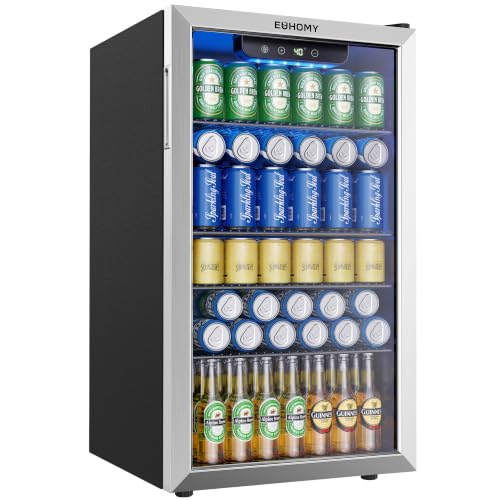
As an Amazon Associate we earn from qualifying purchases at no extra cost to you. Ratings are shown as listed on Amazon.
Head-to-head comparison
| Refrigerator | Rated capacity | Approx. external size (W × D × H) | Temperature range | Shelf arrangement | Approx. weight | Best fit |
|---|---|---|---|---|---|---|
| NewAir NBF046SS00 | Up to 160 cans | 19.3 × 18.9 × 33.1 in | 37–64°F | Adjustable wire shelves; can-rack layout | About 58 lb | Maximum can capacity in a compact upright cabinet |
| EdgeStar CBR1501SG | Up to 130 cans | 23.4 × 24.8 × 34.0 in | 38–65°F | Adjustable shelves with removable racks | About 88 lb | Mixed cans and bottles with a wider interior |
| hOmeLabs 120-Can Beverage Refrigerator | Up to 120 cans | 17.3 × 19.3 × 33.1 in | 34–61°F | Removable and adjustable chrome shelves | About 67 lb | Budget-conscious buyers needing a narrow cabinet |
| Danby DBC026A1BSSDB | Up to 95 cans | 19.7 × 18.9 × 32.7 in | 43–57°F | Adjustable glass shelves | About 55 lb | Smaller households and quieter indoor use |
Dimensions and capacity can vary slightly by production revision, so confirm the specification sheet before ordering. The depth figures above do not include every possible door-handle projection or the rear clearance required for ventilation.
Which refrigerator wins for your situation?
| Your situation | Best choice | Why | Trade-off |
|---|---|---|---|
| You mostly store standard cans | NewAir NBF046SS00 | Its tall, narrow cabinet makes efficient use of vertical floor space and offers one of the largest can ratings in this group. | Less convenient for large bottles and unusually shaped containers. |
| You alternate between cans, bottles, and mixers | EdgeStar CBR1501SG | The wider cabinet and adjustable shelving make it easier to create a tall section for bottles without sacrificing every shelf. | It needs considerably more floor depth and is heavier to move. |
| You have a narrow alcove and a limited budget | hOmeLabs 120-Can | Its roughly 17-inch width fits spaces where wider 130- or 160-can units may not. | Interior organization is less useful if you regularly store tall bottles. |
| You value moderate capacity and a conservative temperature range | Danby DBC026A1BSSDB | Glass shelves are easier to wipe clean, and the cabinet is suitable for ordinary beverage chilling rather than near-freezing storage. | The 95-can rating is noticeably lower than the other options. |
Capacity: compare usable storage, not the number on the box
A 160-can rating assumes nearly perfect packing of identical cans. A more realistic planning figure is 70–85% of the advertised capacity when you want drinks visible and accessible. For the NewAir, that means roughly 112–136 cans in normal mixed use. If you reserve one shelf for 16-ounce cans and another for bottles, usable capacity can fall further.
For bottles, shelf spacing matters more than the total can rating. Measure the bottle height and diameter, then compare it with the clear distance between shelves. A removable shelf is more valuable than a shelf that adjusts only by one-inch increments. Also check whether the door racks accept your preferred bottle size; door storage is often narrower than the main cabinet.
Temperature range and control
Most beverage refrigerators in this class use a compressor and a digital thermostat. A range beginning around 34–38°F is useful when you want very cold cans, while a range beginning around 43°F, as on the Danby model, is more limited but still appropriate for ordinary beverage storage. Do not assume the displayed setting equals the temperature in every part of the cabinet: the rear wall, top shelf, and door area can differ.
For consistent results, place an inexpensive refrigerator thermometer on the middle shelf for 24 hours after loading. Avoid setting the thermostat to its coldest position immediately after adding warm drinks. The compressor may run for a long time while the cabinet catches up, and tightly packed shelves slow air circulation.
Noise, door clearance, and floor space
Compressor beverage refrigerators are usually quieter than a full kitchen refrigerator but are not silent. A low mechanical hum, brief vibration, and occasional clicking during cycling are normal. Noise is more noticeable in a bedroom, home office, or aquarium room with other equipment already running. A level floor and a small gap around the cabinet help prevent vibration from transferring into a wall or cabinet.
Door clearance is an easily missed constraint. A cabinet about 19 inches wide may need 20–24 inches of open space in front of it for comfortable loading, depending on the door swing and handle. The EdgeStar’s approximately 25-inch depth becomes even more significant when you add rear ventilation space and door-opening room.
Use this floor-space estimate before buying:
- NewAir NBF046SS00: about 2.54 square feet from cabinet width and depth alone.
- EdgeStar CBR1501SG: about 4.04 square feet, nearly 60% more than the NewAir.
- hOmeLabs 120-Can: about 2.32 square feet.
- Danby DBC026A1BSSDB: about 2.59 square feet.
These figures exclude ventilation gaps. Add at least 1–2 inches where the manufacturer specifies, and do not push a front-venting model tightly against a wall unless its manual permits that installation.
Worked capacity calculation
Suppose your household drinks 10 cans per day and you want seven days of reserve. The basic requirement is 70 cans. Add a 20% buffer for visitors, uneven consumption, and drinks that occupy more space than standard cans:
70 cans × 1.20 = 84 cans.
That makes a nominal 95-can refrigerator sufficient if most drinks are standard cans. If half the drinks are 16-ounce cans or bottles, choose a larger cabinet with adjustable shelves rather than buying solely by the 95- or 120-can label. Extra capacity also reduces the temptation to overpack the shelves, which helps cooling performance.
Ownership realities and maintenance
The parts most likely to need attention are the door gasket, shelf supports, condenser area, and internal fan. A loose or dirty gasket lets warm air enter continuously; a blocked condenser makes the compressor run longer; and a shelf overloaded with bottles can bend or crack its supports.
- Leave space between containers so cold air can circulate.
- Wipe spills promptly, especially sugary mixers that make shelf edges sticky.
- Clean the door gasket with mild soapy water and dry it fully.
- Vacuum dust from the accessible condenser area according to the manual.
- Keep the cabinet level so the door seals evenly and bottles do not roll.
- Allow a newly transported unit to stand upright for the period specified in its manual before switching it on.
Glass doors improve visibility but can show condensation when room humidity is high or the door is opened repeatedly. Frequent door opening also undermines the capacity advantage of a tightly packed cabinet. For a garage or unheated room, check the manufacturer’s operating-temperature limits before installation; many beverage refrigerators are intended for conditioned indoor spaces rather than extreme heat or cold.
Final recommendation
Choose the NewAir NBF046SS00 if your priority is the largest practical can supply without taking up the depth of a wide cabinet. Choose the EdgeStar CBR1501SG for a mixed beverage collection where shelf flexibility and bottle accommodation matter more than floor space. The hOmeLabs 120-Can is the sensible narrow-budget option, while the Danby DBC026A1BSSDB suits buyers who can live with less capacity and want a compact, orderly refrigerator for routine indoor use.

Write Your Review
No reviews yet. Be the first to share your experience!