

Key takeaways
- Throw size: An 8 mm throw is easier to control near edges and on small cabinets. A 15 mm throw removes defects faster while remaining versatile. A 21 mm throw covers large flat areas quickly but is less comfortable in tight spaces.
- Speed range: Look for a usable low speed around 2,000–3,000 orbits per minute and a maximum near 5,000–7,000 OPM. A low setting helps with spreading compound; higher settings improve correction and finishing.
- Motor performance: A strong motor should maintain pad movement when moderate pressure is applied. Stall resistance matters more than a headline wattage figure.
- Vibration control: Counterweights, balanced backing plates, a comfortable grip, and a progressive trigger reduce fatigue during long cabinet panels.
- Power source: Corded machines are lighter for long sessions and do not slow as a battery empties. Cordless models are convenient around a filled aquarium where routing a cable is awkward.
The best dual action polishers for most aquarium hobbyists are the Griot’s Garage G9 for beginners and small, controlled jobs, the Rupes LHR15 Mark V for frequent polishing, and a cordless 15 mm machine such as the Milwaukee M18 FUEL for working away from an outlet; choose a 21 mm model only when speed on broad, flat panels matters more than control.
Our top picks
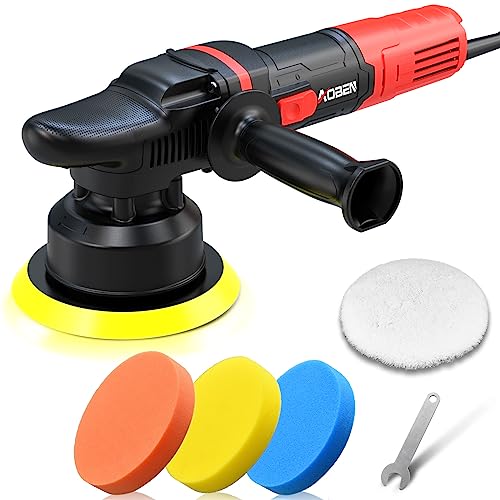


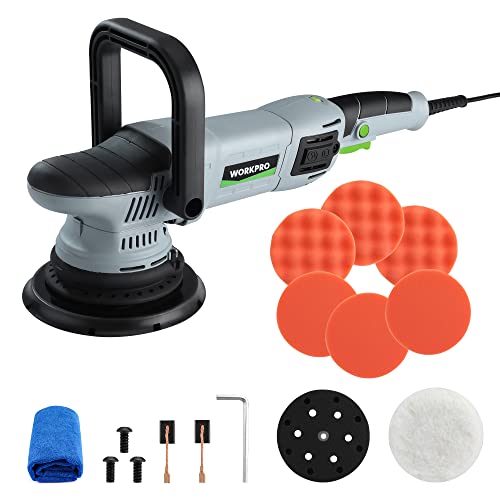
As an Amazon Associate we earn from qualifying purchases at no extra cost to you. Ratings are shown as listed on Amazon.
What to look for before buying
A dual action (DA) polisher combines pad rotation with an orbital movement. That motion spreads heat and reduces the chance of creating sharp rotary-style holograms, making a DA safer for painted aquarium cabinets, stands, canopies, and other non-glass surfaces. It is not automatically suitable for removing scratches from glass or acrylic aquarium panels: polishing transparent panels requires the correct abrasive system, careful temperature control, and a method designed for that material.
- Throw size: An 8 mm throw is easier to control near edges and on small cabinets. A 15 mm throw removes defects faster while remaining versatile. A 21 mm throw covers large flat areas quickly but is less comfortable in tight spaces.
- Speed range: Look for a usable low speed around 2,000–3,000 orbits per minute and a maximum near 5,000–7,000 OPM. A low setting helps with spreading compound; higher settings improve correction and finishing.
- Motor performance: A strong motor should maintain pad movement when moderate pressure is applied. Stall resistance matters more than a headline wattage figure.
- Vibration control: Counterweights, balanced backing plates, a comfortable grip, and a progressive trigger reduce fatigue during long cabinet panels.
- Power source: Corded machines are lighter for long sessions and do not slow as a battery empties. Cordless models are convenient around a filled aquarium where routing a cable is awkward.
Best dual action polishers compared
| Polisher | Throw | Speed range | Backing plate | Approx. tool weight | Best suited to |
|---|---|---|---|---|---|
| Griot’s Garage G9 | 8 mm | 2,000–6,400 OPM | 5 in | 5.3 lb / 2.4 kg | Beginners, small and medium panels |
| Rupes LHR15 Mark V | 15 mm | 3,000–5,200 OPM | 5 in | 4.2 lb / 1.9 kg | Frequent users, balanced correction |
| Rupes LHR21 Mark V | 21 mm | 3,000–4,500 OPM | 6 in | 5.1 lb / 2.3 kg | Large, mostly flat surfaces |
| Milwaukee M18 FUEL 15 mm | 15 mm | 2,650–5,100 OPM | 5 in | 6.2 lb / 2.8 kg with battery | Portable work and existing M18 owners |
| DeWalt XR 15 mm | 15 mm | 2,000–5,500 OPM | 5 in | About 6 lb / 2.7 kg with battery | Cordless convenience and occasional correction |
Published weights can vary according to backing plate, battery, and included accessories. Prices also vary substantially by region: expect roughly $150–$250 for a capable corded 8 mm machine, $300–$500 for a premium corded 15 or 21 mm machine, and about $250–$450 for a cordless tool before adding batteries and a charger.
Our picks by situation
Best beginner choice: Griot’s Garage G9
The G9’s 8 mm throw is forgiving. It is less likely to walk toward an aquarium stand edge than a long-throw machine, and its 5-inch plate accepts widely available pads. The broad speed range makes it suitable for gentle finishing as well as moderate defect removal. Its main limitation is coverage: a large cabinet takes longer than it would with a 15 or 21 mm polisher.
Choose it if you polish a stand a few times a year, are learning pad and compound combinations, or need a machine that remains manageable around handles, trim, and corners.
Best all-round corded upgrade: Rupes LHR15 Mark V
A 15 mm throw is the most useful compromise for many owners. It covers panels faster than an 8 mm machine but remains easier to control than a 21 mm model. The LHR15 Mark V is designed around smooth operation, good balance, and consistent pad motion under load. It makes particular sense for someone maintaining several aquariums, refinishing furniture, or doing regular detailing work in addition to aquarium projects.
The premium price is harder to justify for one small cabinet. It also requires more care near sharp edges, where a long throw can move the pad unpredictably if the operator tilts the machine.
Best for large flat surfaces: Rupes LHR21 Mark V
The 21 mm throw produces efficient coverage on broad, open panels. If you are restoring a long wooden stand or polishing large painted surfaces, fewer passes can offset the machine’s less nimble behavior. The trade-off is reduced control in corners and around narrow rails. A 21 mm tool should not be your only machine if most of your work involves small aquarium furniture.
Best cordless option: Milwaukee M18 FUEL 15 mm or DeWalt XR 15 mm
Both cordless choices remove the cable from the area around a filled aquarium. That is useful when an outlet is distant or when the cable could catch on equipment. Their 15 mm throws provide a practical middle ground.
The ownership calculation is important. A typical 5.0 Ah battery may provide roughly 20–35 minutes of loaded polishing, depending on pressure, pad size, compound, and battery condition. A 30-minute job may therefore require one fully charged pack; a full stand and cabinet session can require two packs or a larger-capacity battery. Cordless machines also become heavier with the battery installed, and replacement batteries are a meaningful part of the total cost.
Decision matrix
| Your situation | Recommended type | Why |
|---|---|---|
| First machine, one small stand | 8 mm corded DA | Lowest learning curve and strong control |
| Several aquariums or monthly use | 15 mm corded DA | Faster coverage without excessive bulk |
| Large, flat cabinet surfaces | 21 mm corded DA | Efficient correction across open panels |
| No convenient outlet near the aquarium | 15 mm cordless DA | Convenience and fewer cable hazards |
| Tight trim, corners, and narrow rails | 8 mm DA, possibly with a smaller plate | More precise control and less edge loading |
How to use a DA polisher safely on aquarium furniture
- Protect the aquarium first. Cover the tank, filter openings, lighting, and nearby plumbing. Keep compound dust away from the water. Do not operate a powered polisher over an uncovered aquarium.
- Clean and inspect the surface. Dirt trapped beneath a pad can create fresh scratches. Confirm that the finish is sound and identify loose veneer, peeling paint, or exposed substrate.
- Start with the least aggressive combination. Use a finishing polish and soft polishing pad before trying a cutting compound. Test a hidden area and check the result under strong light.
- Work small sections. A section around 18 by 18 inches is manageable. Use slow overlapping passes, keep the pad reasonably flat, and use only enough pressure to maintain contact.
- Control heat. Stop if the surface becomes uncomfortably hot. Long-throw machines and aggressive compounds can remove finish quickly on edges and thin painted parts.
- Clean between sections. Blow or brush residue from the pad, and change pads when they become saturated. A clogged pad increases heat and reduces correction.
For a transparent acrylic aquarium, do not assume an automotive paint polish is appropriate. Acrylic-specific polishing compounds and pads are required, and deep scratches may need a staged wet-sanding process. If the damage is near a seam or affects the tank wall, consult an aquarium fabricator rather than experimenting with a high-speed tool.
Ownership costs and common failure points
Pads usually wear before the polisher. Foam can tear at the edge, become permanently compressed, or load up with dried compound. Microfiber discs eventually lose their cutting ability. Keeping at least two cutting pads and two finishing pads makes it possible to rotate clean pads during a job. Wash reusable pads according to the manufacturer’s instructions and let them dry completely before storage.
Backing plates, carbon brushes on some corded designs, switches, and power cords are the next likely wear items. Do not lift the tool by its cord, store it with compound packed into the vents, or press harder when the pad stalls. A stalled pad is usually a sign that the machine is tilted, the section is too large, or the pressure is excessive.
For occasional aquarium furniture work, an 8 mm corded DA offers the best value. Choose a 15 mm machine if speed and regular use matter, and select a cordless model when cable management is the deciding concern. A 21 mm polisher is a specialist choice: excellent on broad panels, but not the most beginner-friendly option for compact aquarium projects.

Write Your Review
No reviews yet. Be the first to share your experience!