

Key takeaways
- Wheel spacers: inexpensive and reliable, but changing height can require removing wheels or multiple spacers.
- Pin-adjusted brackets: quick to change and easy to understand, although pins and holes can wear if loaded while adjusting.
- Rear rollers: help reduce scalping and leave a striped appearance, but add weight and require cleaning around their bearings.
- Hydraulic or linkage adjustment: convenient from the seat, but more expensive and dependent on properly set tractor linkages.
The best finishing mowers are three-point hitch rear-discharge mowers for most tractor owners, while tow-behind finishing mowers make more sense when the tractor lacks a rear lift or when covering large, open lawns quickly.
A finishing mower is designed for already-maintained grass rather than rough pasture. Its multiple blades, enclosed deck, and fine discharge pattern produce a cleaner lawn than a rotary cutter, but it needs a reasonably smooth surface and a tractor with enough lift capacity and PTO power. The right choice depends less on the lowest purchase price than on deck width, tractor compatibility, height adjustment, and how often you are prepared to clean and service it.
Our top picks



As an Amazon Associate we earn from qualifying purchases at no extra cost to you. Ratings are shown as listed on Amazon.
Best finishing mower choices by situation
| Situation | Best choice | Why it fits | What to watch |
|---|---|---|---|
| Small lawn and compact tractor | 48-inch three-point rear-discharge mower | Fits narrow gates and typically needs about 15–25 PTO horsepower | May not cover the tractor’s tire tracks unless the mower is centered carefully |
| Typical residential acreage | 60-inch three-point finishing mower | Good balance of maneuverability, productivity, and transport width | Confirm the tractor can lift roughly 450–650 lb safely |
| Large open lawn | 72-inch finishing mower | Fewer passes and better coverage on open ground | Needs more lift capacity, wider access, and adequate PTO power |
| Very smooth lawn with frequent mowing | Rear-discharge mower with adjustable rollers or anti-scalp wheels | Spreads clippings evenly and follows small ground contours | Deck can scalp on ridges if set too low |
| No three-point hitch | Pull-type or tow-behind finishing mower | Works with suitable lawn tractors, utility vehicles, or ATVs depending on the model | Turning radius and hitch height affect cut quality |
| Uneven ground or occasional rough grass | Heavier three-point model, or a rotary cutter instead | More resistant to bumps and occasional coarse growth | A finishing mower is not a substitute for a brush cutter |
Three-point versus tow-behind finishing mowers
Three-point hitch models
Three-point finishing mowers, including models such as the Land Pride FDR series, Woods finishing mowers, and King Kutter three-point finish mowers, attach directly to the tractor’s Category 1 hitch and use the tractor PTO. They are usually the best option for compact and subcompact tractor owners because the tractor controls the mower’s position, lift, and turning path.
The main advantage is maneuverability. You can raise the deck at the end of a row, reverse away from an obstacle, and make relatively tight turns. The disadvantages are more demanding tractor matching and the need to set the top link, side links, and lift height correctly. A mower that is too heavy for the tractor’s three-point hitch can make steering light and reduce braking control, even when the PTO horsepower appears sufficient.
Tow-behind models
Pull-type finishing mowers generally offer simpler attachment and can be useful for large lawns maintained by a garden tractor or utility vehicle. Some use their own engine, while others are powered through the towing machine’s PTO or a dedicated drive system. They track behind the vehicle differently from a three-point mower, so they may cut inside or outside the vehicle’s path during turns.
They are less convenient around trees, fences, and buildings, but their independent weight distribution can be helpful when the towing vehicle has limited rear lift capacity. Check the manufacturer’s requirements for hitch type, towing speed, turning radius, and slope use rather than assuming any lawn tractor can pull one safely.
Cutting width, deck height, and real productivity
Common finishing mower widths are 48, 60, and 72 inches. A wider deck does not always finish a lawn faster: it may require slower turns, wider access, and a heavier tractor. As a planning estimate, a 60-inch mower moving at 4 mph has a theoretical capacity of 2.42 acres per hour. Allowing for overlap, turns, and obstacles at 70 percent field efficiency gives about 1.7 acres per hour.
The calculation is:
Width in feet × speed in miles per hour × 0.1212 × field efficiency
For a 5-foot deck at 4 mph and 70 percent efficiency: 5 × 4 × 0.1212 × 0.70 = 1.70 acres per hour. A lawn with 2 acres of mowable area would therefore take about 70 minutes in ideal conditions, before trimming and refueling.
| Nominal width | Typical operating weight | Typical tractor requirement | Common cutting-height range | Approximate theoretical capacity at 4 mph |
|---|---|---|---|---|
| 48 inches | 350–500 lb | 15–25 PTO hp | 1.5–6 inches | 1.45 acres/hour |
| 60 inches | 450–650 lb | 20–35 PTO hp | 1.5–6 inches | 1.82 acres/hour |
| 72 inches | 550–800 lb | 25–45 PTO hp | 1.5–6 inches | 2.18 acres/hour |
These are representative planning figures, not universal specifications. Actual requirements vary with blade arrangement, deck construction, terrain, grass density, and the manufacturer’s manual. A tractor’s lift capacity should be checked at the hitch points and at the mower’s actual distance behind the tractor, not only from the headline lift rating.
How to choose deck height adjustment
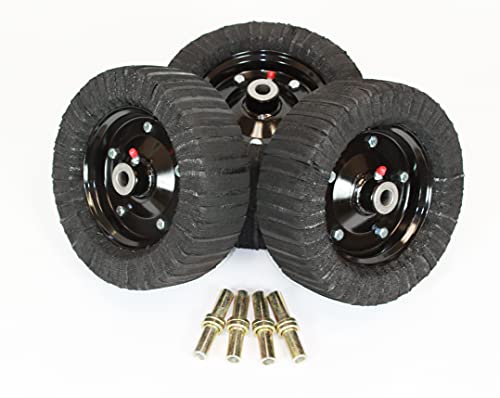
For a smooth lawn, choose a mower with a positive, repeatable height system rather than relying only on the tractor’s hydraulic position control. Common systems include spacer rings on caster wheels, adjustable rear rollers, threaded lift links, and pin-selected wheel brackets.
- Wheel spacers: inexpensive and reliable, but changing height can require removing wheels or multiple spacers.
- Pin-adjusted brackets: quick to change and easy to understand, although pins and holes can wear if loaded while adjusting.
- Rear rollers: help reduce scalping and leave a striped appearance, but add weight and require cleaning around their bearings.
- Hydraulic or linkage adjustment: convenient from the seat, but more expensive and dependent on properly set tractor linkages.
For cool-season turf, 2.5–3.5 inches is a useful starting range; warm-season grass may be maintained lower, depending on the species and local practice. Cutting more than one-third of the grass blade at a time is a common mistake that leaves clumps and stresses the turf. Raise the deck when the grass is overgrown instead of forcing the mower through a single very low pass.
Terrain performance and tractor compatibility
Finishing mowers perform best on lawns that have been graded, cleared of large stones, and mowed regularly. Their low decks and multiple blades can strike hidden objects more easily than a high-deck rotary cutter. On slopes, the mower’s width and rear overhang can affect stability, particularly when the deck is raised. Follow the tractor and mower slope limits, use appropriate ballast, and avoid mowing across slopes when the combination feels unstable.
Before buying, verify all of the following:
- Category 1 or Category 2 hitch compatibility.
- Required PTO speed, commonly 540 rpm on compact tractor models.
- Minimum and recommended PTO horsepower.
- Three-point lift capacity at the mower’s center of gravity.
- Available rear tire clearance and driveline length.
- Gate width, storage width, and transport height.
- Whether the mower is approved for front, rear, or side discharge.
For a 60-inch mower, a tractor rated just above the minimum PTO requirement may work on a flat, frequently mowed lawn but struggle in damp, tall grass. Choosing some reserve power helps maintain blade speed, which is important for a clean cut and even discharge.
Maintenance realities that affect ownership
The blades and spindle bearings are usually the first wear items. Blades become dull after striking soil, gravel, or hidden roots; dull edges increase fuel use and leave torn grass. Inspect blade bolts, spindle play, belt tension, and gearbox oil at the intervals specified by the manufacturer.
- Park on level ground, disengage the PTO, shut off the engine, remove the key, and wait for every blade to stop.
- Remove packed grass from beneath the deck, around the belt guards, and near the spindle housings.
- Inspect blades for bends and cracks; sharpening a cracked blade is not a repair.
- Grease spindle and wheel fittings where specified, avoiding excess grease that can damage seals.
- Check the driveline shield, slip clutch or shear-bolt protection, and PTO shaft guards.
- Store the mower under cover with the deck dry and supported securely.
Do not pressure-wash directly at spindle seals, bearings, gearboxes, or electrical components. Water forced into these areas can shorten bearing life. Before the first cut each season, confirm that the deck is level side-to-side and that the front is slightly higher or lower only as directed by the manual; an incorrect pitch can cause uneven cutting and excessive belt load.
Bottom line
For most owners, the best finishing mower is a 60-inch rear-discharge three-point model matched to the tractor’s real lift and PTO capacity. Choose 48 inches when access and maneuverability matter most, 72 inches for broad open lawns with a suitably heavy tractor, and a tow-behind design when a three-point hitch is unavailable. Prioritize a durable deck, accessible spindle service, dependable height adjustment, and replacement parts availability over a small difference in purchase price.

Write Your Review
No reviews yet. Be the first to share your experience!