

Key takeaways
- What wears first: Knurling does not usually disappear quickly, but coating can become polished where hands contact the handles. Bushings, weld areas, and sleeve ends deserve inspection after years of frequent use.
- Keep sleeves moving: If the sleeves rotate, wipe away dust and chalk buildup and follow the manufacturer’s lubrication guidance. Do not assume every sleeve uses the same lubricant.
- Protect the finish: Store the bar off damp concrete, especially if it has bare-steel sections. A dry cloth after sweaty sessions prevents surface rust.
- Check fasteners: Bolted handles and removable components can loosen through repeated loading. Inspect and tighten them according to the manufacturer’s instructions.
- Avoid capacity mistakes: A high rating does not make dropping a loaded trap bar safe. Use appropriate flooring, collars, and controlled returns to the floor.
The best trap bars for stronger, safer lifts are the Rogue TB-2 Trap Bar for a durable closed-frame bar, the REP Fitness Open Trap Bar for easier loading and rack work, and the Kabuki Strength Trap Bar HD for lifters who need exceptional clearance and a very high load ceiling.
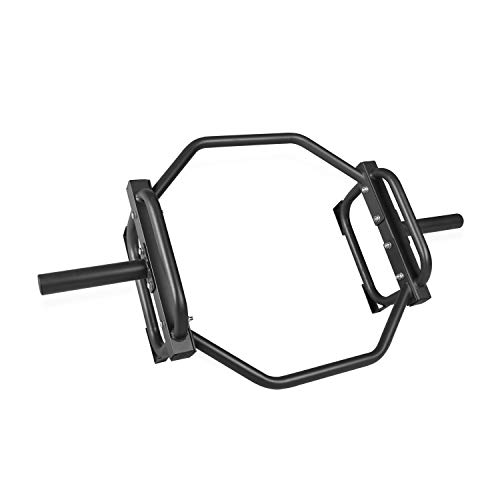
A good trap bar should put the handles beside—not far in front of—you the body, leave enough room for your knees and plates, fit your rack or storage system, and remain stable when loaded. The right choice depends less on the longest list of features than on how you train: deadlift height, low-handle access, open or closed frame, available floor space, and how often the bar will be loaded.
Our top picks



As an Amazon Associate we earn from qualifying purchases at no extra cost to you. Ratings are shown as listed on Amazon.
Best trap bars by training situation
| Training situation | Best choice | Why it fits | Typical price range in 2026 |
|---|---|---|---|
| General home gym use | Closed-frame trap bar with high and low handles | Stable, versatile, and usually compatible with standard plates | $200–$400 |
| Frequent loading and easier plate changes | Open trap bar | No rear crossbar blocks the plates; many models can be rolled away from the lifter | $300–$600 |
| Very tall lifters or athletes needing clearance | Open bar with raised frame and neutral handles | More knee and shin room, often with a better walking path | $400–$700 |
| Heavy strength training | Commercial bar rated around 1,000 lb or more | Thicker steel, longer sleeves, and less concern about flex under heavy loads | $350–$800 |
| Small room or low ceiling | Compact closed-frame bar with removable or vertical storage | Usually easier to store than a long open-frame design | $200–$450 |
What matters when comparing the best trap bars
Bar dimensions and handle height
Measure the bar’s outside width, inside width, overall length, and handle height before buying. A typical trap bar is about 55–70 inches long and 25–30 inches wide. The inside width should let you stand naturally without your hands rubbing your thighs, while the outside width must leave room around a rack, wall, or storage stand.
Handle height changes the lift substantially. High handles commonly place the gripping surface around 22–25 inches from the floor, similar to a conventional deadlift starting position for many lifters. Low handles may sit around 14–16 inches, increasing the required range of motion. A dual-handle bar is usually the most useful option because you can use high handles for heavy work and low handles for a deeper pull.
Handle spacing matters as much as height. Handles that are too close can force the elbows inward; handles that are too wide may make the bar awkward in a narrow training area. Look for a neutral grip roughly shoulder-width apart or slightly wider.
Load capacity and sleeve length
Manufacturer capacity ratings are useful, but they are not interchangeable. A 1,000-pound rating may describe the bar’s tested maximum, while another brand may publish a conservative recommended working load. For most home lifters, a 500–700-pound usable capacity is ample. Serious strength athletes should look for a bar rated at least 1,000 pounds and made from substantial steel rather than choosing by rating alone.
Sleeve length determines whether you can fit enough plates. Standard loadable sleeves are often about 12–16 inches long; premium heavy-duty bars may provide roughly 16–18 inches. As a simple example, suppose a plate has an average thickness of 2 inches. A 16-inch sleeve provides room for approximately eight plates per side in theory, but collars, plate shape, and clearance reduce that practical number. A 12-inch sleeve may become restrictive well before the bar’s advertised capacity.
Check sleeve diameter too. Olympic sleeves accept 2-inch center-hole plates, but some specialty bars use thicker sleeves that may not work with every bumper plate or change-plate combination.
Knurling and handle diameter
Trap-bar handles commonly measure about 25–32 millimeters in diameter. Thinner handles can feel easier to secure for smaller hands, while thicker handles increase grip demand. A moderate, clearly cut knurl is the best compromise for most users. Aggressive powerlifting-style knurling can become uncomfortable during high-repetition carries or deadlift variations.
Look for knurling that covers the actual gripping area rather than a short textured patch that leaves your hands on smooth steel. Bare steel, manganese phosphate, and hard chrome can all work well; the coating affects rust resistance and feel more than the fundamental quality of the bar.
Frame clearance and open versus closed design
A closed trap bar surrounds the lifter with a rectangular or hexagonal frame. It is usually stable and relatively compact, but the rear crossbar can interfere with plates, benches, or walking movements. It also limits how easily you can step out of the bar after a loaded carry.
An open trap bar removes the rear crossbar. This gives better rear clearance, easier plate loading, and a more natural path for farmer’s carries. Some open designs also allow you to place the bar down and walk away without stepping through the frame. The trade-off is that an open bar can feel less stable when starting a lift, particularly if its center of mass is not well balanced.
Check the frame’s lowest point and the distance from the handles to the floor. A raised frame can provide valuable foot and shin clearance, but an excessively high frame may turn the movement into a partial deadlift. If low-handle work matters, compare the actual low-handle height rather than relying on photographs.
Rack compatibility
Many trap bars are too wide to fit inside a standard power rack. If you want to squat, press, or store the bar on rack-mounted attachments, measure the rack’s internal width and the bar’s external width. A bar that is 28 inches wide may fit inside some racks but collide with uprights, spotter arms, or plate storage on others.
Also measure the length of the sleeves and the position of the frame. A bar can technically fit between the uprights while its plates hit the rack posts during loading. For vertical storage, confirm that the bar’s center of mass will not make it tip and that the sleeve ends will not damage the ceiling.
Head-to-head: three strong choices
Rogue TB-2 Trap Bar
The Rogue TB-2 is a conventional closed-frame option aimed at serious home and commercial training. It is commonly specified at about 60 pounds, with high and low handles, roughly 16-inch sleeves, and a load rating around 1,500 pounds depending on the published version. Its strengths are a robust frame, familiar deadlift geometry, and enough sleeve length for substantial loading.
Choose it if you want a traditional trap-bar feel and do not need the unrestricted walking path of an open design. Its weaknesses are the space occupied by the closed frame and the possibility that the rear bar will interfere with certain carries or bench setups.
REP Fitness Open Trap Bar
The REP Fitness Open Trap Bar is designed around easier entry, loading, and carries. Models in this category typically use high and low neutral handles, a raised open frame, sleeves around 16 inches long, and a capacity in the neighborhood of 1,000–1,350 pounds. The open front makes it particularly convenient when plates are already on the bar and you want to walk into position.
It is a strong choice for a home gym that uses the trap bar for deadlifts, carries, shrugs, and split-stance work. Before buying, verify the current handle heights and the bar’s unloaded weight, because these can vary by revision.
Kabuki Strength Trap Bar HD
The Kabuki Strength Trap Bar HD is built for heavy training and demanding commercial use. It emphasizes a substantial frame, multiple handle positions, long loadable sleeves, and unusually generous clearance. The bar is heavier and more expensive than basic closed-frame designs, but that mass can make it feel planted during heavy pulls and carries.
It makes sense for experienced lifters who will use the bar frequently and want more adjustment than a simple high-handle model provides. It is less attractive for a compact garage gym if storage space, moving weight, or budget is the main constraint.
Durability and ownership details
- What wears first: Knurling does not usually disappear quickly, but coating can become polished where hands contact the handles. Bushings, weld areas, and sleeve ends deserve inspection after years of frequent use.
- Keep sleeves moving: If the sleeves rotate, wipe away dust and chalk buildup and follow the manufacturer’s lubrication guidance. Do not assume every sleeve uses the same lubricant.
- Protect the finish: Store the bar off damp concrete, especially if it has bare-steel sections. A dry cloth after sweaty sessions prevents surface rust.
- Check fasteners: Bolted handles and removable components can loosen through repeated loading. Inspect and tighten them according to the manufacturer’s instructions.
- Avoid capacity mistakes: A high rating does not make dropping a loaded trap bar safe. Use appropriate flooring, collars, and controlled returns to the floor.
One common buying mistake is choosing a bar based only on maximum capacity. A 1,500-pound rating is of little value if the frame does not fit your rack or the low handles are too high for your training goals. Another is ignoring unloaded weight: a 70-pound bar can be excellent for heavy work but inconvenient to move around a small home gym.
Final buying recommendation
For most lifters, prioritize dual handle heights, approximately 16-inch sleeves, a frame rated for at least 1,000 pounds, moderate knurling, and enough interior width to stand comfortably. Select a closed frame when stability, compact storage, and conventional deadlifts matter most. Select an open frame when plate changes, carries, and easy entry are more important. If you train several times per week and expect to progress into very heavy loads, spend more on frame stiffness, weld quality, sleeve length, and clearance rather than on decorative coatings.
Before ordering, write down your preferred starting height, maximum plate diameter, rack opening, storage location, and the bar’s unloaded weight. Those five measurements will usually identify the best trap bar for your gym more reliably than a capacity number alone.

Write Your Review
No reviews yet. Be the first to share your experience!