
Our Short List of 3

- Best for: Heavily stocked freshwater tanks between roughly 125 and 250 gallons that need long intervals between cleanings.
- Aquarium capacity: up to 250 US gal / 1000 L
- Pump output: 700 US GPH / 2650 LPH
- Filter circulation: 450 GPH
- Canister volume: 3.7 US gal / 14 L

- Best for: Planted and community tanks up to 100 gallons in living spaces where pump noise carries.
- Aquarium capacity: up to 100 US gal
- Flow rate: 1450 litres per hour
- EZ-Lift media baskets with centre handle
- Vertical pre-filter cartridge with independent access
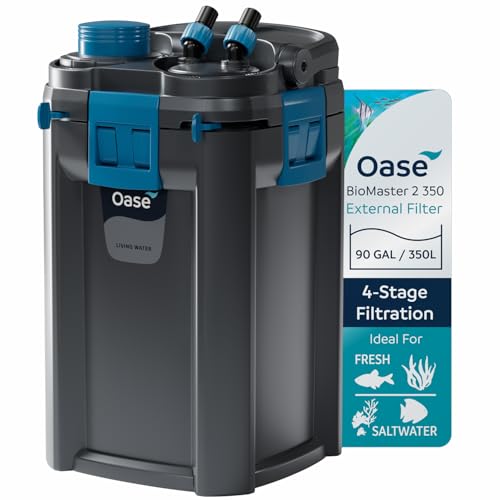
- Best for: Hobbyists with tanks up to 90 gallons who would rather rinse a small prefilter weekly than open a full canister monthly.
- Aquarium capacity: up to 90 gallons
- Max flow rate: 300 GPH
- Power consumption: 16 W
- Filter volume: 5.6 L
All 5 Picks at a Glance
| Product | Specs | Action |
|---|---|---|
| Fluval FX4 |
| Check price on Amazon |
| Fluval 407 |
| Check price on Amazon |
| OASE BioMaster 2 350 |
| Check price on Amazon |
 SunSun HW-303B Pro |
| Check price on Amazon |
 Penn-Plax Cascade 1200 |
| Check price on Amazon |
Key takeaways
- Compare five external aquarium canister filters for hobbyists by flow rate, media capacity, priming and noise, matched to real tank sizes and stocking.
Choosing an external canister filter is really a decision about three numbers and one habit: how much water the pump actually moves once the baskets are full, how much media the canister holds, how tall the unit is under your stand, and how often you are willing to open it for cleaning. A filter that matches your stocking level and your maintenance routine keeps water clear without becoming a chore, while an undersized or awkward one gets neglected until water quality slips.
This guide is for freshwater and saltwater hobbyists running anything from a planted 40 gallon community tank to a heavily stocked 250 gallon setup, plus first-time canister buyers upgrading from hang-on-back filtration. Every model below was picked from the names and specifications on its Amazon product page, with flow figures, media layouts and priming methods compared directly.
Quick Picks
As an Amazon Associate we earn from qualifying purchases
| Product | Best for | Key spec from title |
|---|---|---|
| Fluval FX4 | Large, heavily stocked freshwater tanks | 700 GPH pump output |
| Fluval 407 | Mid-size planted and community tanks | 1450 L/h flow rate |
| OASE BioMaster 2 350 | Hobbyists who rinse the prefilter often | 300 GPH max flow |
| SunSun HW-303B Pro | Tanks up to 100 gallons prone to green water | 370 GPH with 9W UV |
| Penn-Plax Cascade 1200 | Bigger tanks on a simple basket layout | 315 GPH, 4 media baskets |
How to Choose
Match Flow Rate to the Loaded Tank, Not the Box Rating
Pump output figures are measured with an empty canister, so the flow reaching your tank drops once baskets are packed with foam and bio media and water is pushed up into the aquarium. A practical approach is to choose a filter whose rated output is several times your tank volume per hour, then check the separate circulation figure where one is listed. Heavily stocked tanks, messy feeders and turtle setups sit at the demanding end, while a lightly stocked planted tank can run happily on gentler turnover that does not pin plants and small fish against the glass.
Media Capacity Decides Your Maintenance Interval
The canister volume and basket layout determine how much biological media you can run and how long the filter goes between cleanings. Stackable baskets let you separate coarse foam, fine polishing pads and bio media so each layer can be serviced on its own schedule. A larger canister with generous media room suits hobbyists who prefer opening the filter every few months, while a smaller unit with an independently accessed prefilter suits anyone happy to rinse one cartridge weekly instead. Check what media is included in the box, because some models ship with a full starter load and others leave baskets partly empty.
Priming and Restart Behaviour Matter After Every Outage
Every canister needs its hoses filled and air purged before the pump can run properly, and the method differs sharply between models. Self-priming designs and push-button primers remove most of the siphoning struggle, while smart pump electronics can restart on their own after a power cut and periodically stop to let trapped air escape. If your area loses power often, or the filter sits in a cabinet that is awkward to reach, prioritise easy priming and automatic restart. Also confirm the valves let you disconnect hoses without draining the canister, which makes every cleaning session faster and drier.
Noise, Height and Cabinet Fit
A canister lives under the stand, often in a living room or bedroom, so running noise and physical size are everyday concerns rather than minor details. Measure your cabinet’s internal height and door opening before ordering, and leave clearance above the unit for lifting the motor head and baskets out. Pump designs that isolate vibration and keep the impeller balanced run more quietly, and several current models advertise noticeably quieter motors than their predecessors. Rubber feet, ribbed hosing and a tip-proof base all help, but the biggest factor is choosing a unit that fits without forcing hoses into sharp bends.
The 5 Best Options
Fluval FX4
- Best for: Heavily stocked freshwater tanks between roughly 125 and 250 gallons that need long intervals between cleanings.
- Aquarium capacity: up to 250 US gal / 1000 L
- Pump output: 700 US GPH / 2650 LPH
- Filter circulation: 450 GPH
- Canister volume: 3.7 US gal / 14 L
Heavily stocked freshwater tanks between roughly 125 and 250 gallons that need long intervals between cleanings.
Measure your cabinet height and door width first; the canister is wide, and the baskets are heavy when lifted out full of wet media.
The Fluval FX4 suits hobbyists running large freshwater aquariums whose fish produce more waste than a mid-size canister can polish between cleanings. Its pump output is the strongest in this roundup, and the stack of media baskets holds a full gallon of media, so biological capacity stays generous even on crowded tanks. Smart Pump Technology monitors impeller speed and force, manages the self-starting feature, and pauses on a twelve-hour cycle to release trapped air. At only 16.5 inches tall, it still slides under most aquarium stands despite the large canister volume.
Fluval 407
- Best for: Planted and community tanks up to 100 gallons in living spaces where pump noise carries.
- Aquarium capacity: up to 100 US gal
- Flow rate: 1450 litres per hour
- EZ-Lift media baskets with centre handle
- Vertical pre-filter cartridge with independent access
Planted and community tanks up to 100 gallons in living spaces where pump noise carries.
Confirm the included media fills your baskets the way you want; demanding setups may need extra bio media bought separately.
The Fluval 407 fits the classic hobbyist setup: a planted or community aquarium in the 50 to 100 gallon range where quiet running matters as much as filtration. Fluval’s eTEC construction makes this generation up to 25 percent quieter than the one before, and the motor is built to hold constant pressure as media loads up. Maintenance is the other draw, because the EZ-Lift baskets come out with a centre handle and the vertical pre-filter cartridge can be reached on its own, so a quick mechanical rinse does not mean dismantling the whole media stack.
OASE BioMaster 2 350
- Best for: Hobbyists with tanks up to 90 gallons who would rather rinse a small prefilter weekly than open a full canister monthly.
- Aquarium capacity: up to 90 gallons
- Max flow rate: 300 GPH
- Power consumption: 16 W
- Filter volume: 5.6 L
Hobbyists with tanks up to 90 gallons who would rather rinse a small prefilter weekly than open a full canister monthly.
Leave vertical clearance above the unit in the cabinet, because the prefilter module needs room to lift straight out.
The OASE BioMaster 2 350 is built around the chore most canister owners put off: cleaning the first mechanical stage. Its EasyClean prefilter module lifts out separately, so the coarse foams get rinsed without opening the main canister or disturbing the biological media below. The sealed four-stage path runs water through fine and coarse foams, activated carbon and Hel-X biomedia, and the standard model leaves a heater slot ready for an optional HeatUp unit if you want one less device inside the tank. For aquariums up to 90 gallons, it is the maintenance-friendly hobbyist pick.
SunSun HW-303B Pro
- Best for: Tanks up to 100 gallons that struggle with green water and owners who want starter media included in the box.
- Aquarium capacity: up to 100 gallons
- Flow rate: 370 GPH (1400 L/h)
- Built-in 9W UV sterilizer
- 4-stage filtration with 3 media baskets
Tanks up to 100 gallons that struggle with green water and owners who want starter media included in the box.
The UV lamp is excluded from the 180-day warranty and needs periodic replacement, so factor the bulb into running costs.
The SunSun HW-303B Pro adds something the other filters here do not: a built-in 9 watt UV sterilizer that works on algae spores and bacteria as water passes through, which appeals to hobbyists fighting green water in bright rooms. It is a four-stage external canister with three flexible media trays, and the kit arrives unusually complete, with carbon, ceramic rings and bio balls included alongside the pads. A self-priming pump removes the manual siphoning step at setup. For aquariums up to 100 gallons, it covers mechanical, chemical, biological and UV treatment in one unit.
Penn-Plax Cascade 1200
- Best for: Tanks up to 150 gallons where straightforward baskets and easy hose routing matter more than electronics.
- Aquarium capacity: up to 150 gallons
- Flow rate: 315 GPH
- 4 stackable large capacity media baskets with handles
- Push button primer
Tanks up to 150 gallons where straightforward baskets and easy hose routing matter more than electronics.
At 20.5 inches tall it is the tallest unit here, so check cabinet clearance, especially under low-profile stands.
The Penn-Plax Cascade 1200 keeps the canister formula simple for hobbyists stepping up to a bigger tank: four large stackable baskets, a push button primer, and valve taps that rotate a full 360 degrees so hoses can be routed neatly inside cramped cabinets. The baskets have built-in handles and arrive loaded with floss pads, a coarse bio-sponge and activated carbon, and the included spray bar spreads the return flow across the surface. It is rated for aquariums up to 150 gallons and works across freshwater, saltwater and even turtle habitats, which makes it a flexible household workhorse.
Which One Fits Your Situation
A Planted Community Tank Between 40 and 100 Gallons
Planted tanks reward gentle, even flow and quiet equipment, which points to the Fluval 407 for most setups in this size band, with the OASE BioMaster 2 350 as the alternative if falling leaves clog your mechanical stage quickly. Both keep the return current manageable for plants and small fish, and both make routine cleaning light enough that it actually happens on schedule.
A Heavily Stocked Freshwater Tank Over 125 Gallons
Big cichlid groups, large catfish and other heavy feeders produce waste faster than small canisters can process it. The Fluval FX4 is the natural fit here, with the strongest pump output and a gallon of media room, while the Penn-Plax Cascade 1200 covers the lower end of this bracket when the tank sits nearer 125 to 150 gallons and stocking is moderate rather than extreme.
A First Canister After Years of Hang-on-Back Filters
If this is your first canister, setup friction matters more than peak specifications. The SunSun HW-303B Pro primes itself and includes its starter media, and the Penn-Plax Cascade 1200 uses a push button primer with baskets that are hard to assemble wrongly. Either removes the siphoning and guesswork that put many hobbyists off external filters in the first place.
A Tank Plagued by Green Water or Cloudy Spells
When the water itself keeps turning, filtration alone may not be the whole answer, but the SunSun HW-303B Pro is the only model here with a UV stage built in, treating algae spores as water circulates. Pair it with a sensible lighting schedule and the mechanical stages in any of these canisters will keep pace with the clearer water that follows.
Common Mistakes
- Sizing the filter by the box’s maximum tank rating alone, then discovering real flow with full media baskets is far lower than the headline pump figure.
- Packing baskets so tightly that water channels around the media instead of through it, which cuts both flow and biological performance.
- Rinsing all bio media under untreated tap water during a deep clean, wiping out the bacterial colony the canister exists to protect.
- Forgetting to measure cabinet height and door swing, then finding the motor head or prefilter module cannot be lifted out for servicing.
- Letting the first cleaning wait six months because priming was difficult at setup, instead of choosing a model whose valves and primer make servicing painless.
Frequently Asked Questions
How Much Flow Does My Aquarium Actually Need?
A common hobbyist target is turning the tank’s volume over several times per hour, but the right figure depends on stocking and livestock. Because rated pump output is measured with an empty canister, expect noticeably less once media and hose height are involved. Choosing a filter rated above your tank size, like the step-up models in this guide, leaves headroom as the media loads between cleanings.
How Often Should a Canister Filter Be Cleaned?
There is no single interval, because bioload and feeding habits vary. Prefilters and fine pads need attention most often, sometimes every few weeks, while established bio media can go months between gentle rinses in removed tank water. Models with a separately accessed prefilter, such as the BioMaster 2 350 or the Fluval 407’s vertical cartridge, let you service the fast-clogging stage without opening the whole canister.
Can an External Canister Filter Run a Saltwater Tank?
Yes, several models here are rated for both freshwater and saltwater use, including the SunSun HW-303B Pro, the Penn-Plax Cascade 1200 and the OASE BioMaster 2 350. Marine setups often pair the canister’s mechanical and chemical stages with live rock handling much of the biological work. Rinse schedules usually tighten in saltwater, since trapped detritus breaks down into nitrate faster in a reef system.
Why Does My Canister Gurgle or Lose Prime?
Gurgling usually means air is entering or staying inside the canister, often through a hose connection, a seal that needs reseating, or an intake drawing air near the waterline. Filters with self-priming pumps or automatic air evacuation, like the Fluval FX4’s Smart Pump cycle, recover on their own. On manual models, re-priming and checking the O-ring and valve taps normally restores quiet running.
More from Amazon
Programs that pair well with the guide above. Offers and eligibility are set by Amazon and may change.
Set up recurring deliveries of everyday items on eligible products. Terms and savings are set by Amazon.
Explore Subscribe & SaveFree shipping on eligible items, Prime Video and more. Eligible new members can start with a free trial.
Start a Prime free trialAudiobooks and podcasts to listen to on the go. Eligible new members can start with a free trial.
Try Audible freeRead from a large library of eBooks and audiobooks on any device. Check Amazon for current plans.
Explore Kindle UnlimitedAs an Amazon Associate we earn from qualifying purchases.


Write Your Review
No reviews yet. Be the first to share your experience!