

Key takeaways
- Find the best aquarium tunnels for shy fish, shrimp and fry. Compare ceramic, resin and plastic tube hideouts, sizes and placement tips before you buy.
- Top Pick: EMUTOL Dual-Entrance Aquarium Tunnel
- Runner-up: JIH Ceramic Shelters Breeding Tube
- Also consider: Aiqriwv 90 Degree Corner Fish Cave Viewing Tunnels
An aquarium tunnel gives shy fish, shrimp, and fry a place to retreat, rest, and breed without leaving the open water entirely. The best aquarium tunnels are open-ended tubes that fish can swim straight through, with smooth interiors and entrances sized to the animals that will use them. A tunnel that is too narrow can trap a growing fish, while one that is too wide offers little cover.
This guide compares five tunnel and tunnel-style hideouts made from ceramic, resin, and plastic. Some are true open tubes with two ends, and others are rock-shaped shelters with tunnel-like passages. Each pick states plainly which kind it is.
As an Amazon Associate, we earn from qualifying purchases.
Quick Answer
For most freshwater community tanks, the EMUTOL Dual-Entrance Aquarium Tunnel is the best aquarium tunnel overall, with two entrances, a low buried profile, and room for shrimp and small bottom dwellers to pass through. Shrimp keepers who want a heavier, stackable option should look at the ceramic shelter from JIH, and betta keepers who want a wall-mounted tube should consider the SeeShelter tunnel. The Aiqriwv corner hideout suits tanks where floor space is tight, and the compact maze tunnel works best as a shrimp and fry refuge in a nano setup.
Table of Contents
- Quick Answer
- How to Choose an Aquarium Tunnel
- 1. EMUTOL Dual-Entrance Aquarium Tunnel
- 2. JIH Ceramic Shelters Breeding Tube
- 3. Aiqriwv 90 Degree Corner Fish Cave Viewing Tunnels
- 4. Aquarium Tunnel Cave Fish Tank Decor Maze
- 5. SeeShelter Brand Betta Tunnel
- Tunnel Shapes Compared
- Where to Place a Tunnel in Your Tank
- FAQ
- Conclusion
- Product and ASIN Reference
How to Choose an Aquarium Tunnel
Start with the animals, not the decoration. Measure the body width of the largest fish that will use the tunnel and compare it with the entrance size. A betta, a dwarf shrimp, or a fry needs a much smaller opening than a corydora, a kuhli loach, or a small pleco. If no entrance size is listed, use the overall dimensions and choose generous openings.
Material is the next decision. Ceramic is heavy, stays put on the substrate, and suits shrimp and breeding setups. Resin can be molded into rock shapes that blend into an aquascape, and it is light enough to move during cleaning. Plastic and acrylic tubes are the lightest options, and wall-mounted designs keep the floor clear. Look for smooth edges and a finish described as safe for aquarium use, and rinse any new tunnel before placing it in the tank.
Shape determines how the tunnel behaves. A true open tube with two ends lets fish swim through and out the other side, which matters for species that panic when they feel cornered. A single-chamber cave gives darker cover but offers only one way out, so it suits a single shy fish or a breeding pair better than a busy community. Corner designs save floor space, while a low buried tunnel can sit partly under substrate.
1. EMUTOL Dual-Entrance Aquarium Tunnel
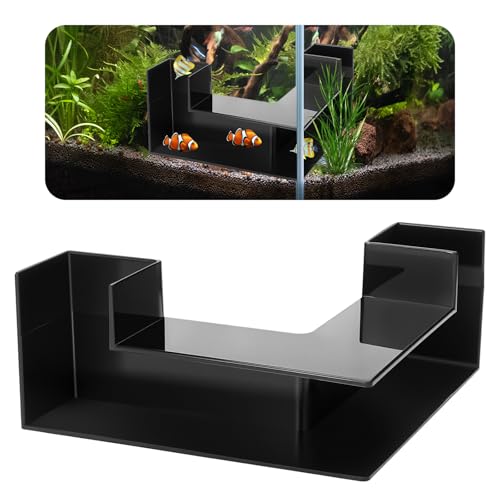
The EMUTOL Dual-Entrance Aquarium Tunnel is the most straightforward tunnel in this guide: a black plastic tunnel with two entrances, measuring 4.96 inches long, 4.96 inches wide, and 2.2 inches high. Its low, wide shape sits on the tank floor or partly buried in substrate, creating an underground-style passage fish and shrimp can enter from either side.
Two entrances make a real difference: a shrimp, a corydora, or a small loach can pass through without turning around, and a shy fish always has an escape route. The black finish creates a dark interior, which helps shy animals settle. This budget pick suits nano and small community tanks built around shrimp, dwarf catfish, and other bottom dwellers. Press it gently into the substrate so it stays in place, and leave both entrances clear.
Specs
| Feature | Detail |
|---|---|
| Material | Plastic |
| Dimensions | 4.96 x 4.96 x 2.2 inches |
| Entrances | 2 |
| Tunnel type | Open tunnel, can be buried in substrate |
| Best for | Shrimp, dwarf catfish, kuhli loaches, and small bottom dwellers |
| Price group | Budget |
| ASIN | B0FD64B9KP |
2. JIH Ceramic Shelters Breeding Tube

The JIH Ceramic Shelters Breeding Tube is a ceramic shelter shaped like a rock, with tunnel-like openings that shrimp and small fish can use as a breeding and hiding space. To be plain about its shape, this is a solid shelter rather than a straight open tube: fish enter through openings in the rock form and shelter inside the chamber. For shrimp breeding and fry cover, a sheltered chamber is often the more useful design.
Ceramic is the main reason to choose this pick. It is heavy enough to stay where you put it, it can be stacked with other pieces to build a larger shelter, and its rough rock-like surface gives shrimp and fry places to graze. The listing measures it at 5 inches long, 3.15 inches wide, and 3.15 inches high, which fits a nano or small community tank. It suits bettas, shrimp, and small fish that need a dark retreat. Handle it with care, since ceramic can chip if dropped, and place it on flat substrate with the openings facing open water.
Specs
| Feature | Detail |
|---|---|
| Material | Ceramic |
| Dimensions | 5 x 3.15 x 3.15 inches |
| Entrances | Openings in the rock-shaped shelter, exact count not stated |
| Tunnel type | Solid shelter with tunnel-like openings, not a straight open tube |
| Best for | Shrimp breeding, fry cover, bettas, and small fish |
| Price group | Budget |
| ASIN | B08NGMMXC2 |
3. Aiqriwv 90 Degree Corner Fish Cave Viewing Tunnels
The Aiqriwv 90 Degree Corner Fish Cave Viewing Tunnels is a resin hideout shaped like a rock formation, made to fit into a tank corner at a right angle. It measures 5.3 inches deep, 5.3 inches wide, and 2.8 inches high, and the listing describes it as a dual-hole hideout, so fish can enter from one side and leave from another. Like the ceramic shelter above, this is a rock-shaped shelter with tunnel passages rather than a bare open pipe.
Resin is a practical choice for a corner piece because it can be molded into a natural rock look while staying light enough to lift out for cleaning. The listing states that it is made from premium resin described as free of BPA and safe for aquarium use, and it is listed for freshwater aquariums, saltwater tanks, and nano tanks. It is listed for shrimp, plecos, cichlids, corydora, bettas, and loaches, though the 2.8-inch height means it suits small and juvenile fish better than large adults. Push it into a back corner with both holes facing open water.
Specs
| Feature | Detail |
|---|---|
| Material | Resin, described as free of BPA |
| Dimensions | 5.3 x 5.3 x 2.8 inches |
| Entrances | 2, dual-hole design |
| Tunnel type | Rock-shaped shelter with tunnel passages, corner fit |
| Best for | Shrimp, small plecos, corydora, bettas, loaches, and small cichlids |
| Price group | Mid-range |
| ASIN | B0FHRL15V1 |
4. Aquarium Tunnel Cave Fish Tank Decor Maze
The Aquarium Tunnel Cave Fish Tank Decor Maze is the smallest tunnel in this guide, and the most clearly aimed at shrimp and fry. It is a double-entrance maze made from polypropylene, with a listed size of about 4.92 inches long, 0.98 inches wide, and 1.57 inches high. That narrow width is the point: shrimp and fry can move through the maze while larger fish stay outside, which makes it a useful refuge in a community tank.
This is a true tunnel design with two entrances and a maze-like interior, rather than a solid cave. The listing names bettas, corydora, catfish, kuhli loaches, and dwarf crabs among the animals it suits, but the slim profile means it works best for shrimp, fry, and the smallest bottom dwellers. Place it on the substrate in a quiet part of the tank, near plants or moss. Lift it out and rinse it regularly, since food and debris can collect inside a narrow maze.
Specs
| Feature | Detail |
|---|---|
| Material | Polypropylene |
| Dimensions | About 4.92 x 0.98 x 1.57 inches |
| Entrances | 2, double-entrance maze |
| Tunnel type | Open maze tunnel with two entrances |
| Best for | Shrimp, fry, and very small bottom dwellers |
| Price group | Budget |
| ASIN | B0GPJV6XZ1 |
5. SeeShelter Brand Betta Tunnel

The SeeShelter Brand Betta Tunnel is a clear plastic tube that mounts to the aquarium wall with suction cups, and it is the only wall-mounted tunnel in this guide. The translucent purple version measures 5.5 inches long, 2.5 inches wide, and 1.6 inches high, and weighs 1.44 ounces. It is a true open tube: fish swim in one end and out the other, and the translucent wall lets you see them while they do.
Wall mounting changes how a tunnel fits into a tank. Instead of taking up floor space, this tube hangs on the glass, which leaves the substrate free for bottom dwellers and plants. The listing says it is safe for both freshwater and saltwater aquariums, has no sharp edges, and suits small and medium fish, including large bettas. Its placement guidance by species: bettas often prefer a tunnel near the water line, corydoras and loaches prefer one in the middle of the tank, and plecos and juvenile axolotls prefer one near the bottom. Start where the listing suggests, watch where your fish actually rest, and move the tube if they ignore it. To clean it, wipe it down and rinse it with warm water, and avoid soap, since residue can harm fish.
Specs
| Feature | Detail |
|---|---|
| Material | Plastic |
| Dimensions | 5.5 x 2.5 x 1.6 inches |
| Weight | 1.44 ounces |
| Entrances | 2, open tube |
| Color | Translucent purple |
| Mounting | Suction cups on the aquarium wall |
| Tunnel type | Open wall-mounted tube |
| Best for | Bettas, small and medium fish, corydoras, and loaches |
| Price group | Mid-range |
| ASIN | B0BZZT7564 |
Tunnel Shapes Compared
The five picks cover three shapes. The EMUTOL tunnel, the maze tunnel, and the SeeShelter tube are true open tunnels with two ends, so fish can swim through them. The JIH ceramic shelter and the Aiqriwv corner hideout are rock-shaped shelters with tunnel passages, giving darker, more enclosed cover but no straight swim-through.
For a busy community tank, an open tunnel with two entrances is usually the safer choice because no fish can be cornered inside. For a breeding setup or a shrimp tank, a sheltered chamber with small openings gives fry and molting shrimp a place where larger fish cannot follow. For a tank short on floor space, a corner shelter or a wall-mounted tube adds hiding places without crowding the substrate. Ceramic suits breeding tanks, resin suits aquascaped tanks, and plastic suits light, movable, and wall-mounted designs.
Where to Place a Tunnel in Your Tank
Place a floor tunnel where the animals that will use it already spend time. Bottom dwellers want a tunnel on or partly buried in the substrate, near the front glass or in a corner. Shrimp and fry want a tunnel near plants or moss, so they have cover the moment they leave it. A betta often prefers a wall-mounted tube near the surface.
Leave both entrances clear. Plants, wood, and other decor should frame a tunnel, not block it, and a tunnel pressed against the glass loses one of its entrances. If you bury a tunnel, leave the openings proud of the substrate so they do not fill with gravel. Clean tunnels regularly: lift each one out, rinse it in water removed from the tank during a water change, and check the inside for trapped food before putting it back.
FAQ
What is the difference between an aquarium tunnel and an aquarium cave?
A tunnel is an open-ended tube that fish can swim through, while a cave is usually a chamber with one main entrance and a closed back. Tunnels suit fish that want a pass-through hiding place with an escape route, while caves suit a single shy fish or a breeding pair that wants a dark, enclosed space.
Are aquarium tunnels safe for shrimp and fry?
Yes, when the entrances match the size of the animals using them. Shrimp and fry need small openings that larger fish cannot enter, and smooth interiors without sharp edges. A narrow maze tunnel or a ceramic shelter with small openings gives shrimp a refuge during molting and breeding, while fry can hide inside until they are large enough for open water.
What material is best for an aquarium tunnel?
Ceramic is heavy and stable, which suits shrimp and breeding tanks. Resin can be molded into natural rock shapes and is easy to lift out for cleaning. Plastic and acrylic are light, and they suit wall-mounted tubes and slim maze tunnels. Choose ceramic for stability, resin for a natural look, and plastic when you want a light or wall-mounted design.
How do I clean an aquarium tunnel?
Lift the tunnel out during a water change and rinse it in water removed from the tank. Wipe the inside with a clean cloth or soft brush if debris has collected, and rinse again before putting it back. Avoid soap and household cleaners, since residue can harm fish.
Conclusion
The best aquarium tunnel depends on the animals that will use it, the space you have, and whether you want a true swim-through tube or a sheltered chamber. The EMUTOL Dual-Entrance Aquarium Tunnel is the best all-round pick for small community tanks, with two entrances, a low buried profile, and room for shrimp and bottom dwellers. The JIH ceramic shelter suits shrimp breeding, the Aiqriwv corner hideout suits tight aquascapes, the maze tunnel protects the smallest shrimp and fry, and the SeeShelter tube adds a wall-mounted option for bettas. Measure your fish, match the entrance size to the animals, and leave both ends of an open tunnel clear.
More from Amazon
Programs that pair well with the guide above. Offers and eligibility are set by Amazon and may change.
Set up recurring deliveries of everyday items on eligible products. Terms and savings are set by Amazon.
Explore Subscribe & SaveFree shipping on eligible items, Prime Video and more. Eligible new members can start with a free trial.
Start a Prime free trialAudiobooks and podcasts to listen to on the go. Eligible new members can start with a free trial.
Try Audible freeRead from a large library of eBooks and audiobooks on any device. Check Amazon for current plans.
Explore Kindle UnlimitedAs an Amazon Associate we earn from qualifying purchases.


Write Your Review
No reviews yet. Be the first to share your experience!