

Key takeaways
- Stand-mixer hub: confirm the exact mixer family and whether the attachment requires a powered front hub, a bowl drive, or a separate adapter.
- Food processor: check the bowl size and lid design. A disc that fits a 9-cup bowl may not lock into a 13-cup bowl from the same brand.
- Handheld or immersion systems: these generally use proprietary containers and are not a substitute for a full-size slicer attachment.
- Voltage and regional versions: powered appliances can differ between countries; an attachment normally does not overcome an incompatible motor or electrical system.
Best Food Slicer Attachments for Home Use
The best food slicer attachment for most homes is a rotary slicer/shredder designed for the stand mixer or processor you already own: choose a fixed-drum model for quick vegetables and cheese, an adjustable-disc processor attachment for thickness control, or a heavy-duty metal attachment if you slice frequently.
Food slicer attachments are not interchangeable in the way many buyers expect. A drum attachment may fit one mixer family but not another, while a food-processor disc usually requires a specific bowl, drive hub, and lid. Before comparing blades, confirm the appliance model, available counter space, and the foods you actually slice.
Our top picks


As an Amazon Associate we earn from qualifying purchases at no extra cost to you. Ratings are shown as listed on Amazon.
Quick comparison: which type is best?
| Attachment type | Typical slice range | Practical capacity | Cleaning | Best for |
|---|---|---|---|---|
| Rotary drum slicer/shredder | About 1.5–4 mm, fixed by drum | 1–2 cups before emptying | Removable drum; hand washing is often safest | Carrots, cucumber, cheese, potatoes, occasional meal prep |
| Food-processor slicing disc | About 1–8 mm, depending on model | 4–10 cups in the bowl | Disc, lid, pusher, and bowl usually separate | Large batches and adjustable slices |
| Mandoline-style attachment | About 1–6 mm, often adjustable | One item at a time | Small parts and blade grooves require care | Uniform potato, onion, and cucumber slices |
| Heavy-duty metal slicer attachment | Usually fixed; roughly 2–5 mm | 1–3 cups before clearing | More parts, but generally less staining than plastic drums | Frequent use and firm ingredients |
These figures are useful buying benchmarks rather than universal specifications. Actual slice thickness varies with the attachment, ingredient firmness, feed pressure, and whether the food is chilled.
Best picks by situation
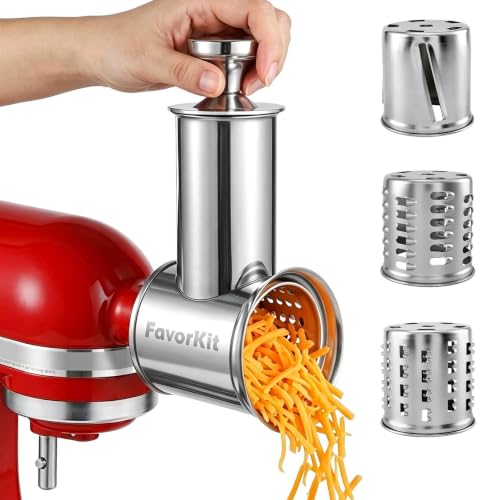
Best for a KitchenAid stand mixer: KitchenAid Fresh Prep Slicer/Shredder
The KitchenAid Fresh Prep Slicer/Shredder is a sensible choice for owners of compatible KitchenAid stand mixers who want a compact attachment rather than another countertop appliance. It uses interchangeable drums for slicing and shredding and includes a food pusher intended to keep fingers away from the cutting surface.
Its main limitation is thickness control: the supplied drums provide particular cuts rather than a continuously adjustable slice. That is fine for shredded cheese, coleslaw, vegetable toppings, and potatoes, but less suitable when a recipe requires precisely 2 mm or 5 mm slices. The plastic housing keeps weight and storage demands low, while the cutting drums are the parts most likely to become dull or damaged if hard food is forced through them.
Check your mixer’s model and hub compatibility before ordering. A KitchenAid attachment is not automatically compatible with every stand mixer brand, even when the front hub looks similar.
Best for large batches: a compatible food-processor slicing attachment
A food-processor attachment is the better choice when you routinely slice more than two or three cups of food. The work bowl catches the output, so you can prepare a large batch of potatoes, onions, carrots, or cabbage without stopping to empty a narrow drum.
Look for a model with a reversible or adjustable slicing disc, a wide feed tube, and a pusher that has more than one diameter. A wide tube reduces the need to halve vegetables and can produce more even slices. The trade-off is storage: bowl, lid, disc, pusher, and drive parts can occupy as much cabinet space as a small processor.
Food processors are also better at repeated slicing because their motor and bowl are designed for that workload. An attachment driven from a stand-mixer hub can work well, but it may be slower and less convenient for continuous high-volume preparation.
Best for precise slices: an adjustable mandoline-style attachment
Choose an adjustable attachment when thickness matters more than capacity. A dial or sliding plate can produce thin cucumber slices, medium potato slices, or thicker vegetable pieces without changing drums or discs.
Precision brings extra cleaning and safety responsibility. The adjustment track can trap food, and the exposed blade remains sharp after use. A hand guard is essential; never hold a small remaining piece of food directly over the blade. If the guard loses grip, replace it rather than trying to compensate by pressing harder.
Best for frequent use: metal-bodied drum or disc attachments
For several uses each week, favor stainless-steel cutting surfaces, a rigid drive connection, and replaceable or separately available cutting parts. Metal does not make an attachment indestructible, but it usually resists flexing better than a thin plastic drum when processing firm cheese or chilled vegetables.
Durability depends as much on technique as on materials. The common failure points are a cracked pusher, a stripped plastic drive coupler, a bent drum edge, and a dull slicing surface. Forcing a potato, hard squash, or frozen cheese through the feed tube increases stress on all four.
Compatibility matters more than the blade count
- Stand-mixer hub: confirm the exact mixer family and whether the attachment requires a powered front hub, a bowl drive, or a separate adapter.
- Food processor: check the bowl size and lid design. A disc that fits a 9-cup bowl may not lock into a 13-cup bowl from the same brand.
- Handheld or immersion systems: these generally use proprietary containers and are not a substitute for a full-size slicer attachment.
- Voltage and regional versions: powered appliances can differ between countries; an attachment normally does not overcome an incompatible motor or electrical system.
Do not judge fit by the attachment’s external diameter alone. The locking tabs, drive shaft height, lid interlock, and pusher opening all need to match.
Decision matrix for real household use
| Your situation | Recommended choice | Why | What to avoid |
|---|---|---|---|
| Budget-conscious, use once or twice a month | Compatible fixed-drum attachment | Lower cost and fewer parts | Large systems with discs you will rarely use |
| Beginner who values simple operation | One-touch rotary attachment with enclosed drum | Minimal adjustment and straightforward loading | Exposed mandoline blades with complicated settings |
| Small kitchen with limited storage | Compact stand-mixer attachment | Uses an appliance already on the counter | Multi-disc processor kits without a storage case |
| Weekly meal prep or family-sized batches | Food-processor attachment with 4–10 cup bowl | Fewer stops and more consistent output | Narrow feed tubes and tiny collection chambers |
| Recipes requiring exact thickness | Adjustable slicing disc or mandoline-style model | Allows repeatable thin, medium, and thick cuts | Fixed drums marketed as “multi-purpose” without measurements |
Cleaning, safety, and maintenance
Unplug the motor or turn off the appliance before removing a jam. Do not pull food out while the drive is engaged. Feed ingredients with the supplied pusher, keep hands above the marked loading line, and let the blade stop completely before opening the lid.
Wash the attachment soon after use. Dried cheese and potato starch are harder to remove and may encourage users to scrape near the blade. Rinse drums or discs from the blunt side where possible, use a brush rather than fingers, and dry metal parts fully before storage. Dishwasher-safe labeling is convenient, but repeated high-heat cycles can cloud plastic, loosen labels, and shorten the life of some nonmetal components. Follow the manufacturer’s care instructions for the specific part.
Inspect the drive coupler and pusher every few uses. Replace parts showing cracks, excessive play, or deep cuts. A slightly dull blade produces ragged slices and requires more force, which is a safety problem as well as a performance problem.
A simple cost-per-use calculation
Suppose an attachment costs $60 and you use it twice a month for three years. That is 72 uses, or about $0.83 per use before considering replacement parts and electricity. If cleaning takes ten minutes each time, the practical value depends on whether the attachment saves more time than hand slicing or washing a separate appliance. A cheaper fixed-drum model can therefore be the better purchase for occasional use, while a larger processor attachment earns its higher price through batch size and reduced stopping.
Bottom line
Buy a fixed-drum attachment for simple vegetable and cheese preparation, an adjustable food-processor disc for batch cooking and thickness control, and a metal-bodied model when frequent use justifies stronger construction. The best food slicer attachments are the ones that fit your exact appliance, accept food without force, clean without hidden traps, and provide the slice size and capacity your recipes actually require.

Write Your Review
No reviews yet. Be the first to share your experience!