

Key takeaways
- 304 stainless steel: The preferred general-purpose material for repeated washing and humid kitchens. It resists corrosion and does not rely on plating.
- Aluminized steel: Light and heat-tolerant, but the surface can scratch and should not be treated as corrosion-proof.
- Chrome-plated steel: Affordable and functional when intact, but damaged plating is the main long-term weakness.
- Nonstick-coated wire: Easy to release sticky foods from, but unsuitable for aggressive scouring and vulnerable to scratches.
The best commercial cooling rack set for high-volume baking is usually a set of heavy-gauge stainless-steel racks in standard half-sheet dimensions: choose a stackable 18-by-13-inch format for most bakeries, add full-sheet racks only when your oven and storage system support them, and avoid thin chrome-plated racks that flex under loaded trays.
Our top picks
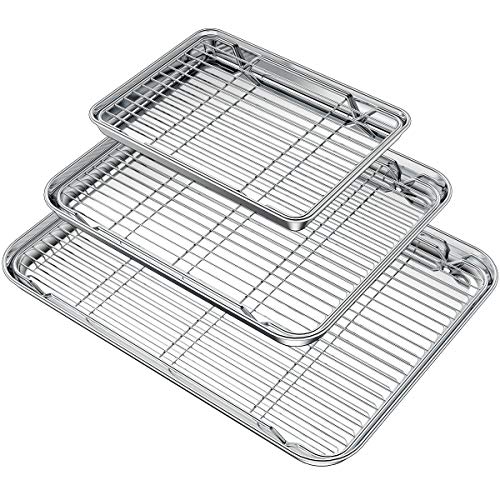
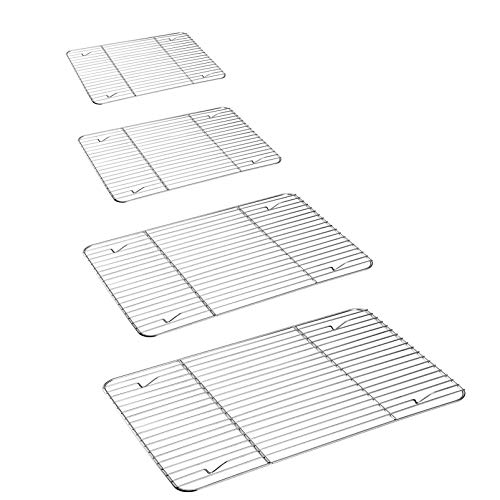


As an Amazon Associate we earn from qualifying purchases at no extra cost to you. Ratings are shown as listed on Amazon.
Quick picks by baking situation
| Situation | Best rack type | Recommended size | Why it fits |
|---|---|---|---|
| Home baker producing several batches weekly | Stainless-steel half-sheet rack set | 18 x 13 inches | Fits common sheet pans, countertop ovens, and standard storage shelves |
| Small bakery with frequent cookie and pastry production | Heavy-gauge stainless commercial rack set | 18 x 13 inches, 1-inch or tighter grid | Balances airflow, strength, cleaning, and tray compatibility |
| Large bakery using full-size sheet pans | Full-sheet wire racks or rolling rack inserts | 26 x 18 inches | Provides maximum cooling area but requires matching oven racks and storage |
| Decorating cakes and delicate pastries | Fine-grid, rigid wire rack | 12 x 16 to 18 x 13 inches | Reduces marks on small cookies and prevents narrow items from falling through |
| Limited counter or cabinet space | Stackable racks with locking feet | 18 x 13 inches | Uses vertical space and keeps cooling layers separated |
What separates a commercial cooling rack from a household rack?
Commercial suitability is less about a brand name than about the rack’s dimensions, wire construction, and ability to survive repeated washing and handling. A useful rack should remain flat when lifted by two corners, support a loaded sheet pan without sagging, and have feet that do not twist out of alignment.
For most operations, 18 x 13 inches is the practical starting point because it matches the footprint of a half-sheet pan. A rack slightly smaller than the pan can leave unstable overhang; one much larger may waste valuable counter space. Full-sheet racks measuring approximately 26 x 18 inches offer more cooling area, but they are awkward for many residential ovens and can be difficult to wash in standard sinks.
Wire spacing
Spacing affects both cooling performance and product stability. A grid or crosswire spacing near 1 inch provides good airflow for bread, cakes, and sheet-pan cookies. Smaller openings, roughly 3/8 to 1/2 inch, are better for small biscuits, macarons, tartlets, and cookies that could sag between wide wires. Very fine mesh cools evenly but is more difficult to scrub and may retain crumbs or grease.
Parallel wires are adequate for large baked goods, while a crosswire grid is more versatile for mixed production. If the rack will also hold glazed pastries, choose a configuration with enough support that a soft item cannot bend between wires.
Best commercial cooling rack set categories
Best overall: stainless-steel half-sheet rack set
A set of rigid 18-by-13-inch stainless-steel racks is the strongest all-purpose choice. Look for welded joints, reinforced perimeter bars, and feet that raise the food at least 3/4 inch above the counter. Stainless steel resists rust and does not depend on a coating that can chip or wear away.
These racks suit high-volume cookies, quick breads, cakes, and roasted foods. They also work with common half-sheet pans from brands such as Vollrath, Nordic Ware, and USA Pan, provided the pan and rack dimensions are checked rather than assumed. A typical commercial set costs more than basic chrome-plated racks, but the additional cost is easier to justify when racks are washed daily or used in a professional kitchen.
Best for a tight budget: chrome-plated steel rack set
Chrome-plated steel racks can be a sensible low-cost option for occasional production. They are widely available in half-sheet sizes and often cost about $10 to $20 per rack, while stainless commercial racks commonly fall in the $20 to $45 range depending on gauge and construction.
The trade-off is ownership. Scratches, bent wires, and chipped plating can expose the underlying steel. Do not leave these racks submerged overnight, and dry them promptly after washing. They are suitable for moderate use, but stainless steel is the safer choice for a bakery running multiple cycles every day.
Best for cakes and delicate pastries: fine-grid rack
A fine-grid rack prevents narrow cookies, sponge layers, and small pastries from dipping into large openings. It is also useful when transferring freshly baked items because the support is distributed across more contact points.
Fine grids are not automatically better. They can restrict airflow slightly, collect sticky glaze, and take longer to clean. A bakery making mostly loaves and large cookies may cool more efficiently on a conventional crosswire rack with approximately 1-inch openings.
Best for maximum throughput: full-sheet or rolling-rack system
Full-sheet racks provide about 2.25 times the surface area of an 18-by-13-inch half-sheet rack. The calculation is simple: a half-sheet footprint is 234 square inches, while a 26-by-18-inch full sheet is 468 square inches. Two half-sheet racks offer 468 square inches as well, but they are easier to lift, wash, and store separately.
Choose full-sheet racks only if your oven, pans, worktables, and storage shelves are designed around that format. For a bakery, a rolling speed rack with removable shelves may deliver more usable capacity than a large pile of loose racks. Confirm shelf spacing and wheel locks before purchase; a rack that rolls easily when empty can become unstable when loaded with warm trays.
Material and construction: what lasts?
- 304 stainless steel: The preferred general-purpose material for repeated washing and humid kitchens. It resists corrosion and does not rely on plating.
- Aluminized steel: Light and heat-tolerant, but the surface can scratch and should not be treated as corrosion-proof.
- Chrome-plated steel: Affordable and functional when intact, but damaged plating is the main long-term weakness.
- Nonstick-coated wire: Easy to release sticky foods from, but unsuitable for aggressive scouring and vulnerable to scratches.
The welds and feet often fail before the wire itself. A rack with a thick perimeter frame and four securely attached feet is preferable to one with heavier-looking interior wires but weak corner joints. Plastic feet can crack when exposed to oven heat or commercial dishwashers, so confirm the manufacturer’s temperature guidance before using a rack inside an oven.
Oven compatibility and heat limits
Many cooling racks are intended only for countertop cooling, not baking. “Commercial” does not automatically mean oven-safe. Before placing a rack over a sheet pan in the oven, verify that the rack is rated for the intended temperature and that it has no plastic feet, adhesive labels, or coating that can degrade under heat.
For oven use, uncoated stainless steel is generally the least complicated option, but the manufacturer’s rating still matters. Chrome-plated racks may discolor or deteriorate at high temperatures. Keep the rack clear of heating elements and allow room for air circulation. If the rack is being used only after baking, oven compatibility matters less than food-safe construction, flatness, and cleanability.
Stacking stability and usable capacity
Stacking feet should nest securely without requiring force. Test the rack set with three or four empty racks before loading it with food. A stable stack should not slide when the worktable is lightly bumped, and each layer should leave enough clearance for air to circulate around the baked goods.
As a practical example, six half-sheet racks provide 1,404 square inches of nominal surface area: 6 × 18 × 13. In real use, subtract space occupied by frame edges and avoid stacking delicate items so closely that warm moisture is trapped. For cookies, six racks might hold roughly 180 pieces if each rack carries three rows of ten, but the actual number depends on cookie diameter and spacing.
Cleaning and durability realities
Remove crumbs while the rack is dry, then wash with warm water and a mild degreaser. A nylon brush reaches around crosswires without damaging stainless surfaces. Avoid steel wool on chrome or stainless racks because it can create scratches that retain residue and encourage corrosion.
The most common mistakes are soaking plated racks overnight, stacking wet racks, using a rack that is too small for a loaded pan, and placing coated racks under a broiler. Inspect the feet and corner welds monthly in a busy kitchen. A rack that rocks on a flat surface should be retired or reserved for light items; instability becomes more dangerous when moving hot trays.
Final buying recommendation
For most buyers, the best commercial cooling rack set is four to six 18-by-13-inch, welded 304 stainless-steel racks with a crosswire grid, approximately 1-inch openings, reinforced edges, and nesting feet. Choose a fine-grid version if small or delicate products dominate. Choose chrome-plated steel only when the lower initial price matters more than maximum service life. Move to full-sheet or rolling-rack equipment when your oven and production workflow already use the full-sheet format—not simply because the larger rack appears to offer more capacity.

Write Your Review
No reviews yet. Be the first to share your experience!