

Key takeaways
- Remove the leaves and rinse the interior with warm water.
- Wash the infuser separately, using a soft sponge rather than abrasive scouring pads.
- Empty all water from the pot and lid.
- Dry the exterior immediately with a towel.
- Leave the lid slightly ajar until the interior is completely dry.
Best Cast Iron Teapots
The best cast iron teapot for everyday brewing is usually an enamel-lined pot with a removable stainless-steel infuser, a 24–32 oz (700–950 ml) capacity, and a weight you can comfortably lift when full; choose an unlined pot only if you specifically want a traditional Japanese-style brewing vessel and are prepared for more careful drying.
Quick recommendations by brewing situation
| Situation | Best choice | Why it fits |
|---|---|---|
| One or two cups every day | 24–28 oz enamel-lined pot | Manageable weight, quick warm-up, and enough capacity for roughly two 10–12 oz mugs |
| Several drinkers or a long tea session | 32–40 oz enamel-lined pot | Fewer refills while retaining heat well |
| Traditional Japanese green tea | Unlined cast iron kyusu-style teapot | Traditional construction and fine-mesh infuser, but it requires prompt drying |
| Limited cupboard or counter space | 18–24 oz low-profile pot | Smaller footprint and lower filled weight |
| First cast iron teapot | Removable basket infuser with enamel interior | Most forgiving to clean and easiest to use with different tea styles |
| Lowest purchase cost | Small enamel-lined pot from a reputable cookware brand | Typically avoids the maintenance demands of unlined iron without requiring premium decoration |
What matters more than appearance
Enamel interior versus unlined iron
An enamel interior is the safest default for everyday use. The glass-like coating separates tea and water from the iron, so it reduces rust risk, prevents metallic flavors, and makes the pot suitable for a wider range of teas. It is particularly practical if the pot may sit damp for a short time or if several people share cleaning duties.
Our top picks

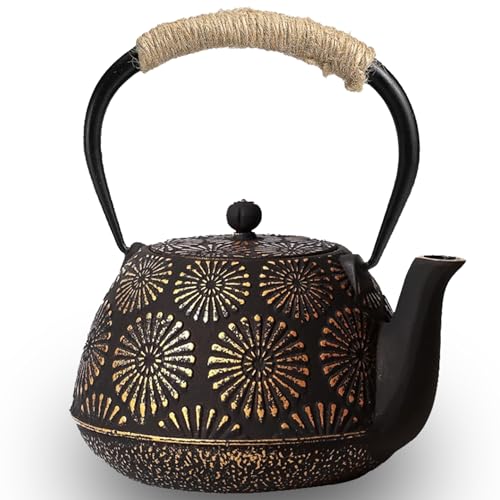
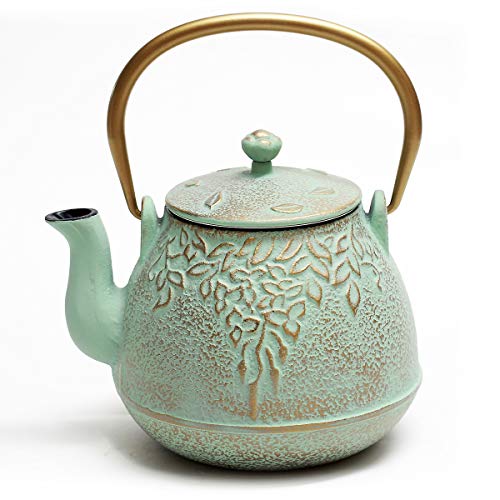

As an Amazon Associate we earn from qualifying purchases at no extra cost to you. Ratings are shown as listed on Amazon.
Enamel is not indestructible. Dropping the pot, striking the interior with a metal spoon, or thermal-shocking it with very hot and very cold water can chip the lining. Once exposed iron is visible, stop using that area for brewing until the manufacturer advises whether the pot is repairable; most interior chips are not realistically repaired at home.
Unlined cast iron offers traditional construction and can be attractive for collectors, but it is less forgiving. It must be emptied and dried after every use, and it should not be scrubbed aggressively. It is also a poor match for people who want to brew acidic drinks, leave tea overnight, or use one vessel without learning its care requirements.
Capacity and filled weight
Manufacturers often quote the vessel’s maximum capacity rather than its comfortable brewing capacity. A 28 oz pot may hold 28 oz to the rim, but leaving roughly 10–15% of headspace makes pouring easier and leaves room for a basket infuser.
Cast iron is heavy before water is added. A typical 24 oz pot weighs about 3.0–4.5 lb empty; a 32 oz pot commonly weighs about 4.0–5.5 lb empty. Add the water weight—approximately 2.1 lb per liter—and a large pot can become awkward for anyone with limited hand strength.
As a practical calculation, a 28 oz pot filled to 90% holds about 25 oz of water. If your mugs are 10 oz, that is enough for two generous servings with a small amount left in the spout. For one person, a 16–20 oz pot is easier to lift and wastes less water.
Heat retention without overclaiming
Cast iron retains heat better than thin stainless steel or glass, especially when the pot is preheated. It does not keep tea at a precise temperature, however, and heat retention varies with wall thickness, lid fit, room temperature, and how full the pot is.
For most home brewing, the useful advantage is a slower temperature drop during a 10–20 minute tea session. The trade-off is a slower response when you need the tea to cool. A thick pot can keep delicate green tea hotter than intended, so pour it into cups promptly rather than leaving it to “finish” inside the vessel.
| Pot size | Practical servings | Typical empty weight | Best use |
|---|---|---|---|
| 16–20 oz (475–600 ml) | 1–2 small cups | 2.2–3.5 lb (1.0–1.6 kg) | Personal brewing and small kitchens |
| 24–28 oz (700–830 ml) | 2 standard mugs | 3.0–4.5 lb (1.4–2.0 kg) | Most everyday tea drinkers |
| 32–40 oz (950 ml–1.2 L) | 3–4 standard mugs | 4.0–6.5 lb (1.8–3.0 kg) | Sharing and longer sessions |
Infuser designs compared
Removable stainless-steel basket
This is the most versatile design. A wide basket gives leaves room to expand, and removing it prevents over-extraction once the tea reaches the desired strength. Look for a basket that extends close to the base rather than a small ball suspended near the lid. A fine mesh is useful for broken black tea and rooibos, while a slightly more open mesh rinses more easily.
Built-in spout filter
Some cast iron teapots use a perforated filter fixed inside the spout. It cannot be misplaced, but it provides less room for leaves and is harder to clean when fine particles lodge behind it. This design is acceptable for bagged tea or small-leaf blends, but a removable basket is better for whole-leaf tea.
Infuser ball or small insert
A small ball is compact but commonly restricts leaf expansion. It can work for a single serving of fine-cut tea, yet it is not the best choice for rolled oolong, large green leaves, or herbal blends that swell substantially. Check whether the insert can be lifted out without touching hot metal.
Rust prevention and maintenance
Rust prevention depends more on routine than on the finish. After each use:
- Remove the leaves and rinse the interior with warm water.
- Wash the infuser separately, using a soft sponge rather than abrasive scouring pads.
- Empty all water from the pot and lid.
- Dry the exterior immediately with a towel.
- Leave the lid slightly ajar until the interior is completely dry.
Do not put a cast iron teapot in a dishwasher, soak it overnight, or use chlorine bleach. Avoid dish soap on unlined iron unless the manufacturer specifically permits it; for enamel-lined models, a small amount of mild dish soap is usually acceptable, but thorough rinsing is still important.
Never place a teapot with a decorative exterior directly on a stovetop unless its instructions explicitly say it is stovetop-safe. Many cast iron teapots are designed only for steeping and serving. Heating an empty pot can damage enamel, handles, or the lid fit.
Best cast iron teapot types to consider in 2026
Traditional Japanese makers such as Iwachu and Oigen are worth considering when construction quality and design heritage matter more than the lowest price. Confirm whether a specific model is enamel-lined, because “cast iron” describes the body, not the interior finish.
For value-focused shoppers, a plain enamel-lined pot from an established cookware or tea-equipment brand is often the better buy than a heavily decorated model. Spend the budget on a well-fitting lid, a stable handle, and a useful basket rather than ornamental coating.
Modern designs from brands such as Hario can be attractive for tea drinkers who prefer simple brewing equipment, but model construction varies. Check the product instructions for stovetop compatibility, interior lining, and whether the infuser is included before comparing prices.
Ownership costs and common mistakes
Cast iron teapots have few consumables. The first part likely to wear out is usually the infuser, lid knob, or enamel surface—not the iron body itself. Replacement baskets are easier to find when the pot uses a common cylindrical or round size, so measure the basket before buying a replacement.
A modest enamel-lined pot generally costs about $30–$70 in 2026, while larger, more decorative, or Japanese-made pieces commonly range from $70 to $200 or more. If a $45 pot lasts five years of frequent use, its purchase cost works out to about $0.02 per use when brewed five times weekly; the calculation excludes tea, water, and replacement accessories. Paying more makes sense when it buys a better infuser, safer handling, or a finish that you are likely to maintain—not simply extra weight.
Final buying checklist
- Choose enamel lining for low-maintenance daily brewing.
- Select 24–28 oz for two standard mugs, or 16–20 oz for one drinker.
- Check the empty weight before buying; filled cast iron becomes heavy quickly.
- Prefer a removable, wide stainless-steel basket for loose-leaf tea.
- Look for a lid that stays secure while pouring and a handle with enough clearance for a towel.
- Confirm whether the pot is for steeping only or approved for stovetop heating.
- Plan to empty and dry it after every use, especially if the interior is unlined.
For most households, the best balance is a 24–28 oz enamel-lined cast iron teapot with a removable basket infuser. It provides the characteristic heat retention without making rust prevention, cleaning, or daily handling unnecessarily difficult.

Write Your Review
No reviews yet. Be the first to share your experience!