

Key takeaways
- Full blade enclosure: The safest design keeps most of the blade behind a cage, exposing only the section needed to cut the bagel.
- Finger clearance: The handle should keep hands several inches from the cutting path. Avoid designs that require fingers to steady the bagel beside the blade.
- Locking handle or latch: A closed position prevents the blade from being exposed in a drawer.
- Non-slip feet: Rubber feet or a broad weighted base reduce movement on smooth countertops.
- Clear viewing panels: Transparent guards help you see whether the bagel is centered without opening the cutting area.
- Rounded edges: The plastic or metal frame should not have sharp corners that become uncomfortable during repeated use.
Best Bagel Slicer for Home Use: Safe and Even Cuts
The best bagel slicer for home use is usually a guarded, countertop model with a stainless-steel cutting blade, a stable base, and an enclosed storage position; the right choice depends on how often you slice bagels, how much kitchen space you have, and whether safety matters more than speed.
A bagel slicer is safer than holding a bagel in one hand while cutting through it with a kitchen knife, but designs differ considerably. Some use a fixed blade and a hinged safety cage, while others guide a serrated knife through slots. The best models keep the bagel centered, produce two reasonably even halves, and prevent fingers from reaching the cutting edge.
Our top picks


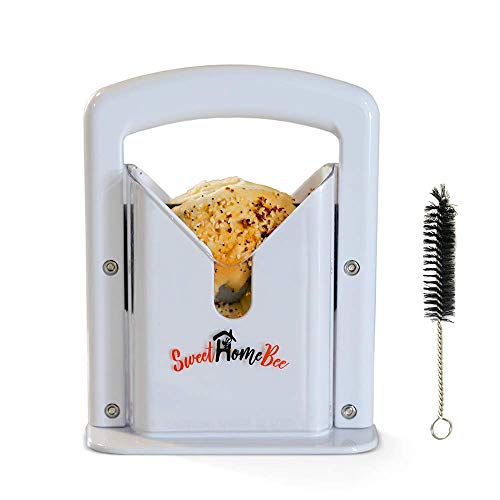
As an Amazon Associate we earn from qualifying purchases at no extra cost to you. Ratings are shown as listed on Amazon.
Quick comparison of common bagel slicer designs
| Design | Typical size | Typical weight | Blade and guard | Best for | Main limitation |
|---|---|---|---|---|---|
| Enclosed guillotine slicer | 8–11 in long, 4–6 in wide | 1.5–3 lb | Stainless-steel serrated blade with hinged cage | Frequent use and safety-conscious households | Needs cabinet or counter storage space |
| Slot-guided knife slicer | 7–10 in long, 3–5 in wide | 1–2 lb | Removable or fixed serrated knife, guide slots | People who want a compact manual tool | Requires more controlled hand movement |
| Folding slicer | 9–12 in open; 9–12 in by 3–4 in stored | 1.5–2.5 lb | Guarded blade or folding cutting frame | Small kitchens and occasional use | Hinges and locks can loosen with heavy use |
| Adjustable commercial-style slicer | 10–14 in long, 5–8 in wide | 3–6 lb | Thicker stainless blade with adjustable guides | Large bagels and batch preparation | Bulky and usually more expensive |
These figures are practical ranges rather than specifications for one particular model. Check the manufacturer’s measurements before buying, especially if the slicer must fit inside a drawer or cupboard.
What makes a bagel slicer cut evenly?
Blade shape and length
A serrated blade is preferable to a smooth edge because its teeth grip the crust instead of forcing the bagel downward. A blade around 5–7 inches long is suitable for most standard bagels. A shorter blade may stop before reaching the sides of a thick bagel, while an excessively long blade can make the slicer larger and harder to control.
Look for a blade that is rigid rather than flexible. Flex can create a sloping cut, particularly through dense or refrigerated bagels. Stainless steel is the most practical material because it resists rust and can usually be wiped clean without special treatment.
Bagel support and alignment
Even cutting depends as much on the cradle as on the blade. A V-shaped or semicircular holder centers the bagel and supports it from below. Side guides should keep the bagel from rotating as pressure is applied. Wider guides are useful for oversized or filled bagels, but they may allow a small bagel to move unless the design includes an adjustable insert.
A fixed cutting path is generally more consistent than a freehand slot. If the blade travels through two parallel guides, inspect whether the guides remain aligned when the handle is lowered. Slight movement at the hinge can produce halves with noticeably different thicknesses.
Safety features worth paying for
- Full blade enclosure: The safest design keeps most of the blade behind a cage, exposing only the section needed to cut the bagel.
- Finger clearance: The handle should keep hands several inches from the cutting path. Avoid designs that require fingers to steady the bagel beside the blade.
- Locking handle or latch: A closed position prevents the blade from being exposed in a drawer.
- Non-slip feet: Rubber feet or a broad weighted base reduce movement on smooth countertops.
- Clear viewing panels: Transparent guards help you see whether the bagel is centered without opening the cutting area.
- Rounded edges: The plastic or metal frame should not have sharp corners that become uncomfortable during repeated use.
A safety guard should not be treated as permission to rush. Keep fingers outside the enclosure, lower the handle in a controlled motion, and never try to pull a stuck bagel free while the blade is under pressure.
Choose by your kitchen and routine
| Your situation | Best choice | Why |
|---|---|---|
| Slice one or two bagels per week | Compact slot-guided or folding model | Lower cost and easier storage outweigh batch speed |
| Prepare breakfast for several people | Enclosed guillotine model | Fast repeatable cuts with less hand positioning |
| Limited drawer space | Folding model under 4 inches wide when stored | Uses less storage volume than a rigid countertop frame |
| Large, thick, or irregular bagels | Adjustable commercial-style model | Wider cradle and longer blade accommodate more sizes |
| Children may help in the kitchen | Fully enclosed model with a locking handle | Offers more separation between hands and blade |
Storage size: calculate the space before buying
Storage volume is easy to underestimate because a slicer’s footprint is only part of the problem. Measure the available space in three directions and leave room to remove the appliance without catching the blade guard on neighboring items.
For example, a rigid slicer measuring 10 by 5 by 7 inches occupies approximately 350 cubic inches of cabinet volume. A folding model measuring 11 by 4 by 3.5 inches occupies about 154 cubic inches. The folding design uses roughly 56 percent less volume:
(350 − 154) ÷ 350 × 100 = 56 percent
That calculation does not make the folding model automatically better. If you use the slicer daily, a rigid model that stays on the counter may be more convenient and less likely to be damaged by repeated folding and unfolding.
Cleaning, durability, and common failure points
Crumbs collect around the blade base, hinge, and guide slots. After each use, brush loose crumbs away with a dry pastry brush or soft brush, then wipe washable surfaces with a damp cloth and mild dish soap. Dry the blade and hinges promptly. Do not soak a model containing springs, rivets, magnets, or an enclosed handle unless its instructions specifically permit it.
The cutting edge usually becomes less effective before the frame fails. A dull serrated blade drags through the crust, encouraging users to apply extra force. Some models have replaceable blades; others require replacement of the entire unit. If replacement parts are unavailable, a modestly priced slicer may be more economical than paying for sharpening, since serrated blades are difficult to restore evenly.
Hinges, latches, and non-slip feet are the other parts most likely to wear. A loose hinge can affect cut alignment, while hardened or missing feet allow the base to slide. Avoid putting a plastic frame in a dishwasher unless the manufacturer rates it for dishwasher use; heat can warp guides and weaken the fit around a blade.
How to use a bagel slicer for a level cut
- Place the slicer on a dry, stable surface and confirm that the feet do not slide.
- Set the bagel flat in the cradle, with its center aligned to the guide marks or support channel.
- Close the guard or hold the bagel only where the instructions indicate. Keep fingertips away from the blade path.
- Lower the handle or guide the knife using steady, moderate pressure. Do not force the blade through a frozen bagel.
- Open the guard only after the blade has stopped moving, then remove both halves.
- Brush away crumbs and wipe the contact surfaces before storing the slicer in its locked or folded position.
For dense bagels, allow them to warm slightly before slicing rather than applying extra force. Very hard or frozen food can damage the guide mechanism and make the cut less predictable.
Bottom line
For most households, the best bagel slicer for home use is an enclosed countertop model with a rigid stainless-steel serrated blade, non-slip feet, a locking handle, and a cradle sized for the bagels you normally buy. Choose a folding design when storage is the deciding factor, a slot-guided model for occasional use, and an adjustable commercial-style slicer only when you regularly cut large bagels or prepare several servings at once. Prioritize blade enclosure and stable alignment over decorative features: those two details do the most to improve both safety and evenness.

Write Your Review
No reviews yet. Be the first to share your experience!