

Key takeaways
- Pavement and indoor venues: Small or medium wheels are usually adequate and keep the wagon lighter. A narrow turning radius matters more than maximum ground clearance.
- Grass and packed dirt: Look for larger rear wheels, a rigid frame, and a handle that can be held comfortably with one hand. Two-wheel steering systems are easier to control than a simple pull wagon.
- Gravel and roots: Choose pneumatic-style or broad solid wheels with a longer wheelbase. Avoid assuming that a large canopy makes a wagon all-terrain; wheel diameter and suspension-free frame rigidity matter more.
- Sand: No ordinary stroller wagon glides easily through loose beach sand. Wider wheels help, but expect pushing effort and keep sand out of wheel bearings and folding joints.
Best Wagon Strollers for Family Outings
The best wagon stroller depends on one practical match: choose a compact two-child wagon for cars and paved paths, a four-seat model for larger families, or a heavy-duty wagon with larger wheels when grass, gravel, and uneven paths are part of the outing.
Wagon strollers combine a push handle, child seats, storage, and a foldable frame. They are useful for parks, zoos, beaches, outdoor events, and long walks, but they differ substantially in folded size, steering effort, harness design, and realistic carrying capacity. The “best” choice is therefore less about the longest feature list and more about whether the wagon fits your children, vehicle, storage space, and usual terrain.
Our top picks

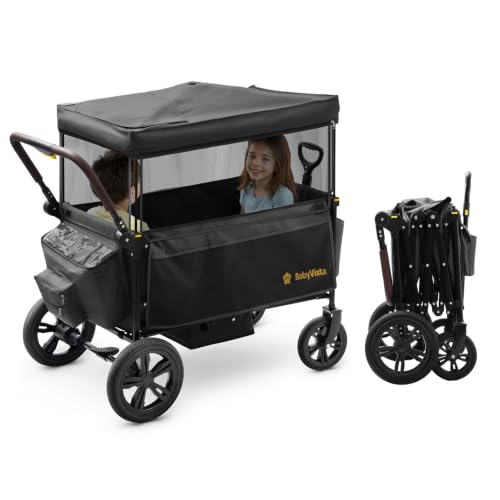


As an Amazon Associate we earn from qualifying purchases at no extra cost to you. Ratings are shown as listed on Amazon.
Quick comparison of leading wagon stroller types
| Model or type | Seating | Published or typical weight limit | Approx. wagon weight | Folded-space expectation | Best match |
|---|---|---|---|---|---|
| Radio Flyer 3-in-1 EZ Fold Wagon | Up to 2 children | About 150 lb total | About 22 lb | Compact fold; roughly 10–12 in thick depending on configuration | Budget-conscious families and paved outings |
| WonderFold W2 Elite | Up to 2 children | About 200 lb total | About 40 lb | Bulky upright fold; measure the vehicle opening | Two children who need seats, harnesses, and shade |
| WonderFold W4 Elite | Up to 4 children | About 300 lb total | About 50 lb | Large fold, commonly around 18–20 in deep and over 30 in wide | Large families and group outings |
| Veer Cruiser XL | Up to 4 children | About 110 lb total | About 37–38 lb | Long, relatively low fold; approximately 38 x 20 x 15 in | Premium build, mixed surfaces, and flexible seating |
| Compact two-seat wagon stroller | Usually 2 children | Typically 100–150 lb total | Usually 20–35 lb | Often the easiest type to store in a sedan | Frequent car travel and smaller homes |
Dimensions and limits can vary by trim, accessory package, and production revision. Treat the manufacturer’s current manual as the final authority, especially when a child is using a seat insert, car seat adapter, or infant accessory. A wagon’s maximum load also includes bags and other contents, not just children.
Best wagon stroller for each family situation
Best for two children and frequent car use: a compact two-seat wagon
A lightweight, narrow wagon is the most practical option when it will be lifted into a vehicle often. The Radio Flyer 3-in-1 EZ Fold Wagon is a useful example of this category: it offers two-child seating, a relatively low carry weight, and a simpler fold than many premium four-seat wagons.
Choose this type if your outings are mainly sidewalks, paved trails, playgrounds, and shopping areas. Its advantages are not only price and weight. A smaller frame is easier to turn around a café table, fit through a gate, and store beside other equipment. The trade-off is less generous padding, less enclosed storage, and generally smaller wheels than an all-terrain model.
Best for two children who need a more substantial cabin: WonderFold W2 Elite
The WonderFold W2 Elite is a better fit when two children will spend longer periods seated and you value a high-sided cabin, built-in seating, harnesses, canopy coverage, and extensive storage. Its weight and folded bulk are the cost of that more structured design.
It is especially suitable for zoo visits, outdoor festivals, and days when children may alternate between walking and riding. Before buying, measure the narrowest point of your vehicle’s hatch opening rather than only the cargo floor. A folded wagon can fit on the floor yet fail to pass through the opening at the required angle.
Best for four children: WonderFold W4 Elite
The WonderFold W4 Elite is the clearest choice when the priority is seating capacity. Four built-in seats and a high total load limit reduce the need for a second stroller during family or group outings. It is also useful for carrying coats, snacks, and picnic supplies, provided the combined load remains within the stated limit.
The compromise is substantial: a four-seat wagon is heavy before children climb in, occupies considerable trunk space, and takes more effort to pivot in tight areas. It works best for parks, large venues, and open paths rather than narrow shops or crowded sidewalks. If you have only two children and limited storage, the W4’s extra capacity may become unused bulk.
Best premium all-terrain choice: Veer Cruiser XL
The Veer Cruiser XL emphasizes a rigid, durable frame, wide wheels, modular seating, and better handling across grass, compact dirt, and other uneven surfaces. Its approximately 110-pound total capacity is lower than some large fabric wagons, so its advantage is construction and maneuverability rather than maximum passenger weight.
It suits families who use a wagon frequently and want a platform that can adapt as children grow. The XL version is the relevant option for more than two children. A premium wagon can also make sense for families who frequently carry beach gear or outdoor equipment, but check whether the chosen wheel and accessory configuration remains easy to lift into your vehicle.
How terrain changes the right choice
- Pavement and indoor venues: Small or medium wheels are usually adequate and keep the wagon lighter. A narrow turning radius matters more than maximum ground clearance.
- Grass and packed dirt: Look for larger rear wheels, a rigid frame, and a handle that can be held comfortably with one hand. Two-wheel steering systems are easier to control than a simple pull wagon.
- Gravel and roots: Choose pneumatic-style or broad solid wheels with a longer wheelbase. Avoid assuming that a large canopy makes a wagon all-terrain; wheel diameter and suspension-free frame rigidity matter more.
- Sand: No ordinary stroller wagon glides easily through loose beach sand. Wider wheels help, but expect pushing effort and keep sand out of wheel bearings and folding joints.
Decision matrix: capacity, space, and frequency of use
| Your situation | Recommended direction | Why | What to avoid |
|---|---|---|---|
| One or two children, small sedan, occasional use | Light compact two-seat wagon | Lower lift weight and easier storage | Large four-seat frames |
| Two children, weekly outings, long park days | Structured two-seat wagon with canopy and harnesses | Better comfort, organization, and containment | Minimalist pull wagons without seating |
| Three or four children | Four-seat wagon | One vehicle for passengers and supplies | Two-seat models used above their seating design |
| Frequent grass, gravel, or outdoor events | All-terrain wagon with larger wheels | Less vibration and easier steering | Very small-wheel compact models |
| Limited closet or garage space | Thin-folding compact wagon; verify folded width | Storage dimensions matter more than open size | Buying by seat count alone |
Assembly and setup: what to check before the first outing
Most wagon strollers require wheel installation, handle attachment, canopy fitting, and sometimes seat-belt or storage-basket assembly. Set aside 20–40 minutes for a first setup, even when the frame arrives mostly assembled. Read the load and age guidance before installing accessories, since a car-seat adapter or infant insert can change how the manufacturer permits the wagon to be used.
- Open the frame fully. Confirm that the locking indicator or latch is engaged. A fabric body can look open while the central folding mechanism is not fully locked.
- Install and pull-test each wheel. The wheel should not slide off when pulled firmly. Check that swivel wheels rotate freely and that the brake holds on a slight slope.
- Attach the handle at your preferred height. A handle that is too low encourages bending, particularly when the wagon is heavily loaded.
- Fit the canopy and seats without twisting straps. Harness straps should lie flat and be adjusted close to the child without restricting movement.
- Perform an unloaded steering test, then a loaded test. Add weight gradually. If the front wheels chatter or the handle pulls sharply to one side, check wheel installation and load distribution.
Ownership realities: cleaning, wear, and cost per use
The parts most likely to show wear are wheels, wheel bearings, brakes, folding-joint hardware, harness buckles, and fabric at the lower corners. Grass, sand, and spilled drinks accelerate that wear. Brush debris from the wheels after outdoor use, wipe the frame with mild soap and water, and dry the wagon completely before folding it. Avoid storing a damp wagon in a closed vehicle or garage.
Do not exceed the total load limit by treating the storage basket as “free” capacity. A wagon carrying two 35-pound children plus 20 pounds of supplies already has a 90-pound load. On a model rated for 110 pounds, only 20 pounds of capacity remains. Distribute heavy bags low and near the center; placing everything behind the handle can make steering light and unstable.
For ownership value, divide the purchase price by realistic uses rather than choosing only by the initial cost. A $250 wagon used 50 times costs $5 per outing in its first year; a $600 premium wagon used 200 times over several years costs $3 per use. The calculation only favors the more expensive model if its weight, handling, and durability actually lead your family to use it more often.
Final recommendation
For most families with two children, start with a compact wagon if vehicle space and lifting weight are priorities, or choose the WonderFold W2 Elite when seating structure, shade, and storage matter more. Families with three or four children should look first at a four-seat model such as the WonderFold W4 Elite. For frequent mixed-terrain use and a premium, adaptable frame, the Veer Cruiser XL is the stronger direction. In every case, measure the folded wagon against the vehicle opening, not just the cargo area, and judge capacity using children plus luggage together.

Write Your Review
No reviews yet. Be the first to share your experience!