

Key takeaways
- Parking locks: levers near the rear wheels that stop the chair from rolling during transfers or while stationary.
- Caregiver hand brakes: bicycle-style levers on the push handles that help the attendant control speed and hold the chair on a gentle slope.
The best transport wheelchairs for most everyday outings are lightweight, foldable chairs with a 17- to 19-inch seat, caregiver hand brakes, locking parking brakes, and a folded size that fits your vehicle without forcing the attendant to lift an awkward frame.
A transport wheelchair is designed to be pushed by another person. It normally has four small wheels, rather than the large self-propelling rear wheels found on a standard wheelchair. That makes it narrower and easier to fold, but the person seated should not be expected to move the chair independently or use it as a walking aid.
Our top picks
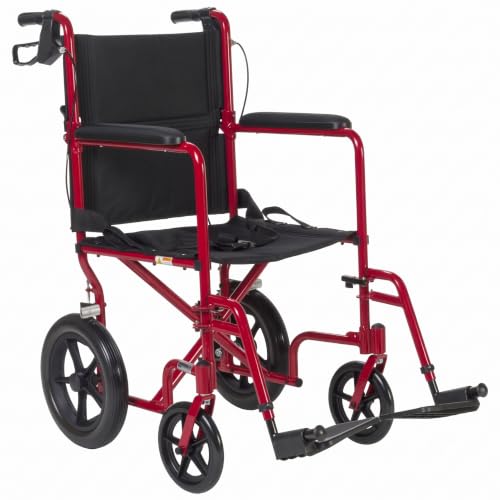


As an Amazon Associate we earn from qualifying purchases at no extra cost to you. Ratings are shown as listed on Amazon.
Best transport wheelchairs by situation
| Situation | Most suitable design | Useful target specifications | Why it fits |
|---|---|---|---|
| Frequent car trips and appointments | Ultralight aluminum transport chair | 14–20 lb; 17–19 in seat; 250–300 lb capacity | Less lifting for the caregiver and quicker loading |
| Longer outings or heavier clothing | Padded, adjustable transport chair | 19–22 in seat; 300–400 lb capacity; desk-length or full-length arms | More sitting room and support, with a modest weight penalty |
| Very limited trunk or closet space | Compact folding chair with removable or swing-away footrests | Folded depth about 9–12 in; removable footrests | More flexible storage and easier placement beside luggage |
| Uneven sidewalks and outdoor paths | Transport chair with larger rear wheels and solid tires | 12–14 in rear wheels; locking hand brakes; 300 lb or higher capacity | Rolls more predictably, although it will still not match an all-terrain wheelchair |
| Occasional emergency or guest use | Basic aluminum chair with fixed upholstery | 18–24 lb; 17–19 in seat; 250–300 lb capacity | Lower purchase cost without paying for features used rarely |
Head-to-head: what matters more than the lowest listed weight?
The lightest chair is not automatically the easiest chair to live with. A 14-pound frame may be convenient to lift, but a slightly heavier model can have better brakes, larger rear wheels, padded armrests, and a more supportive seat. Compare the complete chair with footrests installed, because specifications sometimes exclude detachable parts.
| Chair type | Typical chair weight | Common seat widths | Typical folded dimensions | Braking arrangement | Best use |
|---|---|---|---|---|---|
| Ultralight transport chair | 14–18 lb | 17–19 in | About 9–12 in deep; 30–36 in high | Rear-wheel parking locks; caregiver hand brakes on some models | Travel, errands, and frequent vehicle loading |
| Standard aluminum transport chair | 19–25 lb | 17–19 in | About 10–13 in deep; 30–37 in high | Parking locks, often with companion hand brakes | General-purpose outings |
| Heavy-duty transport chair | 25–40 lb | 20–24 in | Often 12–16 in deep | Parking locks and caregiver hand brakes are common | Higher weight capacity and a roomier seat |
| Transport chair with attendant-propelled large rear wheels | 25–35 lb | 18–22 in | Usually larger when folded | Parking locks plus hand brakes | Outdoor routes where small casters would struggle |
These are useful comparison ranges rather than universal specifications. Confirm the manufacturer’s weight, capacity, folded measurements, and included accessories before ordering. A model advertised as “lightweight” may weigh more once armrests, footrests, a cushion, or an oxygen-bottle holder are added.
How to choose the right seat width and capacity
Measure the seated user while wearing the clothing normally worn outdoors. Measure across the widest part of the hips or thighs, then add approximately 1 to 2 inches. For example, a 17-inch measurement usually points toward a 19-inch seat rather than a 17-inch seat if a coat or transfer space is needed.
Do not choose a seat that is excessively wide simply for comfort. Too much side-to-side space can make the user lean and can make the chair harder to guide through narrow doorways. Also check seat depth: the front edge should not press behind the knees, and the user should be able to sit back against the backrest.
The listed weight capacity includes the person, clothing, cushion, bags, and accessories. If the user weighs 265 pounds and the attached items add 15 pounds, a 300-pound chair leaves only a 20-pound margin. A higher-capacity model may be the more sensible choice, even if it weighs several pounds more.
Brakes and caregiver handling
There are two different brake functions to look for:
- Parking locks: levers near the rear wheels that stop the chair from rolling during transfers or while stationary.
- Caregiver hand brakes: bicycle-style levers on the push handles that help the attendant control speed and hold the chair on a gentle slope.
Parking locks are essential for transfers. Hand brakes are especially useful on ramps, long corridors, and outdoor paths, but they do not turn a transport chair into a safe substitute for a certified stair-climbing device. Test whether the caregiver can reach the levers comfortably while maintaining a firm grip. Some compact models have only parking locks; that can be acceptable for flat, short trips but is less versatile.
Push handles should be high enough that the attendant does not have to hunch. Flip-up or removable footrests reduce the lifting footprint and make side transfers easier. Swing-away footrests add convenience but may rattle or require occasional tightening. Elevating leg rests can be useful for particular positioning needs, but they add weight and length and should be selected with professional guidance where positioning is medically important.
Folded size: calculate whether it will really fit
Measure the vehicle opening, not just the trunk’s maximum internal volume. A chair that is 32 inches tall when folded may fit inside a large trunk but fail to pass through a 28-inch opening.
Use this simple check:
- Measure the narrowest trunk or hatch opening: width and height.
- Measure the available floor depth with luggage removed.
- Compare those measurements with the chair folded, including footrests and handles.
- Leave at least 2 inches of practical clearance so the frame does not need to be forced in.
For example, if the opening is 30 inches wide and the folded chair is 27 inches wide, the nominal clearance is 3 inches. That may be adequate, but a side pocket, folded seat back, or angled loading position can reduce the usable space. Take a photograph or sketch of the cargo area before shopping; it is easier to spot conflicts with a spare tire, third-row seats, or a mobility ramp.
Representative models worth comparing
Established examples include the Drive Medical Lightweight Expedition Transport Wheelchair, the Medline Ultralight Transport Wheelchair, and the NOVA Lightweight Transport Chair. These product families illustrate the usual trade-off: compact aluminum frames and relatively low weights on one side, versus padding, larger wheels, hand brakes, and greater capacity on the other. Exact specifications vary by model number, seat width, and revision, so use the current manufacturer sheet rather than relying on a retailer headline.
Market pricing in 2026 is commonly about $100–$250 for a basic transport chair, $200–$450 for a lighter or better-equipped everyday model, and $400 or more for heavy-duty, reclining, specialized, or highly adjustable designs. Accessories can change the final cost substantially.
Ownership details that affect long-term value
The components that usually need attention first are tire tread, caster bearings, brake cables, upholstery fasteners, and footrest hardware. Solid tires do not need inflation, but they still wear down and can develop flat spots after prolonged storage. Pneumatic tires roll comfortably but require pressure checks and can puncture.
- Wipe the frame and upholstery after outdoor use, especially after rain, grit, or salty conditions.
- Keep the folding joints clear of sand and do not force a frame that is not opening smoothly.
- Check that both parking locks engage evenly before every transfer.
- Inspect footrest pins, armrest screws, and caster fasteners periodically for looseness.
- Never hang a heavy bag from a push handle unless the manufacturer permits it; it can affect balance.
- Use only the specified replacement parts for brakes, wheels, and footrests.
Avoid spraying general-purpose oil onto brake cables or upholstery. Follow the manual’s maintenance instructions, and have a qualified mobility-equipment technician inspect a chair after a crash, bent frame, or brake problem.
Bottom line
Choose the lightest chair that still provides the needed seat width, capacity, wheel size, and braking control. For frequent car travel, prioritize a 14- to 20-pound foldable model. For longer outings, prioritize caregiver hand brakes and supportive seating. For larger users or rougher routes, accept extra weight for a stronger frame and larger wheels. If fit, posture, transfers, or medical positioning are concerns, ask an occupational or physical therapist to assess the chair before purchase.

Write Your Review
No reviews yet. Be the first to share your experience!