

Key takeaways
- Recess depth: confirm that the frame and rotating louvers fit without touching the glass or hardware.
- Square: compare diagonal measurements; a large difference may require an outside mount or a tapered frame.
- Panel width and weight: tall, wide panels may need a divider rail, split tilt, extra hinges, or a mid-rail.
- Trim and opening direction: make sure panels will clear baseboards, handles, faucets, and adjacent walls.
Best Plantation Shutters for Every Window
The best plantation shutters are real wood for living rooms and bedrooms, composite for most kitchens and bathrooms, and vinyl for high-moisture rooms, rental properties, or windows that need a low-maintenance budget solution. The right choice depends less on appearance than on humidity, window shape, frame depth, louver size, and how much installation tolerance you need.
Quick decision guide
| Window or household situation | Best shutter type | Recommended louver | Why it fits |
|---|---|---|---|
| Dry bedroom or living-room window | Painted or stained wood | 3.5 or 4.5 inches | Lightweight, attractive, and easy to customize |
| Kitchen, bathroom, or laundry room | Composite or moisture-resistant hybrid | 3.5 inches | Better resistance to swelling, warping, and frequent cleaning |
| Very humid room, rental, or child’s playroom | Vinyl or solid synthetic | 3.5 inches | Resists moisture and knocks with minimal maintenance |
| Wide picture window | Reinforced composite or engineered wood | 4.5 inches, if the frame allows | Fewer louvers and wider views, with more structural support |
| Odd-shaped, arched, or specialty window | Custom wood or composite | Matched to the shape | More options for templates, split panels, and angled tops |
Wood, composite, and vinyl compared
Wood shutters: best for appearance and lighter panels
Wood plantation shutters use hardwood or engineered wood components covered with paint or stain. They usually provide the broadest range of colors, stains, edge details, and custom shapes. Because wood is relatively light, it is a strong choice for tall windows, frequently opened panels, and installations where heavy panels could strain hinges.
Our top picks
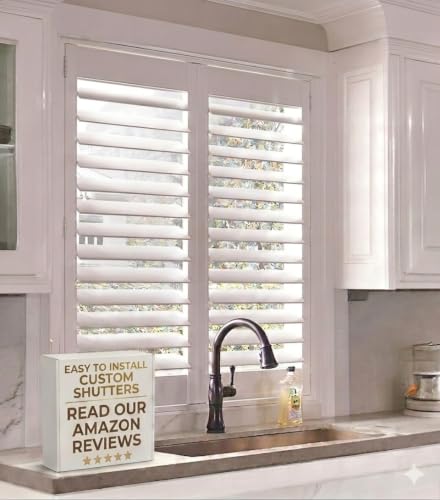

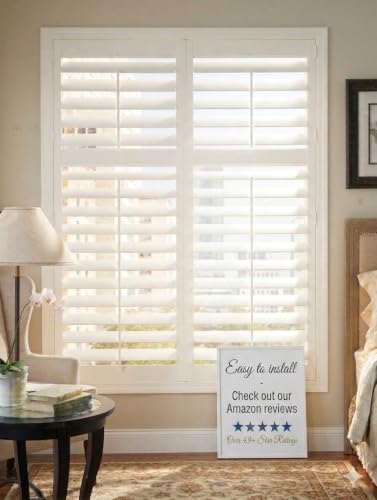
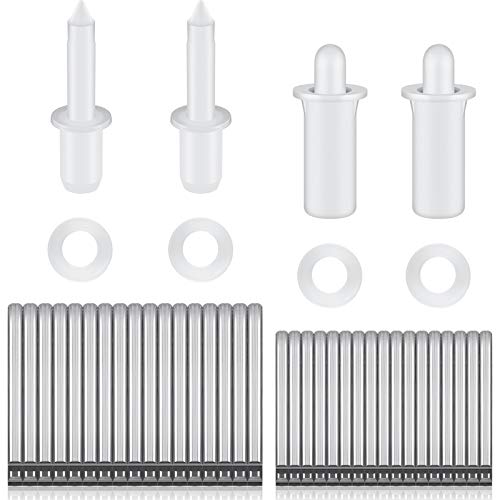
As an Amazon Associate we earn from qualifying purchases at no extra cost to you. Ratings are shown as listed on Amazon.
Wood also has useful insulating value because it is a poor conductor of heat compared with metal or glass. That does not turn a shutter into a replacement for double glazing or properly sealed window frames, however. The biggest energy benefit usually comes from closing the louvers and reducing direct sunlight and air movement at the window.
The weakness is moisture. Wood can absorb humidity through unfinished edges, routed holes, and joints. Repeated condensation may cause paint failure, swelling, or a panel that no longer closes squarely. Wood is best in controlled indoor humidity and should not be selected merely because a bathroom has an exhaust fan.
Composite shutters: best all-round choice
Composite shutters are made from engineered wood, medium-density fiberboard, polymer-coated materials, or combinations of these. Construction varies substantially: some have a wood core with a durable coating, while others use synthetic components in moisture-exposed areas. Ask what the louvers, frame, and hidden edges are made from rather than relying on the word “composite.”
For many homes, composite is the best plantation shutter category overall. It offers a painted appearance similar to wood, good dimensional stability, and stronger resistance to everyday impacts. It is particularly practical for kitchens, bathrooms, and homes where windows are opened and closed often.
Composite panels are usually heavier than comparable wood panels. Large or tall openings may therefore need reinforced hinges, additional divider rails, or a split-panel design. A sturdy product installed into a weak or poorly anchored frame can still sag.
Vinyl shutters: best for moisture and easy care
Vinyl shutters use molded or extruded polymer components. They do not absorb water like unfinished wood, and they are easy to wipe clean. That makes them useful near showers, sinks, humid climates, and rooms where splashes are likely.
Vinyl is not automatically the strongest option. Hollow or lightly reinforced panels can flex, especially in wide widths, and prolonged direct sunlight can discolor or make lower-quality plastics brittle. Look for internal reinforcement, a stated maximum panel width, and hinge hardware appropriate for the panel’s weight.
Vinyl can also have fewer choices for stain colors, custom profiles, and unusually shaped windows. It is a practical material, not always the best architectural match for a traditional interior.
Head-to-head specifications that affect the decision
| Characteristic | Wood | Composite | Vinyl |
|---|---|---|---|
| Common louver sizes | 2.5, 3.5, 4.5 inches | 3.5, 4.5 inches; some 2.5-inch options | 3.5, 4.5 inches; options vary |
| Typical panel weight | About 4–8 lb per square foot | About 6–12 lb per square foot | About 5–11 lb per square foot |
| Insulation potential | Good, but depends on gaps and glass | Good to very good, depending on core | Moderate; air gaps and construction matter |
| Moisture resistance | Fair to good with sealed finishes | Good; verify exposed-edge construction | Very good |
| Large-panel suitability | Good when lightweight and properly hinged | Good with reinforcement; can be heavy | Fair to good; reinforcement is important |
| Typical installed market range | About $200–$1,000 per window | About $175–$850 per window | About $150–$700 per window |
Weight figures and prices are broad market ranges, not specifications for every manufacturer. A 4.5-inch louver in a narrow window may require a different panel design from the same louver in a 72-inch-wide opening. Custom shapes, motorization, premium finishes, shutters above doors, and difficult access can raise the installed cost substantially.
Choosing the right louver size
2.5-inch louvers suit traditional rooms and smaller windows. They provide more individual slats, which can look busy but offer fine control over privacy and light.
3.5-inch louvers are the safest general-purpose choice. They balance privacy, view-through, cleaning effort, and compatibility with common window proportions.
4.5-inch louvers create a more open, contemporary appearance. Fewer slats mean fewer horizontal surfaces to dust and a larger view when the louvers are open. They need enough depth for the wider slats to rotate without hitting glass, locks, handles, or insect screens.
Before ordering, measure the obstruction—not just the glass. A window handle projecting 2 inches into the room can prevent a full-size shutter panel from folding or closing. A frame-mounted installation may solve the problem, while an inside mount may not.
Fit and installation: the details that prevent expensive mistakes
Plantation shutters can be installed inside the window recess, outside the recess, or in a configuration that uses a shallow frame and hinges. Inside mounting looks integrated but requires reasonably square jambs and adequate depth. Outside mounting covers more trim and is useful when the recess is too shallow, uneven, or obstructed.
Measure width in at least three places and height in at least three places. Record the smallest width and smallest height, then follow the manufacturer’s deduction rules; do not invent a deduction. For example, if three width measurements are 35 7/8, 35 3/4, and 35 13/16 inches, the smallest measurement is 35 3/4 inches. The supplier may deduct a specified clearance from that figure for an inside mount.
Check four installation points before buying:
- Recess depth: confirm that the frame and rotating louvers fit without touching the glass or hardware.
- Square: compare diagonal measurements; a large difference may require an outside mount or a tapered frame.
- Panel width and weight: tall, wide panels may need a divider rail, split tilt, extra hinges, or a mid-rail.
- Trim and opening direction: make sure panels will clear baseboards, handles, faucets, and adjacent walls.
Professional installation is particularly worthwhile for bay windows, arched tops, French doors, very wide panels, and openings that are out of square. A do-it-yourself installation is more realistic for a standard rectangular window when the supplied frame is preassembled and the installer can anchor into solid jamb material.
Insulation, light control, and moisture in real ownership
Shutters can reduce glare and solar heat when closed, but their performance depends on the seal around the frame, the gap between panels, the window itself, and how often they remain closed. A shutter with excellent material insulation still loses much of its benefit if the frame is loosely fitted or the panels are left open during the hottest part of the day.
For condensation-prone windows, first identify the source. Persistent moisture can come from indoor humidity, a cold glass surface, or a failed window seal. Shutters may hide the condensation and make drying harder. Leave enough airflow for the window area, wipe moisture promptly, and address the underlying humidity or glazing problem rather than treating shutters as a waterproof barrier.
Maintenance and the parts most likely to wear
- Dust with a soft microfiber cloth or vacuum brush. Avoid abrasive cleaners and excessive water, especially on wood and engineered-wood edges.
- Clean vinyl and sealed composite with a lightly damp cloth and mild soap, then dry the joints and lower frame.
- Do not force a louver that is blocked by a handle or curtain. Repeated pressure can loosen the tilt mechanism.
- Inspect hinges and panel alignment annually. Sagging usually appears first as an uneven gap or a panel that rubs at the bottom.
- Keep bathroom shutters open after bathing so both the window and shutter can dry.
The components that commonly need attention first are tilt-rod connectors, small louver clips, hinge screws, and magnetic catches—not necessarily the shutter material itself. Replacement hardware is often available, but matching the original system is easier when you keep the installation paperwork and product name.
Bottom line
Choose wood when appearance, light weight, and custom finishing matter most in a dry room. Choose composite when you want the strongest balance of appearance, durability, and moisture tolerance. Choose vinyl when water, frequent cleaning, impact, or a lower budget outweighs the need for extensive finish and shape options. In every case, accurate measurements and appropriate reinforcement matter as much as the material label.

Write Your Review
No reviews yet. Be the first to share your experience!