

Key takeaways
- 4–6 lb: useful for beginners, lighter athletes, warm-ups, speed work, and learning the catch.
- 8–12 lb: the most versatile range for general fitness and mixed circuits.
- 14–20 lb: better for experienced athletes using lower repetitions and more rest.
The best wall balls are full-size, soft-shell training balls matched to your throwing height, workout frequency, and strength level—not simply the heaviest ball you can lift.
Quick picks by workout style
| Training situation | Best specification | Useful starting choice | Why it fits |
|---|---|---|---|
| Beginner learning wall balls | 4–6 lb, 14-inch diameter, moderate rebound | 4 lb or 6 lb soft-shell wall ball | Easier to control at the catch and less tiring during technique practice |
| General fitness and mixed circuits | 8–12 lb, 14-inch diameter, low-to-moderate rebound | 8 lb for many adults; 10–12 lb for stronger athletes | Balances squat, throw, catch, and conditioning demands |
| Cross-training and high-repetition sessions | 6–10 lb, durable stitched shell, consistent fill | 6 lb or 8 lb | Reduces early fatigue and makes repeated targets more manageable |
| Strength-biased wall-ball work | 12–20 lb, dense fill, controlled rebound | 12 lb or 14 lb | Adds meaningful loading without turning every rep into a maximal effort |
| Small home gym | 10–14 inches, soft surface, low rebound | 6–10 lb non-bouncing wall ball | Less risk of the ball ricocheting into equipment, windows, or furniture |
What makes a wall ball different from a medicine or slam ball?
A wall ball is designed to be thrown at a target and caught repeatedly. It usually has a large, soft outer shell, a relatively uniform diameter, and filling that distributes its weight across the interior. A medicine ball may be smaller and harder, while a slam ball is commonly denser, tougher, and intended to hit the floor rather than return to the athlete.
Our top picks
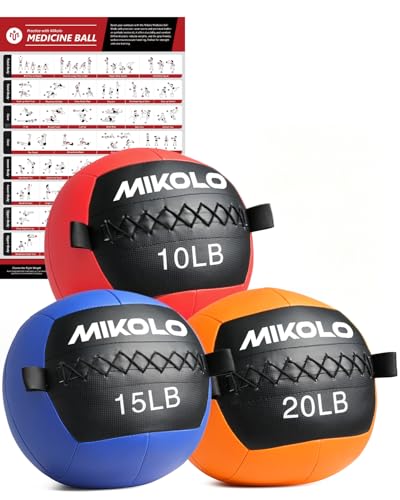


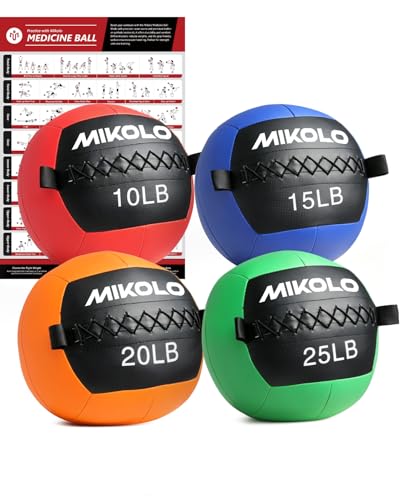
As an Amazon Associate we earn from qualifying purchases at no extra cost to you. Ratings are shown as listed on Amazon.
Do not substitute a hard medicine ball or a slam ball for wall-ball work unless the manufacturer specifically permits throwing it at a wall or target. A hard ball can be uncomfortable or unsafe to catch, and a slam ball may have unpredictable rebound.
The buying criteria that matter most
Weight: choose repeatable effort, not a one-rep challenge
For most conditioning workouts, the right wall ball lets you complete the programmed repetitions with consistent squat depth, a clean upward drive, and a controlled catch. If the ball causes you to shorten the squat, throw with one arm, or hesitate under the target, it is too heavy for that session.
- 4–6 lb: useful for beginners, lighter athletes, warm-ups, speed work, and learning the catch.
- 8–12 lb: the most versatile range for general fitness and mixed circuits.
- 14–20 lb: better for experienced athletes using lower repetitions and more rest.
For a simple test, choose a weight you can throw to the intended target for 10 controlled repetitions without losing posture. If the final two repetitions become slow or inaccurate, move down one weight category. A second, lighter ball is often more useful than buying one very heavy ball for every workout.
Diameter: larger is not automatically better
Many wall balls are approximately 14 inches in diameter, although smaller and larger options exist. A larger ball creates a wider receiving target and can make the movement feel more natural for chest-height catches. It also increases the range of motion required to hold the ball securely and may be awkward for shorter athletes or children.
Check that you can hold the ball at chest height with both hands, elbows slightly below the ball, without shrugging your shoulders. A 10- or 12-inch ball may be easier to control for smaller users, but it can feel denser and less forgiving when caught. Diameter should be considered alongside weight rather than treated as an independent quality score.
Shell durability and stitching
The outer shell is usually the first part to show wear. Look for reinforced seams, dense synthetic leather or heavy-duty vinyl, and a surface that does not become slippery when damp. Stitched panels can provide a predictable shape, while welded or molded construction may reduce exposed seam edges. Either construction can work well when the ball is used as intended.
Inspect the seam before every session if the ball is used outdoors or on rough flooring. A small split can expand quickly once internal filling begins pushing through it. Avoid dragging the ball, leaving it in direct sunlight, or storing it against a sharp rack edge.
Rebound: predictable is better than lively
Wall balls are not selected for maximum bounce. A controlled, modest rebound gives you time to absorb the catch and prepare for the next squat. Excessive rebound may send the ball above the target, toward your face, or back into another person.
For target throws, choose a low- or moderate-rebound wall ball. A ball marketed specifically for slams or bouncing drills may behave differently, even if its weight is similar. If you train in a narrow room, low rebound is particularly valuable.
Grip and filling consistency
A textured shell helps when your palms are sweaty, but a very rough surface may irritate the hands during high-repetition work. The ball should feel secure with bare hands and should not require an aggressive squeeze throughout the set.
Filling consistency is easy to overlook. A well-filled ball should keep its shape when held at chest height and should not have a pronounced lump or a loose, shifting interior. Inconsistent filling changes the catch from repetition to repetition and can make the ball rotate unexpectedly. If buying in person, rotate the ball slowly and check for soft spots. When buying online, prioritize manufacturers that publish dimensions, weights, and intended use rather than relying only on color or promotional photos.
Brand and product types worth considering
Established training brands such as Rogue, Dynamax, REP Fitness, and TRX offer medicine-ball or wall-ball lines in several weights. Product names and exact specifications vary by range, so compare the published diameter, weight options, shell material, and usage guidance before ordering.
Dynamax-style soft wall balls are associated with a large, padded feel and controlled catches, making this type popular for repeated target throws. Rogue and REP Fitness wall balls typically provide multiple weight choices aimed at gym and conditioning use. TRX medicine balls may suit buyers who want a broader conditioning tool, but confirm that the particular model is intended for repeated wall throws rather than only carries, rotational exercises, or slams.
For inexpensive home use, a generic soft-shell wall ball can be adequate if it has a stated weight tolerance, reinforced seams, accurate dimensions, and a return policy. The cheapest option is less attractive when the fill shifts, the shell absorbs moisture, or the diameter is too small for comfortable catches.
A practical decision matrix
| Your priority | Choose | Avoid |
|---|---|---|
| Lowest initial cost | One 6–8 lb soft wall ball with reinforced seams | Unspecified “weighted balls” with no diameter or fill information |
| Training three or more times weekly | Heavy-duty shell, stitched panels, and a moderate rebound | Thin vinyl and exposed seam stitching |
| Limited ceiling or wall space | Low-rebound ball and a clearly marked target | High-bounce balls that can ricochet unpredictably |
| Several users sharing one ball | 8–10 lb general-purpose ball, then add lighter or heavier balls later | Choosing a weight based only on the strongest user |
| Outdoor use | Weather-resistant synthetic shell and storage indoors | Leaving any padded ball on wet ground or in direct sun |
How to set up and maintain a wall ball
- Measure the target area. Make sure the wall or target can tolerate repeated impact, and remove fragile objects from the rebound path.
- Mark a consistent height. A visible target prevents you from gradually throwing higher as fatigue builds. Follow the height specified by your workout or coach.
- Start with a controlled set. Perform 5–10 repetitions, checking that the ball lands in your hands rather than on your forearms or fingertips.
- Clean the shell. Wipe it with a slightly damp cloth after training and use mild soap when needed. Avoid soaking padded balls unless the manufacturer permits it.
- Dry it fully. Moisture trapped in seams can create odor and weaken some materials. Store the ball off the floor in a cool, dry place.
- Check for damage. Retire or repair a ball if the shell is splitting, the stitching is opening, or the filling has formed a hard lump.
As an ownership calculation, a $60 wall ball used twice a week for two years provides about 208 sessions, or roughly $0.29 per use before replacement costs. A cheaper ball that fails after a few months may have a higher real cost, particularly for a busy household or facility.
Final recommendation
For the broadest range of workouts, start with a 14-inch, 8- or 10-pound wall ball that has a durable stitched shell, controlled rebound, grippy surface, and stable filling. Choose 4–6 pounds when learning the movement or prioritizing speed, and move to 12 pounds or more only when you can maintain accurate throws and safe catches under fatigue. The best wall ball is the one that remains predictable for the entire set and survives the way you actually train.
Write Your Review
No reviews yet. Be the first to share your experience!