

Key takeaways
- Choose a compact 10- to 12-amp corded power rake when dependable output and low operating cost matter most. Choose battery power for small, obstacle-filled lawns where cable handling is the main nuisance. Choose an interchangeable scarifier model for renovation work that goes beyond surface thatch,…
The best power rake for most homeowners is a 12-amp corded machine with a 13- to 14-inch working width, adjustable tine height, and a removable collection bag; choose a wider tow-behind rake for large lawns, a battery model for small yards without convenient outlets, and a scarifier-capable machine when renovation includes compacted soil as well as thatch.
Our top picks



As an Amazon Associate we earn from qualifying purchases at no extra cost to you. Ratings are shown as listed on Amazon.
Best power rakes by lawn situation
| Situation | Best choice | Why it fits | Main compromise |
|---|---|---|---|
| Small lawn under 2,000 sq. ft. | Battery or corded 12-amp dethatcher | Easy turning, low storage demand, enough capacity for short sessions | Battery runtime or extension-cord management |
| Typical 2,000–8,000 sq. ft. lawn | 13–14-inch corded power rake | Strong continuous power and a practical balance of width and control | Requires a suitable outdoor-rated extension cord |
| Large lawn over 8,000 sq. ft. | Tow-behind rake or professional walk-behind unit | Wider coverage and less physical handling over long passes | Needs a compatible riding mower or lawn tractor |
| Heavy thatch and occasional soil scarification | Adjustable machine with interchangeable tine and scarifier cartridges | Can rake surface thatch and make shallow renovation cuts | Usually costs more and requires careful depth adjustment |
| Uneven or gently sloped terrain | Light walk-behind model with large rear wheels and independent height control | Easier to keep stable and less likely to gouge high spots | Narrower width may increase working time |
What separates the best power rakes
Dethatching width
Width determines how many passes you need, but wider is not automatically better. A 13-inch machine covers about 1,000 square feet in roughly 77 linear passes if each pass is treated as a full 13-inch strip. In real use, overlaps and turning raise that figure to approximately 85–95 passes. A 21-inch machine reduces the number of passes substantially, while a 36- to 48-inch tow-behind rake is intended for open lawns where turning around trees and beds is not a major issue.
Narrow walk-behind machines are better around fences, planting beds, gates, and irregular front lawns. Wide units make more sense on unobstructed turf and reduce fatigue during annual renovation.
Tine adjustment and working depth
Look for a lever with several positive height positions rather than a loose wheel adjustment. The first pass should usually be shallow enough to remove dead surface material without digging into living crowns. A second pass can be slightly deeper if the lawn still contains a dense thatch layer.
Flexible spring tines are gentler and better suited to routine dethatching. Rigid metal scarifier blades are more aggressive and can open compacted soil, but they also increase the risk of tearing healthy turf. The most useful designs let you change the cartridge or reel rather than forcing one attachment to perform both jobs.
Motor power and drive behavior
For corded electric models, 10 to 12 amps is a useful range for residential dethatching. A 12-amp motor generally maintains momentum better in dense material, although motor power does not eliminate the need to work when the grass is dry and the machine is set correctly. Battery models are quieter and easier to start, but their effective working time depends on battery capacity, grass resistance, and whether the machine uses a high-output brushless motor.
Power rake heads are normally pushed rather than self-propelled. That makes wheel size, balance, and handle design important. A machine that feels light on a level lawn may become awkward when the tine reel fills with debris or the route includes a slope.
Collection options
Collection bags save raking time, but small bags fill quickly with thatch. A bag around 1.5 to 2 bushels is adequate for many residential jobs; larger lawns may be faster if material is windrowed and collected separately with a mower or leaf vacuum.
Check whether the bag detaches without removing the handle and whether the discharge opening clogs when the thatch is damp. Collection is least useful when the lawn is badly overgrown, because frequent emptying can interrupt the work. A rear deflector or discharge guard is valuable when you prefer to rake first and collect later.
Head-to-head: common residential power-rake formats
| Format | Typical width | Power specification | Adjustment | Collection | Best lawn size |
|---|---|---|---|---|---|
| Compact corded dethatcher | 12–14 in. | 10–12 amps | 3–5 depth positions | Approximately 1.5–2 bushels, often removable | Up to about 8,000 sq. ft. |
| Battery walk-behind dethatcher | 13–14 in. | 40V–60V battery systems are common | Usually 3–5 positions | Bag or rear discharge, model dependent | Up to about 4,000 sq. ft. per session, depending on battery |
| Heavy-duty walk-behind power rake | 18–22 in. | Gas engine or high-output electric system | Fine depth control or height-adjustable reel | Often rear discharge rather than a small bag | 8,000–20,000 sq. ft. |
| Tow-behind dethatcher | 36–48 in. | Tractor or riding-mower drawbar | Weight tray or height lever | Usually no integrated bag | Large, open lawns |
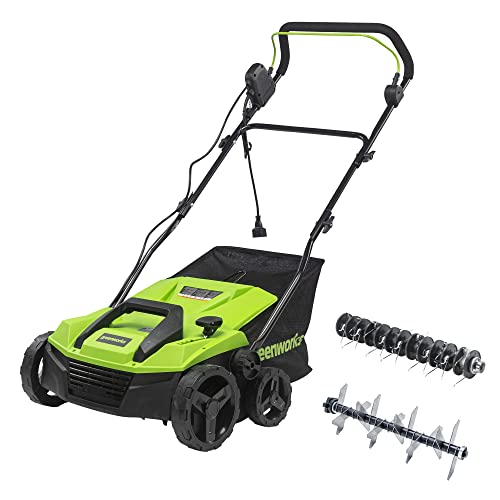
Examples of established residential products include the Sun Joe AJ801E, a 12-amp corded unit with a 13-inch working width and adjustable depth, and the Greenworks DT13B00, a compact corded dethatcher in the same general width class. These illustrate the mainstream homeowner format rather than replacing the need to compare current specifications, included reels, and warranty terms for the exact model year.
How much capacity do you need?
Use the battery or bag calculation before buying. Suppose a 13-inch machine effectively covers 10 inches after overlap and you need to process 5,000 square feet. The approximate distance is:
5,000 square feet ÷ 0.83 feet of effective width = about 6,024 linear feet.
At a working speed of 2 feet per second, that is approximately 50 minutes of continuous forward travel, before turning, emptying the bag, and clearing obstacles. A battery rated for 45 minutes may therefore be marginal even if the manufacturer’s runtime sounds close. For this lawn size, a corded unit or a second compatible battery is more practical.
Power rake setup that avoids lawn damage
- Mow slightly lower than usual, but do not scalp the lawn. Shorter grass lets the tines reach the thatch layer and reduces wrapping around the reel.
- Work only when the surface is dry. Wet soil clings to the tines, blocks discharge, and makes gouging more likely.
- Start at the highest tine setting. Make a short test pass. The machine should remove brown organic material without pulling up large quantities of rooted turf.
- Overlap passes modestly. About one or two inches of overlap improves coverage without repeatedly stressing the same strip.
- Change direction only if necessary. A second pass at a right angle is appropriate for severe thatch, but it increases turf disturbance and cleanup.
- Rake or collect the debris immediately. Leaving loosened thatch on the lawn can shade the crown and make it difficult to judge the result.
- Inspect before reseeding. If the soil is hard and water-repellent, aeration and topdressing may be more useful than repeatedly deepening the rake.
Durability and ownership costs
Tines are the first wear component. Spring tines bend or lose tension, while rigid blades become rounded and less effective. Replacement reels or tine cartridges can determine the real long-term cost, so check availability before purchase. Wheels, height-adjustment levers, belt covers, and collection-bag seams are the next parts most likely to suffer from frequent use.
After every session, disconnect the cord or remove the battery, brush debris from the housing, and clear packed material from the tine reel. Do not hose an electric motor housing. Inspect the cable for cuts, keep the machine dry during storage, and lubricate only points specified in the manual. For gasoline units, add fuel-system maintenance and engine oil to the ownership workload.
The most common mistake is using maximum depth to compensate for an unsuitable lawn condition. If the machine repeatedly stalls, throws soil, or leaves bare grooves, raise the tines, reduce overlap, and make another pass later rather than forcing the reel into the ground.
Bottom line
Choose a compact 10- to 12-amp corded power rake when dependable output and low operating cost matter most. Choose battery power for small, obstacle-filled lawns where cable handling is the main nuisance. Choose an interchangeable scarifier model for renovation work that goes beyond surface thatch, and choose a tow-behind rake only when your lawn is large and open enough to justify a riding mower attachment. The best power rake is the one whose width, depth control, collection method, and available runtime match the actual lawn—not the largest or most aggressive machine on the specification sheet.

Write Your Review
No reviews yet. Be the first to share your experience!