

Key takeaways
- Mixing up RAID and backup: RAID helps maintain availability after a disk failure; it does not protect against deletion, malware, theft, fire, or a failed NAS enclosure.
- Buying mismatched recording types: Check that every selected model is CMR when sustained writes and rebuild behavior matter.
- Ignoring temperatures: Keep drives within the manufacturer’s operating range. Poor airflow shortens the margin for error, especially with 7200 RPM models.
- Filling every bay immediately: Leave room for expansion or keep a compatible replacement disk available. A degraded array is more vulnerable until rebuilt.
- Skipping health checks: Enable scheduled SMART tests, alerts, and scrubs where supported. A periodic scrub can find latent read errors before a second disk fails.
- Assuming all large drives are interchangeable: Verify bay support, NAS firmware compatibility, sector format, and the enclosure’s maximum tested capacity.
The best NAS hard drives for most home users are CMR-based models such as WD Red Plus, Seagate IronWolf, or Toshiba N300; choose WD Red Pro or IronWolf Pro when your NAS runs heavily, has many bays, or supports business workloads.
Our top picks


As an Amazon Associate we earn from qualifying purchases at no extra cost to you. Ratings are shown as listed on Amazon.
Best NAS hard drives by situation
| Situation | Best fit | Why |
|---|---|---|
| Two- to four-bay home NAS, backups, photos, media | WD Red Plus or Seagate IronWolf | NAS-rated CMR recording, moderate power use, and workload ratings around 180 TB per year |
| Small office or frequently accessed file server | WD Red Pro or Seagate IronWolf Pro | Higher workload ratings, stronger vibration management, and five-year warranties |
| Many bays in a rackmount chassis | Enterprise-class or Pro NAS drives | Better vibration tolerance and sustained workload capability than entry-level disks |
| Lowest purchase cost per terabyte | High-capacity conventional NAS drive | Larger disks can reduce the number of bays required, but rebuilding takes longer |
| Quiet living-room NAS | 5400–5900 RPM NAS drive | Usually quieter and less power-hungry than 7200 RPM models |
What makes a hard drive suitable for a NAS?
A NAS drive is designed for continuous operation, vibration from neighboring disks, and workloads that can involve many users or applications at once. The important distinction is not simply “desktop” versus “NAS” on the label. Check the recording method, annual workload rating, vibration features, warranty, and compatibility with your enclosure.
Prefer CMR recording for a NAS. CMR generally provides more predictable sustained write performance, especially during RAID rebuilds. SMR drives can be acceptable for some archival uses, but their write behavior can become awkward during large updates, synchronization, or a degraded-array rebuild. Many NAS vendors also publish compatibility lists; check yours before buying unusual capacities or enterprise models.
Head-to-head: the leading NAS drive families
| Drive family | Typical capacities | Recording | Workload rating | Warranty | Typical behavior |
|---|---|---|---|---|---|
| WD Red Plus | 2–12 TB | CMR | 180 TB/year | 3 years | Good balance of noise, price, and home-NAS performance |
| WD Red Pro | 2–24 TB, depending on model | CMR | 300 TB/year | 5 years | Faster, louder, and better suited to demanding multi-bay systems |
| Seagate IronWolf | 2–24 TB, depending on model | CMR | 180 TB/year | 3 years | Strong general-purpose choice with NAS health-monitoring support on compatible systems |
| Seagate IronWolf Pro | 4–32 TB, depending on model | CMR | Up to 550 TB/year on current high-end models | 5 years | Designed for heavier workloads, with higher noise and power consumption |
| Toshiba N300 | 4–22 TB, depending on model | CMR | Up to 180 TB/year on many models | 3 years | Competitive capacity and performance; model-specific acoustics vary considerably |
Capacities, acoustics, power figures, and workload ratings vary by exact model number. Treat the table as a family-level comparison, then verify the manufacturer’s specification sheet for the capacity you intend to purchase.
WD Red Plus: the sensible home choice
WD Red Plus is a strong default for a two- or four-bay NAS used for computer backups, photographs, documents, and video streaming. Its 180 TB-per-year workload rating is ample for many households, and its relatively modest spindle speed helps keep noise and heat under control. The three-year warranty is shorter than the Pro range’s, but the drive normally costs less.
Seagate IronWolf: a flexible alternative
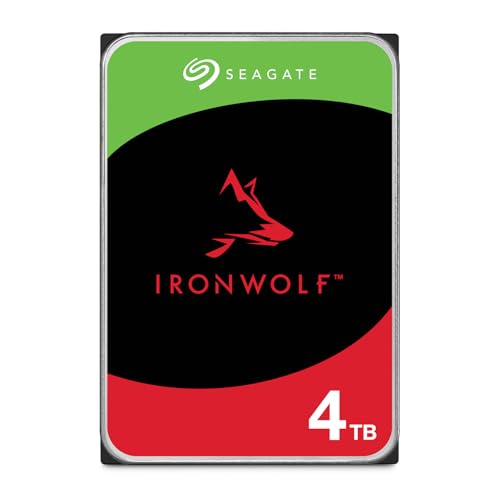
IronWolf occupies a similar position to Red Plus. It is aimed at always-on NAS use, supports CMR in the standard NAS range, and is available in capacities suitable for both compact and larger enclosures. Compatible NAS software can use Seagate’s health-monitoring features to report some drive conditions. Choose it when its capacity or current market price is more attractive than the equivalent WD model.
WD Red Pro and IronWolf Pro: for demanding arrays
Pro models are worthwhile when the NAS serves several computers, runs virtual machines, hosts surveillance recording, or contains eight or more bays. They generally offer higher workload ratings, longer warranties, and more robust vibration management. The trade-off is tangible: 7200 RPM designs commonly use more power and produce more idle and seek noise than quieter home-NAS drives.
Toshiba N300: capacity-focused competition
N300 drives are NAS-oriented CMR models with capacities that can be attractive when you need a large array without moving to a separate enterprise line. They can be noisier than slower home-focused disks, particularly during random access. Confirm the exact model’s workload rating and acoustic specification rather than assuming every N300 capacity behaves identically.
Capacity per bay matters more than the sticker price
Compare usable capacity, not just the disk’s advertised size. In a four-bay RAID 5 or equivalent single-parity array, four 12 TB drives provide approximately 36 TB of decimal raw usable capacity before filesystem overhead. Four 20 TB drives provide approximately 60 TB. The larger disks therefore add 24 TB of raw usable space without requiring a larger enclosure.
That benefit comes with a recovery cost. A 20 TB disk can take many hours or more than a day to rebuild, depending on the NAS, disk speed, and how busy the array remains. During a rebuild, the array has reduced fault tolerance. For critical data, RAID should be paired with an independent backup rather than treated as a backup itself.
Vibration, noise, and power: the overlooked trade-offs
In a multi-drive enclosure, vibration can affect seek behavior and reliability. NAS and Pro drives use firmware and mechanical features intended to operate alongside other disks, while enterprise-oriented models may add more sophisticated rotational-vibration tolerance. A small two-bay NAS rarely needs the most expensive enterprise disk, but a densely populated rackmount chassis benefits more from Pro or enterprise specifications.
As a broad planning range, a 5400–5900 RPM NAS drive often consumes about 3–6 watts when active and roughly 0.5–1.5 watts while idle, excluding enclosure overhead. A 7200 RPM Pro drive may consume about 6–10 watts active and create noticeably more heat. Four drives adding 4 watts each means 16 watts continuously, or about 140 kWh per year. At an electricity rate of $0.20 per kWh, that is approximately $28 annually before cooling costs.
Noise is also workload-dependent. Rotational hum is usually constant, while head movement produces intermittent clicking or chatter. Place a living-room NAS on a solid surface, avoid hollow furniture that amplifies vibration, and use the enclosure’s rubber mounts correctly. Do not select a desktop drive solely because it is quieter; its firmware may not be designed for a multi-disk array.
Warranty and workload rating: how much should you pay for them?
The workload rating is an annual estimate of how much data the drive is designed to read and write under specified conditions. A household storing 5 TB of new data per year is not close to a 180 TB-per-year rating. A NAS used for video editing, surveillance, virtual machines, or multiple daily backups can produce far more traffic through rewriting, snapshots, indexing, and parity operations.
A five-year warranty does not guarantee five years of service, nor does a three-year warranty mean a drive is unsuitable. It does indicate how the manufacturer positions the product and how long replacement support may be available under its terms. If downtime is costly, buy drives with longer warranties and keep a spare or a rapid replacement plan.
Common buying and maintenance mistakes
- Mixing up RAID and backup: RAID helps maintain availability after a disk failure; it does not protect against deletion, malware, theft, fire, or a failed NAS enclosure.
- Buying mismatched recording types: Check that every selected model is CMR when sustained writes and rebuild behavior matter.
- Ignoring temperatures: Keep drives within the manufacturer’s operating range. Poor airflow shortens the margin for error, especially with 7200 RPM models.
- Filling every bay immediately: Leave room for expansion or keep a compatible replacement disk available. A degraded array is more vulnerable until rebuilt.
- Skipping health checks: Enable scheduled SMART tests, alerts, and scrubs where supported. A periodic scrub can find latent read errors before a second disk fails.
- Assuming all large drives are interchangeable: Verify bay support, NAS firmware compatibility, sector format, and the enclosure’s maximum tested capacity.
Bottom line
For the typical home NAS, choose a CMR WD Red Plus, Seagate IronWolf, or Toshiba N300 in the capacity that gives you practical room for growth. Move to WD Red Pro or Seagate IronWolf Pro when workload, bay count, vibration, or downtime matters more than quiet operation and low purchase cost. Whichever family you choose, prioritize a compatible CMR model, maintain good airflow, monitor drive health, and keep a separate backup of irreplaceable data.




Write Your Review
No reviews yet. Be the first to share your experience!