

Key takeaways
- For most aquariums built or upgraded today, LED is the better choice: it uses less electricity, runs cooler.
For most aquariums built or upgraded today, LED is the better choice: it uses less electricity, runs cooler, and offers dimming and color control that fluorescent tubes cannot match. T5 HO still earns a place when you want an even, wide spread of light across a long tank and prefer the look and cost profile of a tube fixture.
This comparison is for keepers deciding between the two on a new setup or replacing an aging fixture, whether the tank holds freshwater plants, a fish-only community or reef corals. We look at light quality, heat, running costs, coverage and maintenance, then match each type to a tank style as of 2026.
How Each Technology Works
T5 HO fixtures use high-output fluorescent tubes about five-eighths of an inch in diameter. Each tube emits light along its length, and a ballast regulates the current. The tubes come in a range of color temperatures, and many setups combine two or more to fine-tune the look.
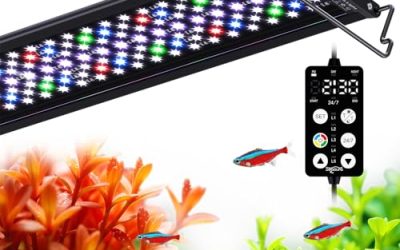
LED fixtures use arrays of small diodes, often in several color channels, driven by a power supply and sometimes a controller. Because each channel can be dimmed independently, a fixture can mimic sunrise, midday and sunset, or tweak the spectrum for plants or corals.
Comparing the Two Side by Side
| Factor | LED | T5 HO |
|---|---|---|
| Energy use | Generally lower for similar output | Moderate to high |
| Heat in the hood | Low, though drivers can warm | Noticeable, tubes run hot |
| Bulb life | Very long, rarely replaced | Tubes dim and need regular replacement |
| Spectrum control | Adjustable on many models | Fixed by tube choice |
| Light spread | Can be spotty without good optics | Even and diffuse along the tank length |
| Dimming and timers | Often built in | Needs dimmable ballast or add-ons |
| Upfront cost | Wide range, often higher | Often lower for basic fixtures |
| Shimmer effect | Pronounced with point sources | Minimal |
Which Tank Style Suits Which Light
Freshwater Community and Low-Tech Planted Tanks
Either type works. LED is the easier route because the fixtures are slim, the hood stays cooler in warm rooms, and timers are common. A single T5 HO tube over a modest planted setup still grows low-light plants well and flatters fish colors with a balanced tube.
High-Tech Planted Tanks
Demanding plants need strong, even light. Quality LEDs with good lenses can deliver it, and dimming helps manage algae. T5 HO remains popular among experienced planted-tank hobbyists because overlapping tubes give uniform coverage without hot spots, though it costs more to run over time.
Reef and Coral Tanks
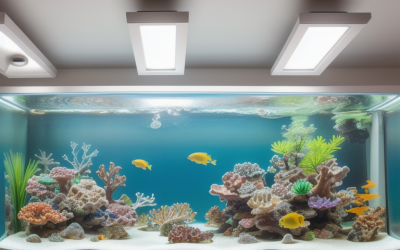
Many reefers have shifted to LED for spectrum tuning and lower heat, which also reduces chiller demand. T5 HO is still used for soft corals and mixed reefs, often alongside LED to fill shadows. Light-hungry corals need high intensity, so check manufacturer guidance for your species before settling on any fixture.
Deep or Very Long Tanks
Depth reduces intensity at the bottom, and long tanks can leave dim zones at the ends. T5 HO tubes spanning the whole length help here. With LED, pick a fixture designed for the tank’s footprint, or use two units.
Running Costs and Maintenance
LED draws less power for similar visible output, and the diodes last for years. T5 HO tubes lose intensity and shift color gradually, so many keepers replace them on a regular schedule, often once a year. Over several years, the tube replacement and higher power draw can offset the lower sticker price of a T5 fixture.
Heat matters too. In a closed hood during summer, T5 tubes can raise water temperature, while LEDs add less heat to the room. That can reduce the need for fans or chillers on smaller tanks.
Common Mistakes When Choosing
- Buying on watt rating alone, which tells you power draw, not how much usable light reaches the plants or corals.
- Ignoring tank depth, which changes how intense light is at the substrate.
- Running lights too long; photoperiods of around eight hours are a common starting point for algae control.
- Mixing tube colors without checking that the result looks natural.
- Assuming any LED is reef-ready or plant-ready just because the box says so.
Before You Buy
- Measure tank length, width and depth, and check hood or mounting options.
- Decide what you are growing: fish only, low-light plants, high-light plants or corals.
- Check whether the fixture has dimming, timers or controller support.
- Think about room temperature and how well your hood vents heat.
- Read manufacturer coverage claims against your own tank footprint.
Color, Spectrum and How the Tank Looks
Light is not just about brightness. Color temperature, measured in kelvin, changes how fish and plants appear. Lower values look warm and yellow, mid-range values look like daylight, and higher values look cool and blue. Freshwater tanks usually look natural in the daylight range, while reef tanks often lean toward cooler, bluer light that makes coral fluorescence stand out.
T5 HO tubes let you mix and match: pair a daylight tube with an actinic tube for a reef look, or two daylight tubes for a planted tank. LED fixtures achieve the same effect with separate channels. Better models let you save presets, so the tank can shift from cool morning light to a warmer afternoon tone without touching a bulb.
Installation and Compatibility
T5 HO fixtures usually sit in a hood or hang above the tank on wires. They are long, so measure the interior length of the hood and any bracing before ordering. Because tubes get warm, ventilation matters, and an open-top tank often handles the heat better than a closed canopy.
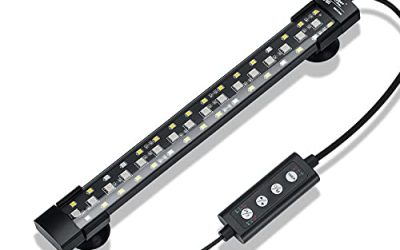
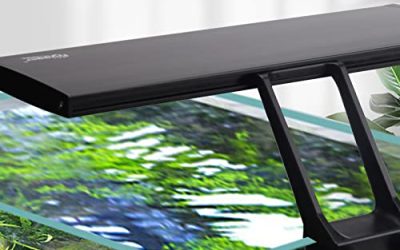
LED fixtures come as slim bars, clip-on lights or hanging pendants. Check that the mounting arms or brackets reach across your tank rim, and confirm the power supply and controller will be placed where splashes cannot reach them. If your tank has a glass lid, make sure the fixture does not trap heat or moisture against the electronics. A drip loop in the cable keeps water from running down to the plug.
When to Upgrade or Switch
If your existing T5 fixture still works and the tank looks healthy, there is no urgency to replace it. Swapping to fresh tubes can restore brightness and color, and may fix algae or plant growth problems that appeared as the old tubes faded. Consider moving to LED when the ballast fails, when summer heat is a problem, or when you want programmable lighting.
When you do switch, start with a shorter photoperiod and lower intensity, then raise gradually over a couple of weeks. A sudden jump in light can trigger algae and stress livestock accustomed to dimmer conditions.
Setting a Photoperiod That Works
Whichever type you choose, how long the light stays on matters as much as the hardware. Most fish-only tanks do fine with six to eight hours, and planted tanks often settle around seven to nine. A midday break of a few hours, where the lights switch off and on again, is a trick some keepers use to discourage algae.
Use a timer, not memory. Consistent days help fish settle into a rhythm and keep plants from stressing. If algae appears, shorten the photoperiod by an hour or lower the intensity before changing anything else.
Related guides
- Canister Filter For 55 Gallon Freshwater Tank
- Programmable App Controlled Aquarium Lights
- Beneficial Bacteria Starters For Aquariums
Frequently Asked Questions
Is LED always cheaper to run?
For comparable output, yes in most cases, thanks to lower power draw and long-lasting diodes. The gap narrows when comparing a single T5 tube against a powerful multi-channel LED, so compare real wattage and photoperiod, not just types.
Do LEDs cause more algae?
Not by themselves. Algae follows excess light, nutrients and long photoperiods. Because many LEDs are dimmable, they actually make it easier to dial back intensity when algae appears.
Can I combine LED and T5 HO?
Yes. Some reef and planted tanks pair them, using tubes for broad, even coverage and LEDs for shimmer and spectrum tuning. Make sure the combined output suits your livestock and watch for heat and wiring complexity.
Which is better for a beginner?
A reasonably priced LED fixture with a timer is the simplest path for most beginners. It needs little maintenance, and the cooler operation is forgiving in smaller tanks.
More from Amazon
Programs that pair well with the guide above. Offers and eligibility are set by Amazon and may change.
Set up recurring deliveries of everyday items on eligible products. Terms and savings are set by Amazon.
Explore Subscribe & SaveFree shipping on eligible items, Prime Video and more. Eligible new members can start with a free trial.
Start a Prime free trialAudiobooks and podcasts to listen to on the go. Eligible new members can start with a free trial.
Try Audible freeRead from a large library of eBooks and audiobooks on any device. Check Amazon for current plans.
Explore Kindle UnlimitedAs an Amazon Associate we earn from qualifying purchases.

Write Your Review
No reviews yet. Be the first to share your experience!